
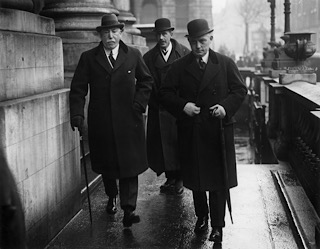
John William Nixon, MBE, a unionist politician and police leader in Northern Ireland, dies on May 11, 1949, at his home in Woodvale House, Ballygomartin Road, Belfast. He is allegedly responsible for several sectarian atrocities, including the McMahon killings and the Arnon Street killings. Eyewitnesses to the Arnon street killings claim they can identify the police involved and allege that their leader is District Inspector Nixon. It is widely believed that Nixon’s “murder gang” within the Royal Irish Constabulary (RIC) hunted down and murdered Catholics as reprisals for the killing of police.
Nixon is born on June 1, 1877, in Graddum, a townland located between the village of Kilnaleck and the hamlet of Crosskeys in County Cavan. He becomes a district inspector in the RIC, and transfers to its successor in the newly created region of Northern Ireland, the Royal Ulster Constabulary (RUC). By 1922, he is responsible for controlling access to the Roman Catholic Ardoyne and Marrowbone areas of Belfast, and works closely with the Ulster Special Constabulary (USC).
Irish nationalist writer and activist Michael Farrell alleges that during this period Nixon leads the Cromwell Club, an unofficial organisation of security officials responsible for killing several Catholic civilians. These allegations are not independently confirmed and during his lifetime Nixon successfully sues the Derry Journal and a book publisher for libel. He is appointed a Member of the Order of the British Empire (MBE) in 1923 “… for services rendered by him during the troubled period.”
In 1924, Nixon, long a member of the Orange Order, makes a political speech at an Orange lodge. This contravenes RUC regulations, and he is dismissed on the orders of Sir James Craig, the first Prime Minister of Northern Ireland.
Nixon is elected to Belfast Corporation as an Independent Unionist, but at the 1925 Northern Ireland general election, he stands unsuccessfully as an Ulster Unionist Party (UUP) candidate in Belfast North. At the 1929 Northern Ireland general election, running once again as an Independent Unionist, he is narrowly elected as the MP for Belfast Woodvale. From September 1932 until the 1933 Northern Ireland general election, he is the only opposition MP attending the Parliament of Northern Ireland. He is founder in 1931 of the Ulster Protestant League (UPL), whose object is to safeguard Protestant jobs, and is also connected with the Ulster Protestant Association (UPA), which includes a hard core of loyalist gunmen who carried out assassinations on Catholics during the mid-1930s. Until the end of his life, fearful that the Irish Republican Army (IRA) would catch up with him, he carries a revolver in the glove compartment of his car.
Nixon holds his seat until his death on May 11, 1949, at home in Woodvale House, Ballygomartin Road, Belfast. He denies the murder allegations against him until the end of his life.
(Pictured: Captain John William Nixon (right) with Northern Ireland Prime Minister James Craig and Colonel Spencer, attending a conference with Michael Collins at City Hall, Dublin in February 1922)


