
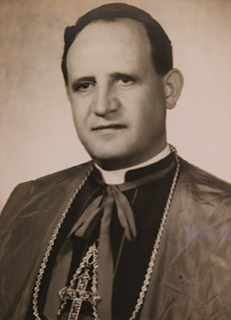
Gaetano Alibrandi, a senior papal diplomat of the Catholic Church and former Personal Secretary to Giovanni Battista Cardinal Montini (later Pope Paul VI), is born on January 14, 1914, at Castiglione di Sicilia in the province of Catania, Sicily.
Alibrandi is ordained priest on November 1, 1936, and obtains a Doctor of Divinity from the Pontifical Lateran University and a Doctorate on Civil and Canon Law. He enters the Diplomatic Corps of the Holy See in 1941, serving for five years in the Vatican Secretariat of State and is then a staff member in the apostolic nunciatures in Italy and Turkey before coming to Ireland as a counsellor at the Apostolic Nunciature for two years from 1954 to 1956. He later describes his first Irish posting as “a spiritual bath.”
In 1961, Alibrandi receives episcopal consecration as titular Archbishop of Binda by Cardinal Fernando Cento upon his appointment as Nuncio of Chile, followed quickly by similar appointments in Lebanon (1963). As Apostolic Nuncio to Chile, he leads the Chilean delegation to the Second Vatican Council.
Alibrandi is appointed Papal Nuncio to Ireland on April 19, 1969, shortly after the outbreak of the Troubles.
This is a challenging time for the Catholic Church in Ireland, then led by Cardinal William Conway, as it adjusts to both the internal changes generated by the Second Vatican Council and the wider social changes. He is ill-suited to coping with these changes and in particular the violence in Northern Ireland. It is widely assumed that he sees to it that the more overtly nationalist Tomás Ó Fiaich is appointed to Armagh in 1977 after the death of Cardinal Conway. The journalist and author Ed Moloney in his book on the Irish Republican Army (IRA) asserts that Alibrandi’s “sympathy for the IRA was a constant source of friction with the government in London.”
Alibrani plays a major role in the 1971 decision by the Vatican to accept the resignation of John Charles McQuaid as Archbishop of Dublin. This comes as a shock to McQuaid, who expected that he would be allowed to remain for some time after the normal retirement age of 75.
In many of the episcopal appointments made while Alibrandi is nuncio, he favours doctrinally “sound,” right-of-centre priests and in the case of the Archdiocese of Dublin picks two priests, Kevin McNamara and Desmond Connell, who are notably ill-suited. In a profile of the Archbishop at the time of his retirement, T. P. O’Mahony observes in The Tablet, “although he rarely gave interviews, and never overtly intervened in policy-making or in public controversies, it is beyond dispute that Archbishop Alibrandi wielded considerable influence behind the scenes.”
The respected academic and church historian Dermot Keogh assessing this period argues that “there was a general view that the best candidates had not been appointed…that a number were not up to the job, that most of the appointees shared a defensive attitude to matters of church and state.”
Alibrandi has “a very testy relationship with three Taoisigh – Jack Lynch, Liam Cosgrave and Garret FitzGerald.” After reaching the retirement age of 75, he returns to his home town in Sicily where he dies on July 3, 2003. His funeral Mass was celebrated on Saturday in Castiglione di Sicilia by Archbishop Paolo Romeo, Apostolic Nuncio to Italy. A memorial Mass for Archbishop Alibrandi will be celebrated by Archbishop Giuseppe Lazzarotto, Apostolic Nuncio to Ireland, on Friday, 11 July at 19.30 in the Church of Our Lady Help of Christians, Navan Road, Dublin.
It is reported in September 2012 during the second Dr. Garret FitzGerald Memorial Lecture at University College Cork (UCC) by Seán Donlon, former secretary general at the Department of Foreign Affairs, that “It came to our [Department of Foreign Affairs] attention that a substantial amount in three bank accounts in Dublin [held by the archbishop] were way in excess of what was needed to run the nunciature. The source [of the money] appeared to be South America.” Donlon goes on to say, “Because of its size, we thought it appropriate to ask if the funds belonged to the Holy See.” When contacted for an answer, Alibrandi “quickly answered ‘no’ and that they belonged to ‘family’. When it was pointed out to him that the money was then liable under Irish taxation law to DIRT, he said he would retire shortly and the accounts would be closed.”
 seamus dubhghaill