seamus dubhghaill

Promoting Irish Culture and History from Little Rock, Arkansas, USA


Leave a comment

The Shooting Death of Eileen Quinn

Eileen Quinn, age 24 and within two months of the birth of her fourth child, is shot by Galway police on November 1, 1920, during the Irish War of Independence (1919-21), while holding her nine-month-old child in her arms and sitting on the lawn in front of her farmhouse at Kiltartan near Gort, bleeding to death later that night. She leaves three children, the eldest of whom is not yet four years old.

Afraid of ambushes, police have begun to “reconnoiter by fire,” shooting blindly into woods and possible ambush sites. Quinn is near one such site when the police open fire, and she is hit by a stray bullet.

At the time of the shooting, her husband Malachy Quinn, who is a farmer, is in Gort. Another messenger going to Ardrahan for Dr. Foley is, it is reported, wounded by a bullet. Uniformed men pass into Gort subsequently firing shots. When the lorry passes the house where the dying woman lay, the terror-stricken occupants flee by the back way.

Rev. Fr. John Considine, C.C., Gort, gives a graphic description of Quinn’s last moments.

“It is too awful, too inhuman, to contemplate.” These are Father Considine’s opening remarks concerning the tragedy. Pressed to explain what occurred, he says, “I have read of Turkish atrocities; I have read of the death of Joan of Arc; I have read of the sufferings of Nurse Cavell, and as I read those things I often felt my blood boil and I often prayed that the good God might change the minds and hearts of those cruel monsters.”

“Little did I then dream that I should witness a tragedy, an atrocity more hideous, more revolting, more frightful, more brutal, more cruel than any of those things, and here in our own little peaceful parish of Gort. My God, it is awful! About three o’clock on Tuesday, Malachy Quinn weeping bitterly, called for me. Father, says he, ‘I have just heard that my wife had been shot. Will you run down immediately?’ I procured a motor car and hurried to the scene. At the gateway there we beheld a large pool of blood. In the yard another pool, and the porch leading to the kitchen was covered with blood. I entered the room. Oh, God! what a sight. There lay the poor woman, the blood oozing out through her clothes.”

“She turned her eyes towards me and said, ‘Oh, Father John, I have been shot.’ ‘Shot!’ I exclaimed. ‘Yes,’ she replied. By whom, I asked. ‘Police’ she answered.”

Quinn then becomes weaker, Father Considine explains, and on rallying exclaims, “Father John, will you do something for me?” He tries to console her and administers the Last Sacrament.

“When I finished, she whispered to me, bring me Malachy, bring him to me, I hear him crying. I have something to tell him. I did so. What a scene. Then she became weak and fainted off. Gradually she became worse.”

“I sent word immediately to the Head Constable at Gort. He arrived with police and military. All seemed shocked at the tragedy. I asked him to go in and see the woman. He and his men felt the trial too much, as he answered, ‘I cannot.’ No trace of the bullet could be found.”

Continuing, Father Considine says Quinn is sitting on the lawn with her child when the lorry passes from which the fatal shot is fired. The bullet pierces her stomach and the child she is holding falls from her arms. She crawls over the wall into the yard, and then crawls to the porch to tell her servant that she has been shot. “Take in the little children!” she exclaims.

From 3:00 p.m. to 10:30 p.m. she lingers on in pain. Occasionally she clasps Father Considine’s hand and pulls him toward her, and says, “I’m done, I’m done!” At 10:30 her condition becomes worse, and they kneel by her bedside to recite the Rosary and prayers for the dying. She tries to join but is too weak.

At 10:45 p.m. the little children begin to cry, and with them the crowded house bursts into tears. As Father Considine reads the last prayer of the Ritual she looks around, then closes her eyes and dies.

Irish public opinion is outraged when a military court of inquiry subsequently returns a verdict of “death by misadventure.” Soon afterward, the Royal Irish Constabulary (RIC) Headquarters and the Chief of Police issue orders against wild firing from motor vehicles.

(From: The Galway Observer, November 1920)

Leave a comment

The Murders of Patrick & Harry Loughnane

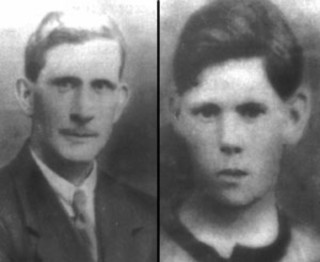
Brothers Patrick and Harry Loughnane, both members of the Irish Republican Army (IRA), are abducted and killed by Black and Tans at Kinvara, County Galway on November 26, 1920.

County Galway sees its share of controversial incidents during the Irish War of Independence. Most of these incidents are carried out by Crown Forces, specifically the Royal Irish Constabulary (RIC) and a new force, the Auxiliaries, created in order to help the RIC in dealing with militant republicanism.

Patrick Loughnane, aged 29, is a local IRA leader and Sinn Féin secretary. He was also active in the local Gaelic Athletic Association (GAA). His younger brother Harry, aged 22, is president of the local Sinn Féin club and a goalkeeper with Beagh Hurling Club.

While working on the family farm in Shanaglish, County Galway, the two brothers are arrested by the Auxiliaries. Not a word is heard from the boys until a week after their arrest when a group of Auxiliaries call Mrs. Loughnane to inform her that her sons had escaped capture. This raises fear and suspicion among the brothers’ family and friends and a search is organised. Ten days after they had been arrested, their bodies are found in a muddy pond near Ardrahan.

Exactly what happened to the two brothers will never be known, however, witnesses, including others arrested at the same time tell a tale of merciless brutality. After being arrested the brothers are beaten for hours in Gort Bridewell and then tied to the tailgate of a lorry, bound to each other, and dragged along the roads to Drumharsna Castle, the headquarters of the Black and Tans, where they are beaten again. At 11:00 PM that night they are taken from Drumharsna Castle to Moy O’Hynes wood where they are shot. Witnesses recount on Saturday morning, Harry is still alive and is heard moaning. On Sunday morning, the Auxiliaries take the bodies to Umbriste near Ardrahan where they are set on fire. After failing to bury the bodies because of the rocky ground they throw them into a muddy pond and, to make their discovery more difficult, throw dirty oil into the water.

After the bodies are discovered, they are examined by a local doctor. The letters “IV” are carved into the charred flesh in several places, two of Harry’s fingers are missing, his right arm is broken and hung over his shoulder. Both of Patrick’s legs and wrists are broken. The doctor believes it possible that hand grenades had been put into their mouths and exploded.

A memorial to the two brothers is later built on the spot where they died.

(From: Stair na hÉireann | History of Ireland, http://www.stairnaheireann.net)


4 Comments

Murder of Frank Shawe-Taylor

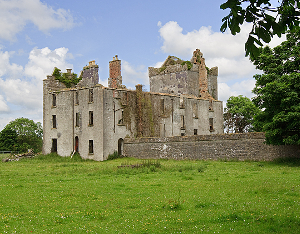
castle-taylor-ardrahan

Frank Shawe-Taylor, Irish land agent and ex-High Sheriff of County Galway, is shot and killed in an Irish Republican Army (IRA) ambush on March 3, 1920, during the Irish War of Independence. Shawe-Taylor is a member of the Taylor family of Castle Taylor, Ardrahan, County Galway. He is related to Lady Gregory and Captain John Shawe-Taylor. He serves as High Sheriff of County Galway in 1915.

Land disputes in Ireland had been a contentious issue for much of the 19th century, with tenants of landlords insisting on fixity of tenure, which later grows into a demand to own their own land. In addition, The Wyndham Land Act of 1903 enables the transfer of about 9 million acres, up to 1914, from landlords to tenants. However, tenure and ownership of land is still a live issue on the eve of the Irish War of Independence.

Shawe-Taylor is a land agent to a local landlord and is himself a tenant. Early in January 1920, a group of local IRA soldiers, including Mick Kelly, Bill Freaney and Larry Lardner, approach Shawe-Taylor on behalf of some local people who are requesting a road to travel to Mass. While Shawe-Taylor himself is amenable to their demands, his landlord refuses them outright and makes this known via Shawe-Taylor.

On March 3, 1920, Shawe-Taylor and his driver, Barrett, are making their way to Galway to attend the fair. At 6:00 AM the coach reaches Egan’s Pub, Coshla, where they find the road blocked. The donkey cart of a local, Johnny Kelly, has been stolen and placed across the road. From behind the wall, at least two shooters fire at Barrett and Shawe-Taylor, wounding Barrett and killing Shawe-Taylor. This results in a huge security presence in the area, which in turn leads to more unrest with the locals. This increases with the arrival of the Black and Tans, whose irregular methods result in shootings, assaults, rapes and deaths. Moorpark House is placed under Royal Irish Constabulary protection out of fear of further killings.

Other people who subsequently die as a result of the unrest in Galway include Ellen Quinn, a pregnant mother of six and a tenant of Lady Gregory, Fr. Michael Griffin, Tom Egan and brothers Patrick and Harry Loughnane. In addition, there are numerous incidents of violence, many of which are recorded with horror by Lady Gregory in her journal, who remarks that “the country has gone wild since the killing of Frank Shawe-Taylor.”

No one is ever tried for Frank Shawe-Taylor’s killing, though the identities of those involved are known to some locals at the time. His widow eventually sells their property and, with her young children, moves to England.

Shawe-Taylor is buried in St. Mary’s graveyard, Athenry. The music critic, Desmond Shawe-Taylor (1907–1995) and British racing driver Brian Shawe-Taylor (1915–1999) are his sons. His grandson is Desmond Shawe-Taylor, Surveyor of the Queen’s Pictures since 2005.

(Pictured: Castle Taylor, near to Ardrahan and Caranavoodaun, Galway, Ireland | Photo © Mike Searle (cc-by-sa/2.0))


1 Comment

Birth of Edward Martyn, Playwright & Activist

edward-martyn

Edward Martyn, Irish playwright and early republican political and cultural activist, is born in County Galway on January 30, 1859. He serves as the first president of Sinn Féin from 1905 to 1908.

Martyn is the elder son of John Martyn of Tullira Castle, Ardrahan and Annie Mary Josephine (née Smyth) of Masonbrook, Loughrea, both of County Galway. He is educated at Belvedere College, Dublin, and Wimbledon College, London, both Jesuit schools, after which he enters Christ Church, Oxford in 1877, but leaves without taking a degree in 1879. His only sibling, John, dies in 1883.

Martyn begins writing fiction and plays in the 1880s. While his own output is undistinguished, he acquires a well-earned reputation as a noted connoisseur of music, both European classical and Irish traditional. He is a fine musician in his own right, giving memorable performances for guests on an organ he has installed at Tullira. He uses his wealth to benefit Irish culture.

Martyn is reportedly pivotal in introducing William Butler Yeats and Lady Gregory to each other in 1896. The three found the Irish Literary Theatre, for whom Martyn writes his best and most popular plays, The Heather Field and A Tale of a Town. He covers the costs of the company’s first three seasons, which proves crucial to establishing the company and the future of the Abbey Theatre. He later parts ways with Yeats and Gregory, something he later regrets, but remains on warm terms with Lady Gregory until the end of his life.

Martyn is a cousin and friend to George Moore (1852–1933). The two make frequent trips all over Europe, where Moore influences Martyn’s views on modern art, which result in the latter purchasing several works by Edgar Degas, Claude Monet, Jean-Baptiste-Camille Corot and Kitagawa Utamaro, all later donated to the National Gallery of Ireland. Moore does not share Martyn’s fenian ideas nor espousal of violent means to achieve national sovereignty. Their different political opinions eventually drive their friendship apart.

Martyn is descended from Richard Óge Martyn, a leading Irish Confederate, and Oliver Óge Martyn, a Jacobite who fights in the Williamite War in Ireland. Yet by his lifetime, the family are unionists. Martyn’s outlook begins to change in the 1880s after studying Irish history, as well as living through the events of the Irish Land War. He comes out as an Irish republican when he famously refuses to allow “God Save The Queen” to be sung after a dinner party at Tullira. By this stage he is involved with the political work of Maude Gonne and Arthur Griffith and is a vocal opponent of the visit of Queen Victoria to Ireland in 1897. He also protests the visit by Edward VII in 1903, this time as chairman of the People’s Protection Committee. He is the first president of Sinn Féin from 1905 to 1908. In 1908 he resigns from the party and politics in general to concentrate on writing and his other activities.

He is on close personal terms with Thomas MacDonagh, Joseph Mary Plunkett and Patrick Pearse, and deeply mourns their executions in the aftermath of the Easter Rising. A parish hall and church that he founded at Labane, near Tullira, are burned by the Black and Tans. He supports the Anglo-Irish Treaty of 1921.

Martyn dies at Tullira on December 5, 1923, after years of ill health. Friends and family are shocked at a provision in his will that directs that his body be donated for the use of medical science and, after dissection, be buried in an unmarked pauper’s grave. The Palestrina Choir sings at his graveside. He bequeaths his papers to the Carmelites of Clarendon Street in Dublin, who subsequently misplace and lose them. Portraits of Martyn exist by, among others, John Butler Yeats and Sarah Purser. On his death the senior line of the Martyn family dies out. His property is inherited by his cousins, the Smyths of Masonbrook and Lord Hemphill. Tullira is sold by the latter forty years later changing ownership several times since.