seamus dubhghaill

Promoting Irish Culture and History from Little Rock, Arkansas, USA


2 Comments

Death of Arthur Armstrong, Northern Irish Painter

Arthur Armstrong, painter who often works in a Cubist style and produces landscape and still life works, dies in Dublin on January 13, 1996.

Armstrong is born on January 12, 1924, at Carrickfergus, County Antrim, Northern Ireland, one of three sons among six children of James Charlton Armstrong, housepainter and decorator, and his wife Margaret (née Howard). Soon after his birth the family moves to Belfast. He attends Strandtown Primary School. He attends Queen’s University Belfast (QUB) in the early 1940s, where he initially studies political science and later architecture. Having an interest in art, which had been fostered by his father, he takes classes for a short time in the early 1940s at the Belfast School of Art. It is there he meets Gerard Dillon, who introduces him to George Campbell and Daniel O’Neill. He is largely self-taught as an artist. It is his close association with Dillon and Campbell, both some years his senior, that proves to be the most important factor in his development. In Belfast in the early 1940s they associate with the Russian artist Daniel Nietzche, who emphasises to them the importance of personal expression.

After leaving university Armstrong works at the Belfast Gas Office. At this point he is the main support for his widowed mother. Having saved some money, he leaves his job in 1946 to attempt to fulfil his ambition to paint full-time, producing a set of etchings with George Campbell, which are published by Walsh Studios. The following year he takes work as a designer for Ulster Laces in Portadown, County Armagh. In 1957, he leaves for London in the hopes of finding greater opportunities as an artist. His friends Campbell and Dillon are already living there, and he takes lodgings with Dillon’s sister at Abbey Road, north London. Though he continues to paint, he is unable to earn a living and so again has to take other work, this time in a Labour Exchange office. However, he is beginning to gain recognition. In 1957, he is awarded a traveling scholarship by the Council for the Encouragement of Music and the Arts (CEMA), which enables him to travel to Spain. He continues to visit Spain throughout the 1960s, often to see Campbell, who spends much time there.

In 1961 he has his first solo exhibition at the CEMA gallery in Belfast. He comes to live in Dublin in 1962, his work having already been exhibited there at the Irish Exhibition of Living Art in 1957 and 1958. He continues to exhibit there annually from 1961 to 1965. During the 1960s and early 1970s his work is regularly included in the Oireachtas exhibition, at which he is awarded the Douglas Hyde Gold Medal in 1968. He also shows his work with the Ritchie Hendriks Gallery and the Tom Caldwell Gallery in Dublin. Ultimately, he is to have over seventy solo exhibitions throughout his career. By 1969, when he is elected an associate member of the Royal Hibernian Academy (RHA), he has established himself as one of the leading landscape painters in Ireland. In 1972 he becomes a full member of the RHA. He exhibits there regularly until 1977.

It is during this period that some of Armstrong’s best work is produced. While landscape is his predominant theme, he never sees himself as a painter of particular views, rather he responds to the abstract qualities of a scene. He sees elements such as the sea, rocks or sky as a series of interlocking textures to be rendered expressively in oil paint. The western coastline of Ireland is a vital source of inspiration for him. Roundstone, County Galway, is a favoured base for painting trips in the company of Dillon and Campbell, who by this time are also living in Dublin.

In 1981, a retrospective exhibition of Armstrong’s work is organised by the Arts Council of Northern Ireland. He is represented in many major public and corporate collections in Ireland. From 1971 he lives at 28 Chelmsford Avenue, Ranelagh, Dublin, in a house he shares with Gerard Dillon.

Armstrong dies unmarried on January 13, 1996, in Dublin. The contents of his studio are sold on February 3, 1998.

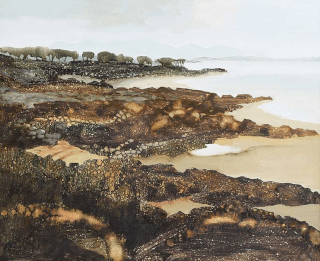
(From: “Armstrong, Arthur” by Rebecca Minch, Dictionary of Irish Biography, http://www.dib.ie, October 2009, revised November 2013 | Pictured: “Near Ballyhubbock,” oil on board by Arthur Armstrong RHA)

Leave a comment

Birth of Arthur Armstrong, Landscape & Still Life Painter

Arthur Armstrong, landscape and still life painter who often works in a Cubist style, is born in Carrickfergus, County Antrim, Northern Ireland, on January 12, 1924. A prolific painter, completing up to 300 paintings a year, in oils, watercolour and mixed media, he regards himself first and foremost as an abstract artist.

Armstrong is the son of a house painter and attends Strandtown Primary School. Later he studies architecture at Queen’s University Belfast, but after two years he moves to study art at Belfast School of Art. The influence of Cubism and the School of Paris can be clearly seen in his work, which takes him to England, France and Spain. He also travels and paints in the west of Ireland and Connemara inspires some of his best work. In 1950 his work is exhibited in the Grafton Gallery in Dublin, and subsequent exhibitions take place in England, Spain and the United States, as well as in Belfast and Dublin. In 1957 he is awarded a travelling scholarship from the Council for the Encouragement of Music and the Arts (CEMA), a forerunner of the Arts Council of Great Britain, and goes to Spain. He eventually settles in Dublin in 1962 and begins showing work at the Royal Hibernian Academy.

In 1968 Armstrong is awarded the Douglas Hyde Gold Medal at the Oireachtas Exhibition. In 1969 he designs sets, with George Campbell and Gerard Dillon, for the Seán O’Casey play, Juno and the Paycock, at the Abbey Theatre in Dublin. He becomes a member of the Royal Hibernian Academy in 1972 and in 1973 he is awarded the Art in Context prize from the Arts Council of Northern Ireland. He becomes a member of Aosdána in 1981, the same year that a retrospective exhibition of his work from 1950 to 1980 is held by the Arts Council of Northern Ireland.

From 1971 Armstrong lives at 28 Chelmsford Avenue, Ranelagh, Dublin, in a house he shares with Gerard Dillon. A bachelor, Armstrong dies in a Dublin hospital on January 13, 1996. The contents of his studio are sold February 3, 1998.

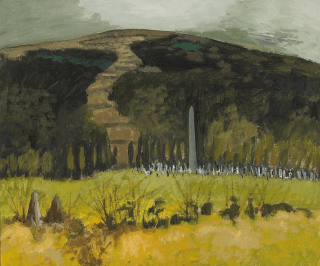
(Pictured: “Glendalough” by Arthur Armstrong, oil on board)


Leave a comment

Death of Artist Margretta “Gretta” Bowen

greta-bowen-children-in-the-parkMargretta Bowen, self-taught Irish artist best known as Gretta Bowen, dies in Belfast, Northern Ireland on April 8 1981. She starts painting late in life, around 1950, after her sons Arthur and George Campbell are already established as artists.

Born in Dublin in January 1880, Bowen lives most of her life in Belfast. She is married to Matthew Campbell, a veteran of the Second Boer War. They have three sons, Arthur, George and Stanley, who all go on to be highly talented artists, with George becoming particularly successful. After her husband death in 1925 she runs a laundrette and takes in lodgers to make ends meet.

Bowen comes to art late in her life. A few weeks before her seventieth birthday she finds paints left behind by her son Arthur and begins to experiment, apparently inspired to some extent by her sons. She uses her maiden name to apparently avoid any obvious connection with them.

Bowen clearly attracts notice early on despite her late start. In 1959, just five years after she takes up painting, she is given a solo exhibition by the Council for Encouragement of Music and the Arts, which continues to support her work when it subsequently becomes the Arts Council of Great Britain. An extensive and admiring review appears in The Times.

Bowen’s work is shown at the Royal Hibernian Academy, the Irish Exhibition of Living Art and the Oireachtas. She also holds one-person exhibitions at the Hendriks Gallery, the Bell Gallery and the Tom Caldwell Gallery. In 1979, at the age of 99, her works gain international fame. She exhibits at the first International Exhibition of Naïve Art in London.

Bowen dies at the age of 101 in Belfast on April 8, 1981.


Leave a comment

Founding of the Arts Council of Ireland

The Arts Council (An Chomhairle Ealaíon), sometimes called the Arts Council of Ireland, is established on May 8, 1951, by the Government of Ireland. The Council’s purpose is to encourage interest in Irish art, including visual art, music, performance, and literature, and to channel funding from the state to Irish artists and arts organisations. This includes encouragement of traditional Irish arts, support for contemporary Irish arts, and finance for international arts events in Ireland. The council is modeled on the Arts Council of Great Britain, founded in 1946, and works closely with the Arts Council of Northern Ireland, formed by the British government in Northern Ireland in 1962 to fulfil a similar role.

The Arts Council consists of twelve members and a chair, each appointed for a five-year term by the Minister for Arts, Heritage, Regional, Rural and Gaeltacht Affairs. The Chair of the Arts Council is entitled to an annual fee of €8,978 and ordinary members are entitled to a fee of €5,985, although some members choose to waive this fee.

The ongoing work of the Arts Council is delivered by the executive. In addition to the Director, a staff of 41 full-time equivalents carries out the daily functions of the organisation. Arts advisers, who provide additional expertise and strategic advice on different aspects of the arts, are retained on a consultancy basis.

The Arts Council of Ireland is the official “Cultural Contact Point” between the European Commission‘s Cultural Programme and Ireland and is a founding member of the International Federation of Arts Councils and Culture Agencies. Visual Artists Ireland, the all-Ireland non-governmental organisation representing Irish artists nationally and internationally, is supported by the Arts Council of Ireland.

For additional information, visit the Arts Council’s website at http://www.artscouncil.ie/home/.