seamus dubhghaill

Promoting Irish Culture and History from Little Rock, Arkansas, USA


Leave a comment

Death of Noel Cantwell, Soccer Player & Cricketer

noel-cantwell

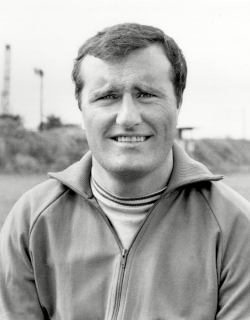
Noel Euchuria Cornelius Cantwell, soccer player and sometime cricketer, dies of cancer on September 8, 2005. Born in Cork, County Cork on February 28, 1932, he is educated at the Roman Catholic Presentation Brothers College there.

Cantwell plays as a full-back for Western Rovers, Cork Athletic F.C., West Ham United F.C. and Manchester United F.C. While at West Ham, he features in the London XI side that competes in the 1955–58 Inter-Cities Fairs Cup final on May 1, 1958. He captains the Hammers to winning the Division Two championship in the 1957–58 season and thereby leads the club into the topflight for the first time since 1932.

In November 1960, Cantwell joins Manchester United for £29,500 which at the time is a record for a full-back. He helps the club win the 1965 and 1967 league titles and captains United when winning the 1963 FA Cup Final, just as his fellow countryman Johnny Carey had done in United’s previous FA Cup win 15 years earlier. He also serves as Chairman of the Professional Footballers’ Association.

Cantwell wins 36 full International caps for the Republic of Ireland national football team, typically playing at left full-back and on several occasions at centre-forward. He makes his debut against Luxembourg in October 1953 with his final appearance coming away to Turkey in February 1967. He scores 14 goals including 5 from penalties and also captains the Republic on several occasions including a match against England at Wembley Stadium.

In his first managerial role at Coventry City F.C. he has the onerous task of following Jimmy Hill who had taken the club into the Football League First Division for the first time in their history. He narrowly keeps the Sky Blues in the top in his first two seasons before taking them to a sixth-place finish in 1969–70, earning them qualification for the Inter-Cities Fairs Cup, a year before it was replaced by the UEFA Cup.

Cantwell departs from Highfield Road on March 12, 1972, to take charge of the New England Tea Men in the United States, but within seven months is back in English football as manager of Peterborough United F.C. He helps Peterborough win the Football League Fourth Division title in his first full season as manager, before leaving on May 10, 1977, for a second spell with the Tea Men. This time he spends a year in the United States.

Cantwell returns to Peterborough on November 19, 1986, for a second spell as manager, remaining in this role until he becomes general manager on July 12, 1988. He is general manager at London Road for a year until he quits football to become licensee of the New Inn at Peterborough, where he remains for 10 years until he retires in 1999. He also is landlord of the Bull and Swan in Stamford, Lincolnshire.

Cantwell also plays cricket for Cork Bohemians Cricket Club and Ireland as a left-handed batsman and a right-arm medium bowler. He plays five times for Ireland making his debut in what is his sole first-class match versus Scotland at Edinburgh in 1956, scoring 31 and 17. His last match for Ireland is against Lancashire in July 1959.

Cantwell dies on September 8, 2005, from cancer at the age of 73, leaving a widow and two children. His former teams each hold a minute of silence for him before their next matches.


2 Comments

Birth of Irish Footballer Billy Behan

billy-behan

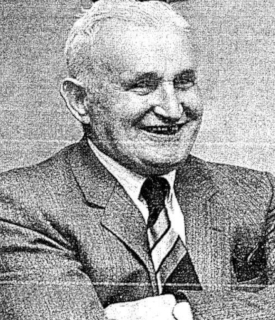
William “Billy” Behan, Irish footballer who plays as a goalkeeper for Shelbourne F.C., Shamrock Rovers F.C. and Manchester United F.C. during the 1930s, is born on August 8, 1911, in Dublin.

Behan makes his Rovers debut on February 8, 1931, in a 5–1 win over Bray Unknowns F.C. at Glenmalure Park. In his first season, he wins the FAI Cup. He signs with Manchester United in September 1933, along with fellow Irishman David Byrne, becoming the first players from the south of Ireland to play for the club in over a decade.

Behan makes his United debut in a Football League Second Division home game against Bury F.C. on March 3, 1934. The following July, he briefly returns to Shelbourne before again returning to the Rovers. Over the next two seasons, he wins another FAI Cup and a League of Ireland Shield. His last game for the Rovers is on August 23, 1936, in a Shield win over Drumcondra F.C..

After his retirement as a player, Behan becomes a respected referee and is in charge of the 1943 FAI Cup Final. He then manages Drumcondra F.C. in the 1950s where he wins the FAI Cup again.

Behan subsequently becomes United’s chief scout in the Republic of Ireland and is credited with discovering, among others, Johnny Carey, Billy Whelan, Tony Dunne, Don Givens, Kevin Moran and Paul McGrath. He also serves as vice chairman of the Dalkey-based Leinster Senior League team, Dalkey United, and it is through this association that he discovers McGrath.

Behan’s father, William Sr., is one of the founder members of Shamrock Rovers. His brothers John and Paddy also play for the Rovers. His son William junior keeps goal for the Rovers side also for a time. His second cousin is Bob Fullam.

Behan’s grandson, Philip Behan, is the former Head of International Football at the Football Association of Ireland and is now a UEFA and FIFA agent organising friendly international matches and tournaments around the world.

Billy Behan dies on November 12, 1991, at the age of 80.


Leave a comment

Birth of Pat Jennings, Northern Ireland Footballer

pat-jennings

Patrick Anthony Jennings, Northern Irish footballer, is born in Newry, County Down, Northern Ireland on June 12, 1945. He plays 119 games for Northern Ireland as a goalkeeper, a figure which at the time is a world record and is still a Northern Ireland record, in an international career which lasts for over 22 years.

After playing for the Shamrock Rovers F.C. under-18 squad at the age of 11, Jennings concentrates on Gaelic football until he is sixteen years old, when he makes his soccer comeback with his hometown Newry City F.C. After impressing with the team, he moves to English Third Division Watford F.C. in May 1963. He again impresses in his first season in England, playing every league game for his club, and making two international appearances that season. He is signed by Tottenham Hotspur F.C. for £27,000 in June 1964.

Jennings spends thirteen years at White Hart Lane, where he plays in 472 league games for the Spurs, and 591 in all competitions. He wins the FA Cup in 1967, the League Cup in 1971 and 1973, and the UEFA Cup in 1972. In 1973 the Football Writers’ Association name him as its footballer of the year. Three years later he wins the Professional Footballers’ Association‘s (PFA) version of the award, the first goalkeeper to receive this accolade.

In August 1977, Jennings is transferred to Tottenham’s arch-rivals, Arsenal F.C., with Tottenham thinking he is nearing the end of his career. However, Jennings plays for Arsenal for another eight years where he helps Arsenal to the FA Cup final in 1978, 1979, and 1980, as well as the UEFA Cup Winners’ Cup final that year. However, Arsenal only manages to win the second of these finals, a 3–2 victory against Manchester United F.C. In total, Jennings makes 327 appearances for Arsenal between 1977 and his eventual retirement from first-team club football in 1985. On February 26, 1983, he becomes the first player in English football to make 1,000 senior appearances, celebrating this milestone with a clean sheet in a goalless league draw for Arsenal at West Bromwich Albion F.C.

After his retirement, Jennings returns to Tottenham Hotspur, playing mostly in their reserve side to maintain his match sharpness for Northern Ireland’s 1986 FIFA World Cup campaign. His final appearance for Tottenham is in the Football League Super Cup against Liverpool F.C. in January 1986. He also plays briefly for Everton F.C., having been signed as goalkeeping cover for the 1986 FA Cup Final against Liverpool.

Despite retiring from club football in 1985, Jennings plays his final international game at the 1986 FIFA World Cup, on his 41st birthday, making him at the time the World Cup’s oldest ever participant. The match is Northern Ireland’s final group game, a 3–0 defeat against Brazil. In total, he participates in the qualifying stages of six World Cups between 1966 and 1986.

Following his retirement Jennings works as a goalkeeping coach. In 2003 he is inducted into the English Football Hall of Fame in recognition of the skills he demonstrated in the English league. His son, also named Pat, is also a goalkeeper. He has played for League of Ireland clubs University College Dublin A.F.C., Derry City F.C., Shamrock Rovers and NIFL Premiership club Glenavon F.C.

Jennings and his family have lived for many years in Broxbourne, Hertfordshire, where his son attended The Broxbourne School along with the sons of fellow Spurs players Chris Hughton, Osvaldo Ardiles and Ray Clemence. He is still associated with the Spurs and hosts Corporate Hospitality fans in the Pat Jennings Lounges at White Hart Lane and Windsor Park, Belfast.


Leave a comment

Death of Peter Doherty, Northern Ireland Footballer

peter-doherty

Peter Dermot Doherty, Northern Ireland international footballer and manager who played for several clubs, including Manchester City F.C. and Doncaster Rovers F.C., dies in Poulton-le-Fylde, Lancashire, England on April 6, 1990.

Born in Magherafelt, County Londonderry on June 5, 1913, Doherty begins his career with Glentoran F.C. in the Irish League. After helping Glentoran to the 1933 Irish Cup, early in the 1933–1934 season he joins English club Blackpool F.C., at the age of 19. He then joins Manchester City on February 19, 1936 for a then-club record of £10,000. Blackpool needs the money urgently, and Doherty is summoned from his lunch to report to Bloomfield Road. He tries hard to persuade Blackpool directors that he does not wish to leave the club, for he is due to marry a local girl and has just bought a new house in the town. The fee is an exceptionally high transfer fee for the period, coming within £1,000 of the British record. Doherty’s Manchester City debut, against Preston North End F.C., is not a successful one. Tightly man-marked by Bill Shankly throughout, he fails to make an impact. He later describes the remainder of his first Manchester City season as “uneventful,” however his second is anything but.

Manchester City starts the 1936–1937 season poorly and are in the bottom half of the table until December. Occasional big wins, including a 6–2 defeat of West Bromwich Albion F.C. and a 4–1 defeat of Everton F.C., are mixed with extended barren runs. At one point the club gains just one win in twelve matches. However, Doherty scores goals regularly. A goal in a 5–3 Christmas day loss to Grimsby Town F.C. is his twelfth of the season. Christmas proves to be a turning point for the club, as a win against Middlesbrough F.C. the following day is the start of a long unbeaten run. By April, Manchester City is second in the table and faces a fixture against Arsenal F.C., league leaders and the dominant club of the period. Doherty scores the first goal in a 2–0 win, and City reaches the top of the table. The unbeaten run continues until the end of the season, and City secures their first league championship with a 4–1 win over Sheffield Wednesday F.C.. Doherty, with 30 league goals, is the club’s leading scorer, helped by a run of eleven goals in seven games as the season draws to a close.

Doherty scores 79 goals in 130 appearances during his time at Maine Road. During the World War II years of 1939–1945, Doherty serves in the Royal Air Force. He remains registered as a Manchester City player, scoring 60 goals in 89 wartime matches, though wartime games are not generally included in official records. He also guests for numerous clubs across the country. During a guest appearance for Port Vale F.C. in 1945, he famously goes to take a penalty but instead of shooting he lays it off to a teammate who scores.

After the conclusion of the war, Doherty transfers to Derby County F.C., with whom he wins the FA Cup, scoring a goal in the final itself. He also goes on to play for Huddersfield Town A.F.C., scoring 33 goals in 83 league appearances.

Doherty makes his final move to Doncaster in 1949, where he assumes the role of player-manager. He later becomes manager of the Northern Ireland national football team (1951–1962), for whom he has 16 caps as a player. He leads the country to the 1958 FIFA World Cup, reaching the quarter-finals. He also manages Bristol City F.C..

Doherty’s coaching techniques are revolutionary at the time. He emphasises ball practice and instead of endless laps of the pitch, suggests volleyball “to promote jumping, timing and judgement,” basketball “to encourage split-second decision-making and finding space,” and walking football “to build up calf muscles.”

Later life sees Doherty become a scout for Liverpool F.C., helping to unearth such talents as Kevin Keegan. He is inducted into the English Football Hall of Fame in 2002.

Following Doherty’s death in 1990, a plaque to mark his birthplace is placed in Magherafelt. It can be found at what is now a barber shop.


Leave a comment

Birth of Nicky Byrne, Singer & Songwriter

nicky-byrne

Nicholas Bernard James Adam Byrne, Jr., singer, songwriter, radio presenter, dancer, television presenter and former semi-professional footballer, best known for being a member of Irish music band Westlife, is born in Dublin on October 9, 1978.

Before his music career, Byrne plays professional football, representing Republic of Ireland at several junior levels. He plays for Home Farm F.C. and St. Kevins Boys in North Dublin before becoming a professional player. He joins Leeds United F.C. as a goalkeeper in 1995 and is a squad member of the FA Youth Cup winning team of 1997. He plays for Leeds for two years, leaving when his contract expires in June 1997. He plays in a reserve game for Scarborough F.C. and in a trial game with Cambridge United F.C. before returning to join Dublin club Shelbourne F.C. He then signs for Cobh Ramblers F.C. playing 15 games, then St. Francis F.C., all in Ireland’s League of Ireland.

On May 14, 2009, Byrne is a substitute for a Liverpool F.C. Legends XI that plays against an All Star XI in a Hillsborough Memorial match to mark the 20th anniversary of the Hillsborough disaster. He represented the Republic of Ireland at U15, U16 and U18 levels.

In June 1998, Byrne attends an audition for new Irish boyband, where Boyzone manager Louis Walsh approaches him to join his new venture, Westlife. He joins Westlife along with Kian Egan, Mark Feehily, Shane Filan and Brian McFadden. With Westlife, he has had 25 top ten UK singles, fourteen of which are number one, seven number one albums and has sold in excess of over 45 million records worldwide. He also has a number one single in Ireland in 2002, alongside the Republic of Ireland national football team and Dustin the Turkey with the Irish 2002 FIFA World Cup anthem, “Here Come the Good Times (Ireland).” He also co-writes many of Westlife’s songs.

On September 7, 2012, it is announced that Byrne will be a contestant for the tenth series of Strictly Come Dancing. He is the ninth contestant to be eliminated. He is ranked number two on Ireland’s Sexiest Man of 2014.

In early January 2016, it is rumored that RTÉ had internally chosen Byrne to represent Ireland in the Eurovision Song Contest 2016. On January 13, he is confirmed to be the Irish singer for the 2016 contest in Stockholm with the song, “Sunlight.” He performs it in the second semi-final but fails to advance to the final.

Byrne’s wife Georgina is the daughter of former Taoiseach Bertie Ahern, and they have twin sons, Rocco Bertie Byrne and Jay Nicky Byrne, and a daughter, Gia.


Leave a comment

Birth of Footballer Ronnie Whelan

ronnie-whelan

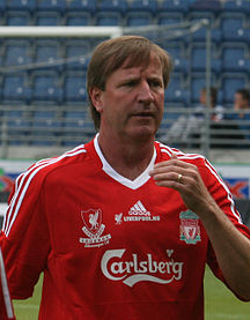
Ronald Andrew Whelan, former Irish association football midfielder and occasional defender, is born in Dublin on September 25, 1961.

Whelan is born into a family of footballers. His father, Ronnie Whelan, Sr., is an Irish international and a key member of the successful St. Patrick’s Athletic F.C. of the late 1950s and early 1960s. His brother, Paul Whelan, plays for Bohemian F.C. and Shamrock Rovers F.C.

Whelan is a skillful and industrious midfield player who, after an unsuccessful trial period for Manchester United F.C., makes his League of Ireland debut for Home Farm F.C. on his 16th birthday at Tolka Park.

Whelan is signed for Liverpool F.C. by Bob Paisley for a bargain £35,000 on September 19, 1979, a few days before his 18th birthday, and makes his debut eighteen months later, on April 3, 1981. He goes on to become an integral part of the dominant Liverpool team of the 1980s. He remains with the club until 1994. In 100 Players Who Shook The Kop, a poll of 110,000 Liverpool fans conducted by the official Liverpool F.C. website, Whelan is in 30th position.

Whelan plays for the Republic of Ireland national football team at one UEFA European Championship (1988) and two FIFA World Cups (1990 and 1994), turning out a total of 53 times for the national side between 1981 and 1995.

Whelan finishes his career at Southend United F.C., where he is also player-manager through the 1996-1997 season. He later manages in Greece and Cyprus, with Panionios G.S.S., Olympiakos Nicosia and Apollon Limassol.

Since retirement Whelan has begun a media career and is a regular contributor to RTÉ Sport in Ireland. He is also Patron of the Myasthenia Gravis Association in Ireland where he is an active fundraiser and works to raise awareness for this rare autoimmune disease.


Leave a comment

Birth of Conor McGregor, Mixed Martial Artist & Boxer

conor-mcgregor

Conor Anthony McGregor, Irish professional mixed martial artist and boxer, is born on July 14, 1988 in Crumlin, Dublin. He is the former Ultimate Fighting Championship (UFC) featherweight and lightweight champion. He has also competed as a welterweight in mixed martial arts (MMA), and light middleweight in boxing. He is #3 on the UFC’s pound for pound rankings.

McGregor is raised in Crumlin and attends a Gaelscoil and Gaelcholáiste at both primary and at secondary level in Coláiste de hÍde in Tallaght, where he also develops his passion for sport playing association football. In his youth, he plays football for Lourdes Celtic Football Club. At the age of 12, he also begins boxing at Crumlin Boxing Club.

In 2006, McGregor moves with his family to Lucan, Dublin, attending Gaelcholáiste Coláiste Cois Life. Following that, he commences a plumbing apprenticeship. While in Lucan, he meet future UFC fighter Tom Egan and they soon start training mixed martial arts (MMA) together.

McGregor starts his MMA career in 2008 and, in 2012, he wins both the Cage Warriors Featherweight and Lightweight Championships, holding both titles simultaneously before vacating them to sign with the UFC. In 2015, at UFC 194, he defeats José Aldo for the UFC Featherweight Championship via knockout thirteen seconds into the first round, which is the fastest victory in UFC title fight history. Upon defeating Eddie Alvarez for the UFC Lightweight Championship at UFC 205, McGregor becomes the first fighter in UFC history to hold titles in two weight divisions simultaneously.

McGregor begins his professional boxing career in 2017. In his debut boxing match, he is defeated by Floyd Mayweather, Jr.

McGregor is the biggest pay-per-view (PPV) draw in MMA history, having headlined four out of the six highest-selling UFC pay-per-view events. His headline bout with Nate Diaz at UFC 202 drew 1.65 million PPV buys, the most ever for an MMA event. His boxing match with Mayweather drew 4.3 million PPV buys in North America, the second most in history.


Leave a comment

Birth of Footballer Jimmy Keaveney

jimmy-keavney

James Keaveney (Séamus Ó Géibheannaigh), retired Gaelic footballer, is born in Whitehall, Dublin on February 12, 1945. His league and championship career with the Dublin GAA senior team spans sixteen seasons from 1964 to 1980. He is widely regarded as one of Dublin’s greatest-ever players.

Keaveney’s first sporting interest is in soccer, however, he is later introduced to Gaelic games by his Belfast-born father. He is educated at St. Joseph’s Secondary School in Fairview, Dublin where he favours hurling over Gaelic football.

Keaveney first plays competitive Gaelic games at underage levels with the St. Vincent’s GAA club before later joining the club’s senior team. Between 1964 and 1981 he wins ten county football championship medals, however, the highlight of his club career is the winning of an All-Ireland medal in 1976. He also wins two Leinster Senior Club Football Championship medals and three Dublin Senior Hurling Championship medals.

Keaveney makes his debut on the inter-county scene when he is selected for the Dublin minor and under-21 teams, however, he ends his underage career without success. He makes his senior debut during the 1964-1965 league. Over the course of the following sixteen seasons, he wins three All-Ireland medals, beginning with a lone triumph in 1974, followed by back-to-back championships in 1976 and 1977. He also wins seven Leinster medals, two National Football League medals and is named Footballer of the Year in 1976 and 1977. He plays his last game for Dublin in February 1980.


Leave a comment

The Munich Air Disaster

munich-air-disaster

The Munich air disaster occurs on February 6, 1958, when British European Airways Flight 609 crashes on its third attempt to take off from a slush-covered runway at Munich-Riem Airport, West Germany. On the plane is the Manchester United football team, nicknamed the “Busby Babes“, along with supporters and journalists. Twenty of the 44 on the aircraft die at the scene. The injured, some unconscious, are taken to the Rechts der Isar Hospital in Munich where three more die, resulting in 23 fatalities with 21 survivors. Among the Manchester United fatalities is inside forward Liam “Billy” Whelan who was born in Cabra on the northside of Dublin in 1935.

The team is returning from a European Cup match in Belgrade, Yugoslavia, having eliminated Red Star Belgrade to advance to the semi-finals of the competition. The flight stops to refuel in Munich because a non-stop flight from Belgrade to Manchester is beyond the Airspeed Ambassador‘s range. After refuelling, pilots James Thain and Kenneth Rayment twice abandon take-off because of boost surging in the left engine. Fearing they will get too far behind schedule, Captain Thain rejects an overnight stay in Munich in favour of a third take-off attempt. By then snow is falling, causing a layer of slush to form at the end of the runway. After the aircraft hits the slush, it ploughs through a fence beyond the end of the runway and the left wing is torn off after hitting a house. Fearing the aircraft might explode, Thain begins evacuating passengers while Manchester United goalkeeper Harry Gregg helps pull survivors from the wreckage.

An investigation by West German airport authorities originally blames Thain, saying he did not de-ice the aircraft’s wings, despite eyewitness statements to the contrary. It is later established that the crash is caused by the slush on the runway, which slows the plane too much to take off. Thain is cleared in 1968, ten years after the incident.

At the time of the disaster, Manchester United is trying to become the third club to win three successive English Football League titles. They are six points behind League leaders Wolverhampton Wanderers with 14 games to go. They also hold the Charity Shield and have just advanced into their second successive European Cup semi-final. The team has not been beaten in eleven consecutive matches. The crash not only derails their title ambitions that year but also virtually destroys the nucleus of what promised to be one of the greatest generations of players in English football history. It takes ten years for the club to recover, with Busby rebuilding the team and winning the European Cup in 1968 with a new generation of “Babes.”


Leave a comment

Birth of Footballer Johnny Giles

Michael John “Johnny” Giles, former association footballer and manager, is born in Ormond Square, Dublin, on November 6, 1940. He is best remembered for his time as a midfielder with Leeds United F.C. in the 1960s and 1970s. After retiring from management in 1985, Giles serves as the senior analyst on RTÉ Sport‘s coverage of association football from 1986 until 2016. The Football Association of Ireland (FAI) votes Giles as the greatest Irish player of the last 50 years at the UEFA Jubilee Awards in 2004.

After winning an FA Cup winner’s medal under Matt Busby at Manchester United F.C., Giles moves to Leeds in 1963 where he plays in midfield alongside captain Billy Bremner. The duo goes on to form a central midfield partnership which is one of the best in English club football. Their pairing helps yield several major trophies in the most successful era in Leeds’ history. By a strange coincidence, Giles and Bremner both score exactly 115 goals for the club.

In his later years in football, Giles pursues a managerial career which sees him installed as player-manager and manager of, among others, West Bromwich Albion F.C., the Republic of Ireland national football team, Vancouver Whitecaps F.C. and Shamrock Rovers F.C. Despite having an outstanding knowledge of the game, Giles personally never likes being a manager. He becomes disillusioned with aspects of the job, such as suffering at the hands of non-committal boardrooms and leaves management permanently in 1985. He later declares that he has no regrets about quitting managerial life.

Subsequently, after repeated encouragement from childhood friend Eamon Dunphy, Giles inadvertently enters the world of football punditry in 1986. He goes on to establish himself as the highly respected senior analyst on RTÉ Sport. In addition, he writes two columns per week for the Irish Evening Herald newspaper and offers his opinions about the game on radio station, Newstalk 106.

Giles resides in the Harborne area of the city of Birmingham, England. To coincide with his 70th birthday, Giles compiles a first ever autobiography chronicling his life in and outside of football which is released in November 2010. The autobiography, titled A Football Man, becomes the best-selling book in the Republic of Ireland.