seamus dubhghaill

Promoting Irish Culture and History from Little Rock, Arkansas, USA


Leave a comment

The Races of Castlebar

races-of-castlebar

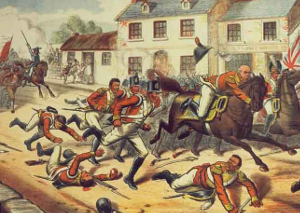
The Battle of Castlebar occurs on August 27, 1798, near the town of Castlebar, County Mayo, during the Irish Rebellion of 1798. A combined force of 2,000 French troops and Irish rebels rout a force of 6,000 British militia in what later becomes known as the “Castlebar Races” or “Races of Castlebar.”

The long-awaited French landing to assist the Irish revolution begun by Theobald Wolfe Tone‘s Society of United Irishmen takes place five days previously on August 22, when almost 1,100 troops under the command of General Jean Joseph Amable Humbert land at Cill Chuimín Strand, County Mayo. The nearby town of Killala is quickly captured after a brief resistance by local yeomen. Following the news of the French landing, Irish volunteers began to trickle into the French camp from all over Mayo.

On August 26, leaving about 200 French regulars behind in Killala to cover his rear and line of withdrawal, Humbert takes a combined force of about 2,000 French and Irish to march on and take Castlebar. In order to avoid a head-on attack, locals advise the French of an alternative route to Castlebar through the wilds along the west of Lough Conn, which the British believe to be impassable for a modern army with attendant artillery train. When General Gerald Lake’s scouts spot the approaching enemy, the surprised British have to hurriedly change the deployment of their entire force to face the threat from this unanticipated direction.

The British have barely completed their new deployment when the Franco-Irish army appears outside the town at about 6:00 AM. The newly sited British artillery opens up on the advancing French and Irish and cut them down in droves. French officers, however, quickly identify an area of scrub and undergrowth in a defile facing the centre of the artillery line which provides some cover from the British line of fire. The French launch a bayonet charge, the ferocity and determination of which unnerve the units stationed behind the artillery. The British units begin to waver before the French reach their lines and eventually turn in panic and flee the battlefield, abandoning the gunners and artillery. A unit of cavalry and British regular infantry attempt to stand and stem the tide of panic but are quickly overwhelmed.

In the headlong flight of thousands of British militias, large quantities of guns and equipment are abandoned, among which is General Lake’s personal luggage. Although not pursued a mile or two beyond Castlebar, the British do not stop until they reach Tuam, with some units fleeing as far as Athlone in the panic. The panic is such that only the arrival of Cornwallis at Athlone prevents further flight across the River Shannon.

Although achieving a decisive victory, the losses of the French and Irish are high, with about 150 men killed, mostly to the cannonade at the start of the battle. About 80 British are killed and some 270 wounded, captured, or deserted. Following the victory, thousands of volunteers flock to join the French who also send a request to France for reinforcements and formally declare a Republic of Connacht, which lasts 3 days and collapses when the French depart.

On September 5, the British forces are again defeated at Collooney however, after that, the rebellion quickly folds. More troops gather and by the Battle of Ballinamuck on September 8, their strength is over 15,000. Ballinamuck is the end for General Humbert, who hands in his surrender. The Irish rebels fight on briefly until scattered. Killala is re-taken on September 12. More French warships sail for Ireland but are decisively defeated by the Royal Navy near Tory Island. With that the 1798 rebellion ends. The captured French soldiers are transferred to England and eventually repatriated. The French officers of Irish origin are hanged in Dublin with the Irish rebels.


Leave a comment

Birth of Tenor John McCormack

john-mccormack

John McCormack, an Irish tenor celebrated for his performances of the operatic and popular song repertoires and renowned for his diction and breath control, is born in Athlone, County Westmeath, on June 14, 1884.

McCormack receives his early education from the Marist Brothers in Athlone, and later attends Summerhill College in Sligo. He sings in the choir of the old St. Peters church in Athlone under choirmaster Michael Kilkelly. When the family moves to Dublin, he sings in the choir of St. Mary’s Pro-Cathedral where he is discovered by composer Vincent O’Brien. In 1903 he wins the coveted gold medal of the Dublin Feis Ceoil.

Fundraising activities on his behalf enable McCormack to travel to Italy in 1905 to receive voice training by Vincenzo Sabatini in Milan. In 1906, he makes his operatic début at the Teatro Chiabrera, Savona. The next year he begins his first important operatic performance at Covent Garden in Mascagni‘s Cavalleria rusticana, becoming the theatre’s youngest principal tenor.

In less than three years he is singing opera in the United States, as well as beginning a career on the recital stage that makes him one of the most successful singers of all time. In 1917 he becomes a citizen of the United States, his adopted country, where his concert appeal has proven to be nearly universal and unrelenting.

McCormack originally ends his career in 1938 at the Royal Albert Hall in London. However, one year after that farewell concert he is back singing for the Red Cross and in support of the war effort. He concertizes, tours, broadcasts, and records in this capacity until 1943 when failing health forced him to permanently retire.

Ill with emphysema, he purchases a house near the sea at Booterstown, County Dún Laoghaire–Rathdown, just south of Dublin. After a series of infectious illnesses, including influenza and pneumonia, McCormack dies on September 16, 1945. He is mourned by his countrymen, his English public who had taken him to their hearts as well, a vast number of his fellow citizens in the United States, and music lovers all over the world. He is buried in Deansgrange Cemetery.


Leave a comment

First Aircraft Lands at Rineanna Airfield (Shannon Airport)

rineanna-airport

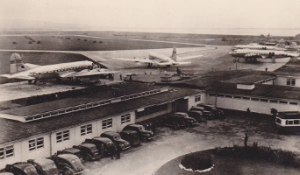
The first aircraft, an Irish Air Corps Aero Anson A43, lands at the newly opened Rineanna Airfield, which is later to become known as Shannon International Airport, on May 18, 1939.

Transatlantic aviation in the Shannon Estuary first commences with a seaplane base at Foynes. In October 1935, the Irish Government makes a decision to initiate a survey to find suitable bases for the operation of seaplanes and land planes on a transatlantic service. The Department of Defence, which provides technical advice on aviation to the Civil Aviation Section of the Department of Industry, is given the task.

On November 21, 1935, a survey party sets out and surveys sites as far north as Athlone and south to Askeaton. Among the sites for a seaplane base to be considered are the Shannon just below Limerick, Lough Derg, Lough Corrib, Tralee Bay, Kenmare Bay, Lough Ree, and Valentia. Foynes, near the mouth of the Fergus River, is finally selected due to its sheltered anchorage and its proximity to long open stretches of water.

The first priority is drainage to remove surface water from the site and to construct embankments to prevent flooding of the airfield due to its proximity to the tidal River Shannon. Several hundred men are employed to dig narrow lateral drains for the approximately 135 miles of pipes which are laid in parallel lines 50 feet apart over almost the entire area of the airfield site. They also excavate catchment drains to collect water from the surface of the site.

At this time all indications are that regular aerial travel between Europe and the United States will be initially by flying boat and accordingly, the base at Rineanna is designed to cater to both land planes and flying boats.  Construction work commences to build embankments and a breakwater to provide for a seaplane base and to protect the airfield site from flooding from the River Shannon.

Developments in aviation during World War I ensure land planes and not flying boats are to be the future of aviation, therefore the mooring basin and the east breakwater which are being constructed for flying boats at Rineanna are never quite finished.  Construction of the embankments continue to protect the site from the River Shannon and to form a drainage lagoon for surface water from the western headland of the airport site.

When World War II ends, the airport is ready to be used by the many new post-war commercial airlines of Europe and North America. On September 16, 1945, the first transatlantic proving flight, a Pan Am DC-4, lands at Shannon from New York City. On October 24, the first scheduled commercial flight, an American Overseas Airlines DC-4, passes through Shannon Airport. An accident involving President Airlines on September 10, 1961 results in the loss of 83 lives. The Douglas DC-6 aircraft crashes into the River Shannon while leaving Shannon Airport for Chicago.

The number of international carriers rises sharply in succeeding years as Shannon becomes well known as the gateway between Europe and the Americas as limited aircraft range necessitates refueling stops on many journeys. Shannon becomes the most convenient stopping point before and after a trip across the Atlantic. Additionally, during the Cold War, many transatlantic flights from the Soviet Union stop here for refueling, because Shannon is the westernmost non-NATO airport.

Shannon Airport is one of Ireland’s three primary airports, along with Dublin Airport and Cork Airport, and includes the longest runway in Ireland at 10,495 feet. It is a designated emergency landing site for the Space Shuttle during the U.S. shuttle program. In 2015, 1.715 million passengers pass through the airport, making it the third busiest airport in the country after Dublin and Cork. Shannon Airport is in Shannon, County Clare, and mainly serves Limerick, Ennis, Galway, and the south-west of Ireland.