seamus dubhghaill

Promoting Irish Culture and History from Little Rock, Arkansas, USA


Leave a comment

Birth of Timothy Lyons, Irish Republican Army Volunteer

Timothy Lyons, also known as Aero or Aeroplane, an Irish Republican Army (IRA) soldier who fights with the Anti-Treaty side during the Irish Civil War, is born in Garrynagore, County Kerry, on December 4, 1895.

Lyons is born in to Margaret (née Sullivan) and Timothy Lyons senior, who is listed on his birth certificate as a cottier. He is the oldest of six siblings. Prior to the Irish Civil War, he works as a labourer. He fights with the IRA’s Kilflynn Company during the Irish War of Independence. He is described as being slight, “adventurous” as a column leader and a marksman who shoots at small birds. He shoots a British officer in an ambush led by captain George O’Shea at Shannow Bridge where the Kilflynn road joins the R557, forcing a retreat. He gains the nickname “Aeroplane” or “Aero” because of the way he suddenly appears and his last-minute escapes. Because of regular searches by Black and Tans, his father fears the family home will be burnt out and asks him to leave.

After the ratification of the Anglo-Irish Treaty, Lyons fights against Free State forces . At the time of his death he is commandant. He is involved in fighting in Listowel and Limerick, is captured near Athea, jailed in Limerick and released in late 1922 with an undertaking not to rejoin the fight. Notwithstanding this, the column continues to operate, generally around Causeway and Ballyduff.

On April 15, 1923, Lyons’ column attacks a Free State raiding party in Meenoghane, County Kerry. The raiding party receives reinforcements. He and his men are eventually surrounded at nearby Clashmealcon on April 16 by Michael Hogan’s 1st Western Division. They descend the rugged, Atlantic cliffs to the caves and hide in Dumfort’s Cave. He shoots out searchlights with his Lee-Enfield rifle and two Free State soldiers are shot dead from the cave. The situation is under Army Emergency Powers. With no escape for the men hiding, troops try to blast them out by dropping mines and smoke them out with petrol-soaked turf.

On April 16, James McGrath, the brother of Thomas McGrath, one of Lyons’s men, is arrested and taken to the cliffs in order to enter the cave and persuade the men to surrender. On the night of April 17-18, Thomas McGrath and Patrick O’Shea, his first cousin, fall trying to scale the cliffs to escape and drown. After offering to surrender himself on the morning of the April 18, Lyons falls several metres onto rocks from a rope that is provided by National Army troops. He is then shot multiple times by troops from the cliff top and is not recovered.

Three of Lyons’ men who surrender, Edmond GreaneyJames McEnery and British deserter-turned-republican Reginald Stephen Hathaway, are executed in Ballymullen Barracks by gunshot on April 25, for breaking their undertaking not to take up arms against the Free State, attacking troops at Clashmealcon, burning the Civic Guard station at Ballyheigue, stripping the same Civic Guards and robbing the post office at Ballyduff.

Lyons’ decomposing body, minus a leg, is washed up on May 5, identifiable by a boot. He is buried alongside George O’Shea and Timothy Tuomey (both killed at Ballyseedy) in the Republican plot at Kilflynn Church (now St. Columba’s Heritage Centre).

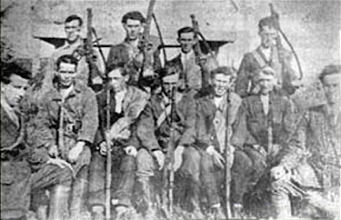
(Pictured: Kilflynn IRA Flying Column, 1922. Back (L to R): Denis O’Connell (Lixnaw), Stephen Fuller (Kilflynn), William Hartnett (Mountcoal), Tim Twomey (Kilflynn). Front (L to R): Terry Brosnan (Lixnaw), John McElligott (Leam, Kilflynn), Danny O’Shea (Kilflynn), Timothy (Aero) Lyons (Garrynagore), Tim Sheehy (Lyre), Pete Sullivan (Ballyduff), Paddy Mahony (Ballyegan, Battalion O.C.).)

Leave a comment

Execution of James McEnery, Irish Republican Army Volunteer

James McEnery, farmer and Irish Republican Army (IRA) volunteer who fights on the anti-Treaty side in the Irish Civil War in north County Kerry, is executed on April 25, 1923. He surrenders during a three-day siege by Irish Free State forces, in the last significant action of the war, and is executed seven days later.

McEnery is born on April 28, 1892, to Henry McEnery and Margaret (née Stack) at 4 Slieveawaddra, Drommartin, County Kerry. His mother and father are national teachers, and his father is also a farmer. Some of his older siblings become teachers and his brother is a Catholic priest.

McEnery marries Johannah (Hannah) Donnelly at Causeway, County Kerry, on April 13, 1918. Their only child, Henry, known as “Sunny,” is born on June 11, 1920.

McEnery joins the Irish Volunteers and is a lieutenant in the 3rd Battalion, North Kerry. As in the Volunteers, in the IRA he is a lieutenant, 3rd Battalion, in the Kerry No.1 Brigade (also of North Kerry). He is part of Timothy “Aeroplane” Lyons‘s column, which is involved in the burning of a Civic Guard station at Ballyheigue and a robbery of the Ballyduff post office. He is captured and imprisoned by the National Army and claims under interrogation that he was forced to join Lyons’s column under fear of death, accused of being a traitor. Despite giving an undertaking, he would not resume militant activity, he rejoins Lyons’s column following his release.

On April 16, McEnery takes part in the column’s ambush on a Free State raiding party at Meenoghane. The National Army’s 1st Western Division supplies reinforcements quickly and pursues the column to Clashmealcon, where the members hide in Dumfort’s Cave on the Atlantic cliffs with no possible escape. Two National Army troops are shot and killed by Lyons when trying to enter the cave. Two of the column’s men fall and drown after trying to scale the cliff at night. McEnery surrendered with Reginald Walter Stenning and Edmond Greaney. They are taken to Ballymullen Barracks in Tralee. Lyons falls from a rope and is shot while lying on the rocks below.

On April 18, McEnery and his two remaining colleagues are charged with the Ballyheigue burning, the Ballyduff robbery, stripping civic guards at Ballyheigue, attacking National troops at Clashmealcon and armed opposition to the government. They are tried and sentenced to death by Paddy Daly, OC of the National Army in Kerry. The following day, Daly asks for confirmation of the sentences, which duly arrive. McEnery is shot at 8:00 a.m. on April 25, three days before his 31st birthday. He is initially interred at the gaol. A death entry is made in the register the following month, incorrectly giving his age as 28. His body is finally released, along with those of others executed, to relatives on October 28 of the following year, when hundreds gather outside the gaol.

McEnery is buried alongside executed colleagues in the republican plot at Rahela Cemetery, Ballyduff. Hannah McEnery is granted £250 from the Irish White Cross and their son Henry £1 per week until working age. In 1932, pending new legislation, she applies for an allowance because of her dependency on McEnery and is awarded £67 and 10 shillings per annum (increased to £250 in the 1950s), and £18 per annum for their son.

McEnery is counted as one of “the seventy-seven,” a term made popular amongst republicans after the writing of Dorothy Macardle in memory of those executed by Free State troops.


Leave a comment

Death of Timothy Lyons, Kilflynn IRA Flying Column Volunteer

Timothy Lyons, an Irish Republican Army (IRA) soldier also known as Aero or Aeroplane, is killed on April 18, 1923, at Clashmealcon caves, County Kerry. He fights with the Anti-Treaty side during the Irish Civil War. After a three-day siege by Irish Free State forces at Clashmealcon, County Kerry, he died after falling from a cliff onto rocks and then being shot.

Lyons is born on December 4, 1895, in Garrynagore, County Kerry, to Margaret (née Sullivan) and Timothy Lyons senior, who is listed on his birth certificate as a cottier. He is the oldest of six siblings. Prior to the Irish Civil War, he works as a labourer. He fights with the IRA’s Kilflynn Company during the Irish War of Independence. He is described as being slight, “adventurous” as a column leader and a marksman who shoots at small birds. He shoots a British officer in an ambush led by captain George O’Shea at Shannow Bridge where the Kilflynn road joins the R557, forcing a retreat. He gains the nickname “Aeroplane” or “Aero” because of the way he would suddenly appear and his last-minute escapes. Because of regular searches by Black and Tans, his father fears the family home will be burned out and asks him to leave.

After the ratification of the Anglo-Irish Treaty, Lyons fights against Irish Free State forces. At the time of his death, he is commandant. He is involved in fighting in Listowel and Limerick, is captured near Athea, gaoled in Limerick and released in late 1922 with an undertaking not to rejoin the fight. Notwithstanding this, the column continues to operate, generally around Causeway and Ballyduff.

On April 15, 1923, Lyons’s column attacks an Irish Free State raiding party in Meenoghane, north Kerry. The raiding party receives reinforcements. He and his men are eventually surrounded at nearby Clashmealcon on April 16 by Michael Hogan’s 1st Western Division. They descend the rugged, Atlantic cliffs to the caves and hide in Dumfort’s Cave. He shoots out searchlights with his Lee-Enfield rifle and two Irish Free State soldiers are shot dead from the cave. The situation is under Army Emergency Powers.

With no escape for the men hiding in the cave, troops try to blast them out by dropping mines and smoke them out with petrol-soaked turf. On April 16, James McGrath, the brother of Tom McGrath, one of Lyons’s men, is arrested and taken to the cliffs in order to enter the cave and persuade the men to surrender. On the night of April 17-18, McGrath and Patrick O’Shea, his first cousin, fall trying to scale the cliffs to escape and drown. After offering to surrender himself on the morning of the April 18, Lyons falls several metres onto rocks from a rope that is provided by National troops. He is then shot multiple times by troops from the cliff top and is not recovered.

Three of Lyons’s men who surrender, Edmond Greaney, James McEnery and British deserter-turned-republican Reginald Walter Stenning, are executed in Ballymullen Barracks by gunshot on April 25, for breaking their undertaking not to take up arms against the Irish Free State, attacking troops at Clashmealcon, burning the Civic Guard station at Ballyheigue, stripping the same Civic Guards and robbing the post office at Ballyduff.

Lyons’s decomposing body, minus a leg, is washed up on May 5, identifiable by a boot. He is buried alongside George O’Shea and Timothy Tuomey, both killed at Ballyseedy, in the republican plot at Kilflynn Church (now St. Columba’s Heritage Centre).

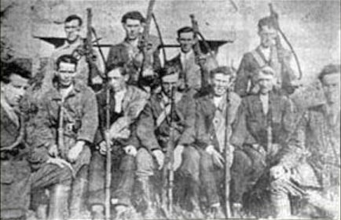
(Pictured: Kilflynn IRA Flying Column, 1922. Back (L to R): Denis O’Connell (Lixnaw), Stephen Fuller (Kilflynn), William Hartnett (Mountcoal), Tim Twomey (Kilflynn). Front (L to R): Terry Brosnan (Lixnaw), John McElligott (Leam, Kilflynn), Danny O’Shea (Kilflynn), Timothy (Aero) Lyons (Garrynagore), Tim Sheehy (Lyre), Pete Sullivan (Ballyduff), Paddy Mahony (Ballyegan, Battalion O.C.).)


Leave a comment

Death of Christy Brown, Writer & Painter

christy-brown

Christy Brown, Irish writer and painter who has cerebral palsy and is able to write or type only with the toes of one foot, dies on September 7, 1981, in Parbrook, Somerset, England. His most recognized work is his autobiography, My Left Foot (1954).

Brown is born into a working-class Irish family at the Rotunda Hospital in Dublin on June 5, 1932. He is one of 22 siblings of parents Bridget Fagan and Patrick Brown. After his birth, doctors discover that he has severe cerebral palsy, a neurological disorder which leaves him almost entirely spastic in his limbs. Though urged to commit him to a hospital, his parents are unswayed and subsequently determined to raise him at home with their other children. During his adolescence, social worker Katriona Delahunt becomes aware of his story and begins to visit the Brown family regularly. She brings him books and painting materials as, over the years, he has shown a keen interest in the arts and literature. He has also demonstrated extremely impressive physical dexterity since, soon after discovering several household books, he had learned to both write and draw himself with his left leg, the only limb over which he has unequivocal control.

Brown quickly matures into a serious artist. Although he famously receives almost no formal schooling during his youth, he does attend St. Brendan’s School-Clinic in Sandymount intermittently. At St. Brendan’s he comes in contact with Dr. Robert Collis, a noted author. Collis discovers that Brown is also a natural novelist and, later, helps use his own connections to publish My Left Foot, by then a long-gestating autobiographical account of Brown’s struggle with everyday life amidst the vibrant culture of Dublin.

When My Left Foot becomes a literary sensation, one of the many people who write letters to Brown is married American woman Beth Moore. Brown and Moore become regular correspondents and, in 1960, he holidays in North America and stays with Moore at her home in Connecticut. When they meet again in 1965, they began an affair. Brown journeys to Connecticut once more to finish his magnum opus, which he had been developing for years. He finally does so in 1967 with help from Moore, who introduces and administers a strict working regimen, mostly by denying him alcohol until a day’s work is completed. The book, Down All the Days, is published in 1970. It is an ambitious project drawn largely from a playful expansion of My Left Foot. It becomes an international best-seller, translated into fourteen languages. The Irish Times reviewer Bernard Share claims the work is “the most important Irish novel since Ulysses.”

Down All the Days is followed by a series of other novels, including A Shadow on Summer (1972), Wild Grow the Lilies (1976) and A Promising Career (published posthumously in 1982). He also publishes three poetry collections: Come Softly to My Wake, Background Music and Of Snails and Skylarks. All the poems are included in The Collected Poems of Christy Brown.

Brown’s fame continues to spread internationally, and he becomes a prominent celebrity. Upon his return to Ireland, he is able to use proceeds from the sales of his books to design and move into a specially constructed home outside Dublin with his sister’s family. Though he and Beth had planned to marry and live together at the new home, and though Moore had informed her husband of these plans, it is around this time that he begins an affair with Englishwoman Mary Carr, whom he meets at a party in London. He then terminates his affair with Moore and marries Carr at the Registry Office, Dublin, in 1972. They move to Stoney Lane, Rathcoole, County Dublin, to Ballyheigue, County Kerry and then to Somerset. He continues to paint, write novels, poetry and plays. His 1974 novel, A Shadow on Summer, is based on his relationship with Moore, whom he still considers a friend.

Brown’s health deteriorates after marrying Carr. He becomes mainly a recluse in his last years, which is thought to be a direct result of Carr’s influence and perhaps abusive nature. He dies at the age of 49 on September 7, 1981, after choking during a lamb chop dinner. His body is found to have significant bruising, which leads many to believe that Carr had physically abused him. Further suspicions arise after Georgina Hambleton’s biography, The Life That Inspired My Left Foot, reveals a supposedly more accurate and unhealthier version of their relationship. The book portrays Carr as an abusive alcoholic and habitually unfaithful. He is buried in the Glasnevin Cemetery in Dublin.

A film adaptation of My Left Foot directed by Jim Sheridan is produced in 1989 from a screenplay by Shane Connaughton. Daniel Day-Lewis stars as Brown and Brenda Fricker as his mother. Both win Academy Awards for their performances. The film also receives Academy Award nominations for Best Picture, Best Director, and Best Adapted Screenplay.

The Anglo-Irish rock band The Pogues pay tribute to Christy Brown with a song titled “Down All the Days.” It is the seventh track on their 1989 recording Peace and Love. Similarly, U2 releases a song titled “Down All the Days” with the 20th anniversary edition of Achtung Baby. The Men They Couldn’t Hang also writes a song “Down All the Days” which appears on their Silver Town album also released in 1989.