seamus dubhghaill

Promoting Irish Culture and History from Little Rock, Arkansas, USA


Leave a comment

The Battle of Ballinamuck

The Battle of Ballinamuck takes place at Ballinamuck, County Longford, on September 8, 1798, marking the defeat of the main force of the French incursion during the Irish Rebellion of 1798.

The victory of General Jean Joseph Amable Humbert at the Battle of Castlebar, despite gaining him around 5,000 extra Irish recruits, did not lead to a renewed outbreak of the rebellion in other areas as hoped. The defeat of the earlier revolt devastated the Irish republican movement to the extent that few are willing to renew the struggle. A massive British force of 26,000 men is assembled under Charles Cornwallis, 1st Marquess Cornwallis, the new Lord Lieutenant of Ireland, and is steadily moving west. Humbert abandons Castlebar and moves toward Ulster, with the apparent intention of igniting an uprising there. He defeats a blocking force of government troops at Collooney in County Sligo. Following reports that rebellions have broken out in County Westmeath and County Longford, he alters course.

Humbert crosses the River Shannon at Ballintra Bridge on September 7, destroying it behind them, and continues to Drumshanbo where they spend the night – halfway between his landing-point and Dublin. News reaches him of the defeat of the Westmeath and Longford rebels at Wilson’s Hospital School at Multyfarmham and Granard from the trickle of rebels who have survived the slaughter and reached his camp. With Cornwallis’ huge force blocking the road to Dublin, facing constant harassment of his rearguard and the pending arrival of General Gerard Lake‘s command, Humbert decides to make a stand the next day at the townland of Ballinamuck on the Longford/Leitrim county border.

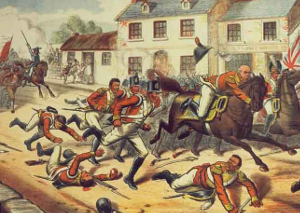
Humbert faces over 12,000 Irishmen and English forces. General Lake is close behind with 14,000 men, and Cornwallis is on his right at Carrick-on-Shannon with 15,000. The battle begins with a short artillery duel followed by a dragoon charge on exposed Irish rebels. There is a brief struggle when French lines are breached which only ceases when Humbert signals his intention to surrender and his officers order their men to lay down their muskets. The battle lasts little more than an hour.

While the French surrender is being taken, the 1,000 or so Irish allies of the French under Colonel Bartholomew Teeling, an Irish officer in the French army, hold onto their arms without signaling the intention to surrender or being offered terms. An attack by infantry followed by a dragoon charge breaks and scatters the Irish who are pursued into a bog where they are either bayoneted or drowned.

A total of 96 French officers and 746 men are taken prisoner. British losses are initially reported as 3 killed and 16 wounded or missing, but the number of killed alone is later reported as twelve. Approximately 500 French and Irish lay dead on the field. Two hundred Irish prisoners are taken in the mopping-up operations, almost all of whom are later hanged, including Matthew Tone, brother of Wolfe Tone. The prisoners are moved to the Carrick-on-Shannon Gaol. The French are given prisoner or war status however the Irish are not and some are hanged and buried in St. Johnstown, today known as Ballinalee, where most are executed in a field that is known locally as Bully’s Acre.

Humbert and his men are transported by canal to Dublin and exchanged for British prisoners of war. Government forces subsequently slowly spread out into the rebel-held “Irish Republic,” engaging in numerous skirmishes with rebel holdouts. These sweeps reach their climax on September 23 when Killala is captured by government forces. During these sweeps, suspected rebels are frequently summarily executed while many houses thought to be housing rebels are burned. French prisoners of war are swiftly repatriated, while United Irishmen rebels are executed. Numerous rebels take to the countryside and continue guerrilla operations, which take government forces some months to suppress. The defeat at Ballinamuck leaves a strong imprint on Irish social memory and features strongly in local folklore. Numerous oral traditions are later collected about the battle, principally in the 1930’s by historian Richard Hayes and the Irish Folklore Commission.

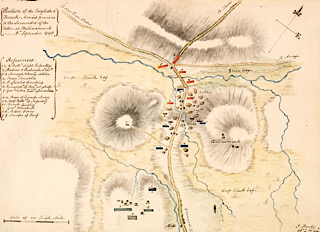
(Pictured: Watercolour plan by an I. Hardy of the Battle of Ballinamuck in County Longford on September 8, 1798, showing position of the English & French Armies previous to the surrender of the latter at Balinamuck)

Leave a comment

The Battle of Collooney

The Battle of Collooney, also called the Battle of Carricknagat, occurs on September 5, 1798, during the Irish Rebellion of 1798 when a combined force of French troops and Irish rebels defeat a force of British troops outside of Collooney near Sligo.

A long-anticipated French landing to assist the Irish rebellion takes place on August 22, when almost 1,100 troops under the command of General Jean Joseph Amable Humbert land at Kilcummin Strand (Cill Chuimín), Killala Bay, County Mayo. Although the force is small, the remote location ensures an unopposed landing away from the tens of thousands of British soldiers concentrated in the east in Leinster, engaged in mopping up operations against remaining pockets of rebels. The nearby town of Killala is quickly captured after a brief resistance by local yeomen and Ballina is also taken two days later, following the rout of a force of cavalry sent from the town to oppose their march. Irish volunteers begin to trickle into the French camp from all over Mayo following the news of the French landing.

The victory of General Humbert at Castlebar, despite gaining him about 5,000 Irish recruits, does not lead to a renewed outbreak of the rebellion as hoped. A British army of some 26,000 men is assembled under Field Marshal Charles Cornwallis, 1st Marquess Cornwallis, the newly appointed Lord Lieutenant of Ireland, and is steadily moving towards his forces. Abandoning Castlebar, Humbert moves towards Ulster via Sligo with the intention of igniting a rising there.

The combined Franco-Irish forces march northeast towards Sligo on their way to County Donegal in Ulster. When they get to the village of Collooney they are confronted by a unit of British troops from the garrison in Sligo, which is approximately five miles to the north of Collooney. A minor battle ensues at Carricknagat, a small townland to the immediate north of Collooney, hence the alternate name for the battle: the Battle of Carricknagat.

On September 5, 1798, the Franco-Irish troops push north through County Sligo but are halted by a cannon which the British forces have installed above Union Rock near Collooney.

A young Irish aide to General Humbert, Lieutenant Bartholomew Teeling, distinguishes himself during the encounter. Teeling clears the way for the advancing Irish-French army by single-handedly disabling a British gunnery post located high on Union Rock when he breaks from the French ranks and gallops toward the gunner’s position. Teeling is armed with a pistol and he shoots the cannon’s marksman and captures the cannon. After the loss of the cannon position, the French and Irish advance and the British retreat toward their barracks at Sligo, leaving 120 dead and 100 prisoners.

Colonel Charles Vereker, who commands the Limerick militia in the standoff, is awarded a peerage for his role in the battle.

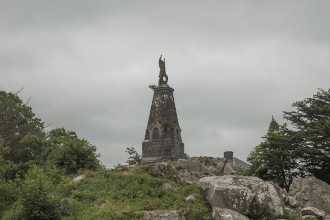
In 1898, the centenary year of the battle, a statue of Teeling is erected in Carricknagat. Johnnie Woods of Aughamore, Sligo, County Sligo, a far-famed reliable scaffolder, erects the spire for this monument.

(Pictured: The monument commemorating the battle)


Leave a comment

John Hely-Hutchinson Created Baron Hutchinson of Alexandria & Knocklofty

Generated by IIPImage

General John Hely-Hutchinson, Jr., Member of Parliament (MP) for Cork Borough, is created Baron Hutchinson of Alexandria and Knocklofty on December 18, 1801, for his military service.

Hely-Hutchinson is born on May 15, 1757, the son of John Hely-Hutchinson and the Christiana Hely-Hutchinson, 1st Baroness Donoughmore. He is educated at Eton College, Magdalen College, Oxford, and Trinity College, Dublin.

Hely-Hutchinson enters the Army as a cornet in the 18th Royal Hussars in 1774, rising to a lieutenant the following year. In 1776 he is promoted to become a captain in the 67th (South Hampshire) Regiment of Foot, and a major there in 1781. He moves regiments again in 1783, becoming a lieutenant-colonel in, and colonel-commandant of, the 77th Regiment of Foot, which is, however, disbanded shortly afterwards following an earlier mutiny. He spends the next 11 years on half-pay, studying military tactics in France before serving as a volunteer in the Flanders campaigns of 1793 as aide-de-camp to Sir Ralph Abercromby.

In March 1794 Hely-Hutchinson obtains brevet promotion to colonel and the colonelcy of the old 94th Regiment of Foot and then becomes a major-general in May 1796, serving in Ireland during the Irish Rebellion of 1798, where he is second-in-command at the Battle of Castlebar under General Gerard Lake. In 1799, he is in the expedition to the Netherlands.

Hely-Hutchinson is second-in-command of the 1801 expedition to Egypt, under Abercromby. Following Abercromby’s death in March after being wounded at the Battle of Alexandria, he takes command of the force. From then he is able to besiege the French firstly at Cairo which capitulates in June and then besieges and takes Alexandria, culminating in the capitulation of over 22,000 French soldiers. In reward for his successes there, the Ottoman Sultan Selim III makes him a Knight, 1st Class, of the Order of the Crescent.

On December 18, 1801, Hely-Hutchinson is created Baron Hutchinson in the Peerage of the United Kingdom, gaining a seat in the House of Lords. In recognition of his “eminent services” during the “late glorious and successful campaign in Egypt,” at the request of the King, the Parliament of the United Kingdom settles on Lord Hutchinson and the next two succeeding male heirs of his body an annuity of £2000 per annum, paid out of the Consolidated Fund.

Hely-Hutchinson is promoted lieutenant-general in September 1803 and made a full general in June 1813. In 1806, he becomes colonel of the 57th (West Middlesex) Regiment of Foot, transferring in 1811 to be colonel of the 18th Regiment of Foot, a position he holds until his death. He also holds the position of Governor of Stirling Castle from 1806 until his death.

Hely-Hutchinson sits as Member of Parliament (MP) for Lanesborough from 1776 to 1783 and for Taghmon from 1789 to 1790. Subsequently, he represents Cork City in the Irish House of Commons until the Act of Union 1800 and is then member for Cork City in the after-Union Parliament of the United Kingdom until 1802.

Hely-Hutchinson dies on June 29, 1832, never having married.


Leave a comment

Death of General Jean Joseph Amable Humbert

jean-joseph-amable-humbert

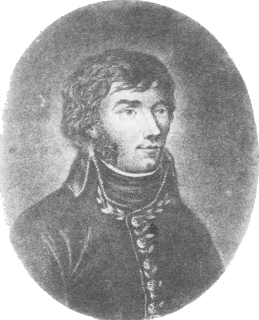
General Jean Joseph Amable Humbert, French soldier and French Revolution participant who leads a failed invasion of Ireland to assist Irish rebels in the Irish Rebellion of 1798, dies on January 3, 1823, in New Orleans, Louisiana.

Born in the townland of La Coâre Saint-Nabord, outside Remiremont Vosges, Humbert is a sergeant in the National Guard of Lyon. He rapidly advances through the ranks to become brigadier general on April 9, 1794, and fights in the Western campaigns before being allocated to the Army of the Rhine.

In 1794, after serving in the Army of the Coasts of Brest, Humbert serves under Louis Lazare Hoche in the Army of the Rhin-et-Moselle. Charged to prepare for an expedition against Ireland, he takes command of the Légion des Francs under Hoche, sailing in the ill-fated Expédition d’Irlande against Bantry Bay in 1796, and is engaged in actions at sea against the Royal Navy. Contrary weather and enemy action force this expedition to withdraw. The trip home ends in a naval battle, the Action of 13 January 1797, during which Humbert, on the French ship Droits de l’Homme (1794), narrowly escapes death. As the ship is destroyed and sinks, hundreds of men perish, but Humbert is among the last to escape.

On his return to France, Humbert serves in the Army of the Sambre-et-Meuse, before being appointed to command the troops in another attempt to support a rising in Ireland in 1798. His command chiefly consists of infantry of the 70th demi-brigade with a few artillerymen and some cavalry of the 3rd Hussars, however by the time he arrives off the Irish coast the United Irish rising has already suffered defeat. The expedition is able to land in Ireland at Killala on Thursday August 23, 1798, meeting with initial success in the Battle of Castlebar where he routs the Irish Militia. Humbert subsequently declares a Republic of Connacht, with hopes of taking Dublin. However, Humbert’s small force is defeated at the Battle of Ballinamuck by the Irish Royal Army, and he is taken as a prisoner of war by the authorities. The British send the French officers home in two frigates and then massacre their Irish supporters. Humbert makes no attempt to save the Irish who bravely supported him.

Humbert is shortly repatriated in a prisoner exchange and appointed in succession to the Armies of Mayence, Danube and Helvetia, with which he serves at the Second Battle of Zurich. He then embarks for Santo Domingo and participates in several Caribbean campaigns for Napoleon Bonaparte before being accused of plundering by General Brunet. It is also rumored that he engages in an affair with Pauline Bonaparte, the wife of his commanding officer Charles Leclerc. He is returned to France by order of General Leclerc in October 1802, for “prevarications, and liaison relationships with organisers of the inhabitants and with leaders of brigands.” A committed Republican, his displeasure at Napoleon’s Imperial pretensions lead to him being dismissed in 1803 and he retires to Morbihan in Brittany.

In 1810, after brief service in the Army of the North, Humbert emigrates to New Orleans, where he makes his acquaintance with French pirate Jean Lafitte. In 1813, Humbert joins the revolutionary Juan Bautista Mariano Picornell y Gomila in an unsuccessful attempt to foment rebellion in Spanish Mexico, but the effort fails. In 1814, Humbert again leaves New Orleans and joins the rebelling forces of Buenos Aires, briefly commanding a corps, before returning home. Humbert last fights the British at the Battle of New Orleans, as a volunteer private soldier in U.S. ranks, in the War of 1812, wearing his Napoleonic uniform. General Andrew Jackson thanks him for his assistance there after the American victory in January 1815. Thereafter Humbert lives peacefully as a schoolteacher until his death on January 3, 1823.

A monument to General Humbert depicting Mother Ireland stands on Humbert Street, Ballina, County Mayo. In 1989, sculptor Carmel Gallagher unveils a bust of General Humbert in Killala, Ireland, to mark the upcoming bicentennial of the Irish Rebellion of 1798.


Leave a comment

The Races of Castlebar

races-of-castlebar

The Battle of Castlebar occurs on August 27, 1798, near the town of Castlebar, County Mayo, during the Irish Rebellion of 1798. A combined force of 2,000 French troops and Irish rebels rout a force of 6,000 British militia in what later becomes known as the “Castlebar Races” or “Races of Castlebar.”

The long-awaited French landing to assist the Irish revolution begun by Theobald Wolfe Tone‘s Society of United Irishmen takes place five days previously on August 22, when almost 1,100 troops under the command of General Jean Joseph Amable Humbert land at Cill Chuimín Strand, County Mayo. The nearby town of Killala is quickly captured after a brief resistance by local yeomen. Following the news of the French landing, Irish volunteers began to trickle into the French camp from all over Mayo.

On August 26, leaving about 200 French regulars behind in Killala to cover his rear and line of withdrawal, Humbert takes a combined force of about 2,000 French and Irish to march on and take Castlebar. In order to avoid a head-on attack, locals advise the French of an alternative route to Castlebar through the wilds along the west of Lough Conn, which the British believe to be impassable for a modern army with attendant artillery train. When General Gerald Lake’s scouts spot the approaching enemy, the surprised British have to hurriedly change the deployment of their entire force to face the threat from this unanticipated direction.

The British have barely completed their new deployment when the Franco-Irish army appears outside the town at about 6:00 AM. The newly sited British artillery opens up on the advancing French and Irish and cut them down in droves. French officers, however, quickly identify an area of scrub and undergrowth in a defile facing the centre of the artillery line which provides some cover from the British line of fire. The French launch a bayonet charge, the ferocity and determination of which unnerve the units stationed behind the artillery. The British units begin to waver before the French reach their lines and eventually turn in panic and flee the battlefield, abandoning the gunners and artillery. A unit of cavalry and British regular infantry attempt to stand and stem the tide of panic but are quickly overwhelmed.

In the headlong flight of thousands of British militias, large quantities of guns and equipment are abandoned, among which is General Lake’s personal luggage. Although not pursued a mile or two beyond Castlebar, the British do not stop until they reach Tuam, with some units fleeing as far as Athlone in the panic. The panic is such that only the arrival of Cornwallis at Athlone prevents further flight across the River Shannon.

Although achieving a decisive victory, the losses of the French and Irish are high, with about 150 men killed, mostly to the cannonade at the start of the battle. About 80 British are killed and some 270 wounded, captured, or deserted. Following the victory, thousands of volunteers flock to join the French who also send a request to France for reinforcements and formally declare a Republic of Connacht, which lasts 3 days and collapses when the French depart.

On September 5, the British forces are again defeated at Collooney however, after that, the rebellion quickly folds. More troops gather and by the Battle of Ballinamuck on September 8, their strength is over 15,000. Ballinamuck is the end for General Humbert, who hands in his surrender. The Irish rebels fight on briefly until scattered. Killala is re-taken on September 12. More French warships sail for Ireland but are decisively defeated by the Royal Navy near Tory Island. With that the 1798 rebellion ends. The captured French soldiers are transferred to England and eventually repatriated. The French officers of Irish origin are hanged in Dublin with the Irish rebels.