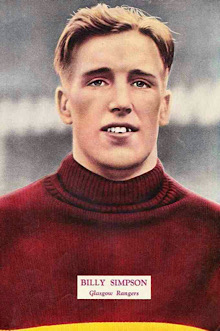
Simpson signs for Rangers from Linfield for a sum of £11,500 in 1950. He spends nine years (1950–59) at Rangers making 239 appearances and scoring 163 goals. He wins three championship medals and a Scottish Cup winners medal with Rangers to add to the two Northern Ireland Football League and two Irish Cups he wins with Linfield. He leaves Ibrox Stadium in 1959 and spends the last couple of years of his career with Stirling Albion, Partick Thistle and (then non-league) Oxford United.
As an illustration of his popularity, in the fictional song “A Trip to Ibrox,” Simpson is credited with scoring twice in a “Ne’erday” Old Firm Derby at Ibrox. Whereby Rangers are 1-0 down at halftime, and Simpson inspires his team to a second half comeback after Willie Waddell has scored an equaliser.
In recognition of his service to that club, Simpson is made a member of the Rangers F.C. Hall of Fame.
Simpson makes his debut for Northern Ireland in 1951 against Wales, scoring in the process. He represents his country twelve times in total between 1951 and 1958, scoring five goals. He is selected in Northern Ireland’s squad for the 1958 FIFA World Cup in Sweden but a late injury ensures he does not play at all during the finals.
In April 2015, the feature-length documentarySpirit of ’58 is screened as part of the Belfast Film Festival. It features Simpson prominently alongside the other surviving players (Billy Bingham, Peter McParland, Jimmy McIlroy and Harry Gregg) as it tells the story of Northern Ireland’s journey throughout the 1950s under the managership of Peter Doherty, culminating in the 1958 World Cup.
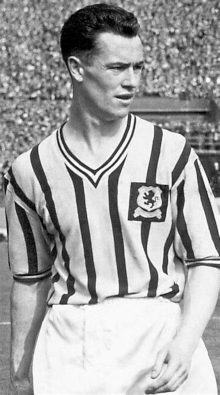
McParland holds a unique place in English football history as the first player in the game to score in and win both English major domestic knockout Finals. One of the finest headers and strikers of the ball of the past fifty years, he is regarded as one of the greatest players to represent both Aston Villa and Northern Ireland.
During his time with Aston Villa, McParland is influenced by Jimmy Hogan. He later wins the FA Cup in 1957, scoring twice in the final against Manchester United but also becoming involved in a controversial incident in which he shoulder-charges (at the time a legitimate form of challenge) the Manchester United keeper after only six minutes. This leaves United’s goalkeeper, Ray Wood, unconscious with a broken cheekbone. McParland’s two-goal haul is remembered fondly as an example of his all-round abilities as a player showcasing his diving header and volleying techniques.
McParland also wins the Second Division title in 1960 and the League Cup in 1961 while with Aston Villa. He is on the scoresheet for the second leg of the 1961 League Cup final, when Aston Villa overturns a 2–0 deficit against Rotherham United to win the second leg 3–0 at Villa Park, becoming the winners of the first Football League Cup.
Following Aston Villa, McParland joins local rivals Wolverhampton Wanderers for a brief period in 1962. Although he is only there for one season, he manages to score 10 goals in 21 games. The following season he moves on to Plymouth Argyle, his final English league club before hanging up his boots. In 1965, he is recruited to play for Toronto Inter-Roma FC of the Eastern Canada Professional Soccer League. He scores many memorable goals, especially one against the Hamilton Steelers to give his side the victory.
McParland represents Northern Ireland 34 times and scores twice in his debut against Wales in the 1953–54 season. He also stars for Northern Ireland in the 1958 FIFA World Cup in which he scores five goals and helps his team to the quarterfinals. France defeats Northern Ireland 4–0 in their quarterfinal match.
McParland holds the record for being the highest-scoring Northern Irish player in World Cup finals history.
In April 2015, the feature-length documentary Spirit of ’58 is screened as part of the Belfast Film Festival. It features McParland prominently alongside Billy Bingham, Billy Simpson, Jimmy McIlroy and Harry Gregg, the other surviving players at the time, as it tells the story of Northern Ireland’s journey throughout the 1950s under the managership of Peter Doherty, culminating in the 1958 World Cup.
McParland is the last surviving player from the 1957 FA Cup Final following the death of Bobby Charlton on October 21, 2023. Following the death of Billy Bingham on June 9, 2022, McParland is the last surviving member of the Northern Ireland squad from the 1958 World Cup campaign. He is one of the last surviving members of the 1958 FIFA World Cup.
From November 1930 to 1957, Hewitt holds positions in the Belfast Museum & Art Gallery. His radical socialist ideals prove unacceptable to the Belfast Unionist establishment and he is passed over for promotion in 1953. Instead in 1957 he moves to Coventry, a city still rebuilding following its devastation during World War II. He is appointed Director of the Herbert Art Gallery & Museum where he works until retirement in 1972.
Hewitt is appointed the first writer-in-residence at Queen’s University Belfast in 1976. His collections includes The Day of the Corncrake (1969) and Out of My Time: Poems 1969 to 1974 (1974). He is also made a Freeman of the City of Belfast in 1983, and is awarded honorary doctorates at the University of Ulster and Queen’s University Belfast.
Hewitt has an active political life, describing himself as “a man of the left,” and is involved in the British Labour Party, the Fabian Society and the Belfast Peace League. He is attracted to the Ulster dissenting tradition and is drawn to a concept of regional identity within the island of Ireland, describing his identity as Ulster, Irish, British and European. He officially opens the Belfast Unemployed Resource Centre (BURC) Offices on May Day 1985.
John Hewitt dies in Belfast on June 22, 1987. His life and work are celebrated in two prominent ways – the annual John Hewitt International Summer School and, less conventionally, the John Hewitt Bar and Restaurant, a Belfast pub is named after him. The bar is named after him as he officially opens the Belfast Unemployed Resource Centre, which owns the establishment. It is a popular meeting place for local writers, musicians, journalists, students and artists. Both the Belfast Festival at Queen’s and the Belfast Film Festival use the venue to stage events.


 seamus dubhghaill