seamus dubhghaill

Promoting Irish Culture and History from Little Rock, Arkansas, USA


Leave a comment

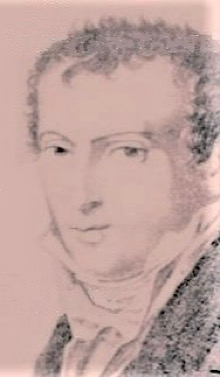
Death of David Bailie Warden, United Irishman & Diplomat

David Bailie Warden, United Irishman, diplomat, and bibliographer, dies in Paris on October 9, 1845, where he had lived for the previous thirty-eight years.

Warden is born in the townland of Ballycastle, near Newtownards in County Down, the eldest among three sons of Robert Warden, tenant farmer, and Elizabeth Warden (née Bailie). Educated locally, he studies for the Presbyterian ministry, despite being told by a clergyman that he is a “blockhead.” Entering the University of Glasgow, he wins a silver medal for his work on barometers, receives a certificate in midwifery, and graduates MA in April 1797. Returning to Ireland, he accepts a provisional license to preach from the Presbytery of Bangor, County Down, and becomes a popular preacher in the region. A patriot in politics, he joins the United Irishmen. Because of this a warrant was issued for his arrest in 1798 and he surrenders himself to the government. Banished from Ireland, he decides to emigrate to the United States and writes a pamphlet explaining his decision, A farewell address to the junto of the presbytery of Bangor, in which he accuses the church leaders of “meanness, injustice and cruelty.”

On his arrival in New York City in 1799, Warden decides to abandon his career as a clergyman and become a teacher. Interested in mathematics, science and literature, he becomes principal of the Columbia Academy in Kinderhook, New York, and is appointed in 1801 the head tutor at Kingston Academy in Ulster County, New York. Employed by General John Armstrong, Jr. to teach his children, he makes useful connections in American society. He becomes a citizen in 1804 and is asked to accompany Armstrong to France when he is appointed ambassador. Arriving in Paris in 1806, he gives strong support to Armstrong and defends him from criticism in the American press. He is appointed acting consul in 1808, and serves as head of the legation on two occasions when Armstrong is absent. Surprisingly, despite their ties of friendship, Armstrong does not recommend Warden to succeed him permanently, and advises President Thomas Jefferson that although “honest and amiable” he is “not well qualified for business.” Stung by these comments, Warden reacts angrily and his friendship with Armstrong ends acrimoniously. As a result he is swiftly recalled from Paris.

Once back in America, Warden lobbies vigorously to be appointed French consul. Supported by Jefferson, now out of office, he returns to Paris in August 1811 having convinced the government of his credentials. Befriending the new ambassador, Joel Barlow, he soon allows pride to get the better of him. Arrogantly styling himself “consul general” after Barlow dies in December 1812, he provokes much anger and is dismissed from office on June 10, 1814. He never holds a diplomatic appointment again.

Deciding to remain in France, he resumes his scholarly activities and publishes his first book, On the Origin, Nature, Progress and Influence of Consular Establishments in 1813. A friend of many of the leading French writers and intellectuals, he also offers assistance to visiting scholars from America, providing a bridge between the European and American intellectual communities. His reputation increases with the publication of Chorographical and Statistical Description of the District of Columbia (1816) and A Statistical, Political and Historical Account of the United States of North America (3 vols., 1819). The publishers of a series, L’art de vérifier les dates, commissions him to research the volumes on North and South America in 1821. These run to ten volumes and are written over thirteen years.

Beset by financial difficulties, Warden is twice forced to sell part of his vast library to raise money. He dies on October 9, 1845, in Paris, after a long illness. He never marries.

(From: “Warden, David Bailie” by Patrick M. Geoghegan, Dictionary of Irish Biography, http://www.dib.ie, October 2009)


Leave a comment

Birth of Richard Irvine Best, Philologist & Bibliographer

Richard Irvine Best, Irish scholar, specifically a philologist and bibliographer, who specialises in Celtic Studies, is born at 3 Bishop Street in Derry, County Londonderry, on January 17, 1872. He is often known as R. I. Best, or simply Best to his close friends and family.

Best’s parents are Henry Best and Margaret Jane Best (née Irvine). His father is an excise officer working in Paisley, Renfrewshire, Scotland, at the time of his birth.

Best’s education takes place locally at Foyle College, a grammar school in County Londonderry which dates back to 1617, schooling children ages eleven to eighteen. Following his time at Foyle College, he does not attend university, however he is a member of the Irish Literary Society in London. Instead of attending university he works as a banking assistant for a time before an inheritance allows him to travel to Paris, France.

It is in Paris that Best meets, and becomes friends with, John Millington Synge, who recommends the lectures of Marie Henri d’Arbois de Jubainville at the Collège de France. He later goes on to translate and annotate Henri d’Arbois de Jubainville’s work, Le cycle mythologique irlandais et la mythologie celtique into The Irish Mythological Cycle and Celtic Mythology.

Upon returning to Dublin from Paris, Best becomes Honorary Secretary of the School of Irish Learning from its inception in 1903. It is incorporated into the Royal Irish Academy in 1926. He acts as joint editor of the school’s journal Ériu, and continues after the transfer of the journal to the Academy. In 1904, he joins the staff of the National Library of Ireland as an assistant director. He succeeds as Chief Librarian in 1924, and subsequently Library Director, a post he holds until 1940. Throughout his career, he becomes a prolific expert on Celtic studies, and is widely attributed to the survival and success of the subject as it is known today.

Best’s work earns him several accolades. He receives the Leibniz Medal of the Royal Prussian Academy in 1914, an honorary D.Litt. by the National University of Ireland in 1920, and an Honorary D.Litt. by Trinity College Dublin in 1923. In 1936, he is awarded the Medal of the Pontifical Academy of Sciences by Pope Pius XI for his facsimile edition of the Milan codex. He is elected as President of the Royal Irish Academy in 1942. His works, Bibliography of Irish Philology and of Irish Printed Literature (1913) and Bibliography of Irish Philology and Manuscript Literature, 1913-41 (1942), are considered to be some of his most important scholarly outputs.

Best is also known for his appearances in famous works of Irish literature. He appears in James Joyce‘s Ulysses. He is drawn by John Butler Yeats, father of William Butler Yeats, and his portrait now hangs in the National Gallery of Ireland.

Upon his retirement from the National Library, Best becomes a Senior Professor at the Dublin Institute for Advanced Studies (DIAS). He retires from the DIAS in 1947 at the age of seventy-five. From 1948 to 1956, he becomes chairman of the Irish Manuscripts Commission, a position previously held by Eoin MacNeill. While in this role, he supervises several facsimiles, including RIA MS 23 N 10, later renamed the Book of Ballycummin in 2019.

Following his retirement from the Irish Manuscripts Commission, Best spends much of the final three years of his life “sorting out his large correspondence,” much of which is currently held in the National Library. He also continues to publish new work throughout his later life. He works on a translation of the Book of Leinster alongside Osborn Bergin and Professor M. A. O’Brien, who takes over after Bergin’s death in 1950. The first fasciculus is published in 1954, the second in 1956 and the third in 1959. His work also appears in multiple academic journals, including Éiriu, and the Zeitschrift für celtische Philologie, Revue Celtique, Études Celtiques, Hermathena, The Dublin Magazine, and The Proceedings of the Royal Irish Academy. He also continues with his work in palaeography, including the last paper he completes on the Book of Armagh in 1958, which appeared in Éiriu vol. xviii. His aid in the writing of others is particularly visible in his surviving correspondence with George Moore.

Best marries his wife, Edith Best (née Oldham), in 1906, he being seven years her junior. She is the older sister of Charles Hubert Oldham, who goes on to become Professor of Economics at University College Dublin. She herself is a musician, a pianist, who had studied at the Royal College of Music in London. The couple has no children, and also claims to have no affiliation with any religion. Edith passes away at their home on March 9, 1950.

Best dies on September 25, 1959, at his home on 57 Upper Leeson Street in Dublin. The Richard I. Best Papers are currently held at the National Archives of Ireland and have been instrumental in the foundation of The Richard Irvine Best Memorial lecture. This discussion and celebration of Best’s work, organised by Richard Irvine Best Memorial Lecture Trust, has taken place since 1969.