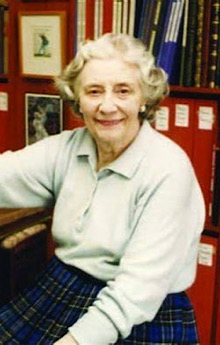
Between 1959 and 1977, Trimble is professor of accompaniment and musicianship at the Royal College of Music.
Trimble’s compositional career spans two decades, producing works such as Buttermilk Point (1938), The Heather Glen (1949), Phantasy for Piano Trio (1940), and the suite Ulster Airs (1939–40). In 1957, she makes a notable mark by composing Blind Raftery, the first new opera by a woman to be broadcast on BBC Television.
Later in life, Trimble inherits her father’s newspaper, becoming its proprietor and editor, and takes up composition again in 1990 when commissioned for her 75th birthday. She dies in Enniskillen on August 6, 2000, at the age of 85, two weeks after the death of her husband. She is remembered for her contributions to Irish music, her skill as a pianist, and her role in preserving her family’s legacy in both the arts and journalism.
In 2002, the Joan Trimble Awards Scheme is established by her family in her memory, and administered by the Fermanagh Trust “in recognition of her lifelong commitment to County Fermanagh.” The purpose of the scheme is to encourage and support the involvement of young people in creativity, the performing arts and Irish culture, and to provide bursaries for training and education.
In 2012, Fermanagh County Museum stages an exhibition titled “Buttermilk Point: The Musical Life of Joan Trimble, 1915–2000.”
On June 18, 2015, “Music in Fermanagh” presents A Celebration Concert as part of the Joan Trimble Centenary Celebration at the Ardhowen Theatre in Enniskillen.
Stanford is born in Dublin into a well-off and highly musical family on September 30, 1852, the only son of John James Stanford, a prominent Dublin lawyer, Examiner to the Court of Chancery in Ireland and Clerk of the Crown for County Meath, and his second wife, Mary (née Henn). He is educated at the University of Cambridge before studying music in Leipzig and Berlin. He is instrumental in raising the status of the Cambridge University Musical Society, attracting international stars to perform with it.
While still an undergraduate, Stanford is appointed organist of Trinity College, Cambridge. In 1882, at the age of 29, he is one of the founding professors at the Royal College of Music, where he teaches composition for the rest of his life. From 1887 he is also Professor of Music at Cambridge. As a teacher, he is skeptical about modernism and bases his instruction chiefly on classical principles as exemplified in the music of Johannes Brahms. Among his pupils are rising composers whose fame go on to surpass his own, such as Gustav Holst and Ralph Vaughan Williams. As a conductor, he holds posts with the Bach Choir and the Leeds Triennial Music Festival.
Stanford composes a substantial number of concert works, including seven symphonies, but his best-remembered pieces are his choral works for church performance, chiefly composed in the Anglican tradition. He is a dedicated composer of opera, but none of his nine completed operas has endured in the general repertory. Some critics regard him, together with Hubert Parry and Alexander Mackenzie, as responsible for a renaissance in music from the British Isles. However, after his conspicuous success as a composer in the last two decades of the 19th century, his music is eclipsed in the 20th century by that of Edward Elgar as well as former pupils.
In September 1922, Stanford completes the sixth Irish Rhapsody, his final work. Two weeks later he celebrates his 70th birthday and thereafter his health declines. On March 17, 1924, he suffers a stroke and dies on March 29 at his home in London, survived by his wife and children. He is cremated at Golders Green Crematorium on April 2 and his ashes are buried in Westminster Abbey the following day.
Stanford’s last opera, The Travelling Companion, composed during World War I, is premiered by amateur performers at the David Lewis Theatre, Liverpool in 1925 with a reduced orchestra. The work is given complete at Bristol in 1928 and at Sadler’s Wells Theatre, London, in 1935.
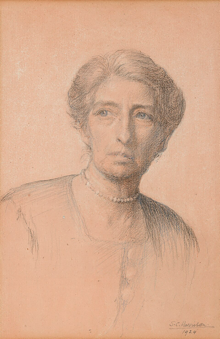
Best is born in Dublin on July 11, 1865, the youngest of fourteen children of Dublin merchant, Eldred Oldham, and Annie (née Alker). Two of her siblings are Alice Oldham, the first of nine women to graduate from university with a degree in either Great Britain or Ireland, and Charles Hubert Oldham, first professor of national economics at University College Dublin (UCD). She attends the Royal Irish Academy of Music (RIAM), studying under Margaret O’Hea and Robert Prescott Stewart. She wins the Lord O’Hagan’s prize in 1883. She is one of the first three candidates to win a scholarship to the Royal College of Music, London, in 1883, becoming an associate of the College by competitive examination in 1887. She is a close friend and confidante of the College’s director, Sir George Grove, to which his 514 letters to her from 1883 to 1899, now housed in the Royal College of Music library, testify.
Best returns to the RIAM as a piano teacher in 1887, remaining in that post until 1932. She is the first female teacher in the RIAM listed as holding a diploma in music. She is also an assistant to Michele Esposito as a local centre examiner. She is a founding member of the Feis Ceoil, undertaking large responsibility for its organisation, and it becomes an annual event under her leadership. In 1898, she describes the foundation of the Feis in a paper to the Incorporated Society of Musicians as being inspired to “ultimately do more for the art of music in Ireland than anything which has yet been attempted.” Along with Joseph Seymour and Edward Fournier she visits the Welsh Eisteddfod to compare it with the Feis, and hopes it will become as influential as the Welsh festival. She works with Eoin MacNeill and the Gaelic League to promote the Feis, and to organise prizes. Under her influence, the festival broadens its scope beyond purely Irish music. She serves as the honorary secretary of the Feis Ceoil Association from 1896 to 1905, and vice-president from 1905 to 1950. In 1897, Esposito dedicates his cantata Deirdre to her. She is a founding member of the Dublin Orchestral Society in 1899, and she succeeds Esposito as the director of music at Alexandra College, Dublin, in 1927. She is made an associate of the Royal Dublin Societyin 1892, and fellow of the RIAM in 1938.
Palmer’s music includes at least three operas, a number of choral pieces and many songs. His strong interest in opera comes during a politically difficult period in Irish history. Ireland is struggling for independence, and cultural politicians often regard opera (and classical music in general) as alien to Irish culture. Initially, however, he is successful, his earliest stage work being Finn Varra Maa (a transliteration from the Gaelic meaning “good Finbar”), subtitled The Irish Santa Claus. It survives as a libretto only, published in a drama series by Talbot Press, Dublin, in 1917. Contrary to what the (sub-)title may suggest, the work is a political satire that is much criticised for its nationalism. Sruth na Maoile (“The Sea of Moyle”) is first performed in July 1923 and restaged by the O’Mara Opera Company in the cultural by-programme of the Tailteann Games in August 1924. Its story is based on the legend of the Children of Lir, while the music relies on numerous references to Irish traditional music, including the song Silent O Moylefrom Thomas Moore‘s Irish Melodies. A third work, Grania Goes (1924), conceived as a light, comic opera, cannot be performed in the years following Irish independence. The manuscript scores of the Sruth na Maoile and Grania Goes are in the National Library of Ireland.
Between 1925 and 1930, Palmer embarks on a cycle of three full-scale operas on the Cuchullain cycle to words by William Mervyn Crofton. In one of them, Deirdre of the Sorrows (1925), Crofton acknowledges Palmer’s “beautiful music.” Despite this, Palmer’s illness prevents the completion of the score, which is later handed over to the composer Staf Gebruers (1902–70), but they are never performed. The manuscript scores of the operas Cuchullain and Deirdre of the Sorrows composed by Gebruers are held by his son Adrian. Unfortunately, despite extensive searching, the score of The Wooing of Emer has not been located, though it is referenced in Gebruers’ own inventories and mentioned as being of three hours duration. In addition, there is a copy of The King’s Song, also composed by Gebruers with lyrics by Crofton and described as from Act 1 of The Black Hag, but whether or not this has any connection with Palmer is unknown.
Palmer is mainly known as the composer of light songs and ballads, often in a folkloristic style, that find publishers in England and are frequently performed. “They show a skilled hand with a talent for vocal harmony but little originality.” His choral music is mainly on a similar miniature scale, an exception being the early cantataThe Abbot of Innisfallen (1909). There are some isolated examples of orchestral music performed by the orchestra of Radio Éireann, but the surviving references may not give a full picture of his output.
In the last decades of his life, Palmer was confined to a wheelchair and depends upon the care of his two sisters, who were running Hillcourt, a private girls’ boarding school in Glenageary, near their home in Sandycove (south Dublin). Palmer dies in Dublin on November 29, 1957.
Frederick May, Irish composer and arranger, dies in Dublin on September 8, 1985. His musical career is seriously hindered by a lifelong hearing problem, and he produces relatively few compositions.
May is born on June 9, 1911, into a Dublin Protestant family who lives in the suburb of Donnybrook. His father, also named Frederick, is employed at the Guinness Brewery. He pursues his musical studies at the Royal Irish Academy of Music, where he is taught composition by John Larchet. In 1930, McCullough Pigott and Co. publishes his Irish Love Song. That same year he is awarded the Esposito Cup at the Feis Ceoil and as a result of this he is nominated as the first recipient of a new scholarship prize worth £100 to be spent on the further study of piano. In July 1930, he takes his preliminary examination for the Bachelor of Music at Trinity College Dublin (TCD) before departing Dublin to utilise his scholarship in London. In September he enrolls at the Royal College of Music (RCM) where his teachers include Charles Kitson, Ralph Vaughan Williams, R. O. Morris and Gordon Jacob. He takes his final TCD examination in December 1931 submitting a string quartet and on December 10 his degree is conferred. During 1932 his study is funded by the RCM’s Foli Scholarship and in October he is awarded the Octavia Travelling Scholarship.
May’s compositions are few in number and he produces most of his small output in the 1930s and early 1940s. His first significant work is the Scherzo for Orchestra, written while he is still a student in London. The first orchestral run through of Scherzo for Orchestra takes place on March 17, 1933, and it receives its first public performance on December 1 when it is heard as part of the Patron’s Concert. Between the months of May and October he composes his Four Romantic Songs, which receive their premiere in London at a Macnaghten-Lemare concert on January 22, 1934. At some point, probably in the second half of 1933, he follows in the footsteps of other Octavia Scholarship winners and travels to Vienna to study with Egon Wellesz.
On January 1, 1936, May takes up the position of Director of Music at the Abbey Theatre in Dublin, a position he retains until he is fired in 1948. His duties mainly consist of leading the piano trio which bears the title “The Abbey Orchestra” in music during the intervals of productions. In 1936, he composes what is today his best-known composition, the String Quartet in C Minor, described in the Grove’s Dictionary of Music and Musicians as “one of the most individual statements from an Irish composer in the first half of the 20th century.” He composes the quartet as his hearing is beginning to deteriorate and he later describes it as “an appeal for release.” String Quartet in C Minor is not premiered until 1948 when it is performed by the Martin Quartet in the Wigmore Hall, London. This is followed by Symphonic Ballad (1937), Suite of Irish Airs (1937), Spring Nocturne (1938), Songs from Prison (1941) and Lyric Movement for Strings (1942). He effectively ceases original composition at this point.
Following a long break from composition, May produces what is to be his valedictory work in 1955, the nine-minute orchestral piece Sunlight and Shadows. It is given its first performance on January 22, 1956, by the Radio Éireann Symphony Orchestra at Dublin’s Gaiety Theatre. Although this is his last original work, he does not abandon music completely. He produces arrangements of Irish music for Radio Éireann, which while not perhaps rewarding artistically, does help to alleviate his always precarious financial situation. He also composes a number of songs for voice and piano and a short piece entitled Idyll for violin and piano. The latter is chosen as a set work for the junior violin competition at the Feis Ceoil in 2017.
Throughout his life May suffers from significant mental health issues which result in hospitalisation. He also experiences otosclerosis, as a result of which he gradually becomes increasingly deaf. In addition, he suffers from severe tinnitus with constant ringing noises in his head. In later life he becomes homeless for a time due to alcoholism and sleeps at night in Grangegorman Asylum, Dublin. He is rescued by some friends led by Garech Browne whose record company, Claddagh Records, records the String Quartet in 1974.
Throughout his career May is an advocate of better musical education in Ireland and expresses his views on this and other musical matters through the medium of The Bell, a monthly journal dealing with the arts. He is a co-founder, along with Brian Boydell and Aloys Fleischmann, of the Music Association of Ireland (now “Friends of Classical Music”), set up in 1948 to promote art music as an integral part of the cultural life of Ireland. Later he becomes a member of Aosdána. He lives the last years of his life at Orthopaedic Hospital of Ireland, Clontarf, Dublin. He dies on September 8, 1985, at the age of 74 and is buried in Mount Jerome Cemetery.
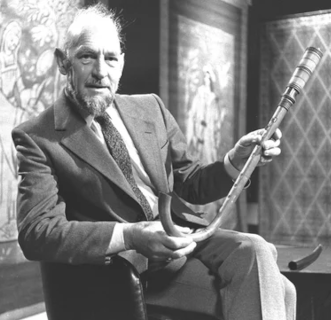
Best’s parents are Henry Best and Margaret Jane Best (née Irvine). His father is an excise officer working in Paisley, Renfrewshire, Scotland, at the time of his birth.
Best’s education takes place locally at Foyle College, a grammar school in County Londonderry which dates back to 1617, schooling children ages eleven to eighteen. Following his time at Foyle College, he does not attend university, however he is a member of the Irish Literary Society in London. Instead of attending university he works as a banking assistant for a time before an inheritance allows him to travel to Paris, France.
It is in Paris that Best meets, and becomes friends with, John Millington Synge, who recommends the lectures of Marie Henri d’Arbois de Jubainville at the Collège de France. He later goes on to translate and annotate Henri d’Arbois de Jubainville’s work, Le cycle mythologique irlandais et la mythologie celtique into The Irish Mythological Cycle and Celtic Mythology.
Upon returning to Dublin from Paris, Best becomes Honorary Secretary of the School of Irish Learning from its inception in 1903. It is incorporated into the Royal Irish Academy in 1926. He acts as joint editor of the school’s journal Ériu, and continues after the transfer of the journal to the Academy. In 1904, he joins the staff of the National Library of Ireland as an assistant director. He succeeds as Chief Librarian in 1924, and subsequently Library Director, a post he holds until 1940. Throughout his career, he becomes a prolific expert on Celtic studies, and is widely attributed to the survival and success of the subject as it is known today.
Best’s work earns him several accolades. He receives the Leibniz Medal of the Royal Prussian Academy in 1914, an honorary D.Litt. by the National University of Ireland in 1920, and an Honorary D.Litt. by Trinity College Dublin in 1923. In 1936, he is awarded the Medal of the Pontifical Academy of Sciences by Pope Pius XI for his facsimile edition of the Milan codex. He is elected as President of the Royal Irish Academy in 1942. His works, Bibliography of Irish Philology and of Irish Printed Literature (1913) and Bibliography of Irish Philology and Manuscript Literature, 1913-41 (1942), are considered to be some of his most important scholarly outputs.
Upon his retirement from the National Library, Best becomes a Senior Professor at the Dublin Institute for Advanced Studies (DIAS). He retires from the DIAS in 1947 at the age of seventy-five. From 1948 to 1956, he becomes chairman of the Irish Manuscripts Commission, a position previously held by Eoin MacNeill. While in this role, he supervises several facsimiles, including RIA MS 23 N 10, later renamed the Book of Ballycummin in 2019.
Following his retirement from the Irish Manuscripts Commission, Best spends much of the final three years of his life “sorting out his large correspondence,” much of which is currently held in the National Library. He also continues to publish new work throughout his later life. He works on a translation of the Book of Leinster alongside Osborn Bergin and Professor M. A. O’Brien, who takes over after Bergin’s death in 1950. The first fasciculus is published in 1954, the second in 1956 and the third in 1959. His work also appears in multiple academic journals, including Éiriu, and the Zeitschrift für celtische Philologie, Revue Celtique, Études Celtiques, Hermathena, The Dublin Magazine, and The Proceedings of the Royal Irish Academy. He also continues with his work in palaeography, including the last paper he completes on the Book of Armagh in 1958, which appeared in Éiriu vol. xviii. His aid in the writing of others is particularly visible in his surviving correspondence with George Moore.
Best marries his wife, Edith Best (née Oldham), in 1906, he being seven years her junior. She is the older sister of Charles Hubert Oldham, who goes on to become Professor of Economics at University College Dublin. She herself is a musician, a pianist, who had studied at the Royal College of Music in London. The couple has no children, and also claims to have no affiliation with any religion. Edith passes away at their home on March 9, 1950.
Best dies on September 25, 1959, at his home on 57 Upper Leeson Street in Dublin. The Richard I. Best Papers are currently held at the National Archives of Ireland and have been instrumental in the foundation of The Richard Irvine Best Memorial lecture. This discussion and celebration of Best’s work, organised by Richard Irvine Best Memorial Lecture Trust, has taken place since 1969.
Described as having an “ardent and self-confident manner,” Hughes is first heard of in an Irish musical capacity (beyond being honorary organist at St. Peter’s Church on Antrim Road at the age of fourteen) collecting traditional airs and transcribing folksongs in North Donegal in August 1903 with his brother Fred, Francis Joseph Bigger, and John Patrick Campbell. Dedicated to seeking out and recording such ancient melodies as are yet to be found in the more remote glens and valleys of Ulster, he produces Songs of Uladh (1904) with Joseph Campbell, illustrated by his brother John and paid for by Bigger. Throughout his career, he collects and arranges hundreds of traditional melodies and publishes many of them in his own unique arrangements. Three of his best-known works are the celebrated songs, My Lagan Love, She Moved Through the Fair, and Down by the Salley Gardens, which are published as part of his four collections of Irish Country Songs, his key achievement. These are written in collaborations with the poets Joseph Campbell and Padraic Colum, and W. B. Yeats himself. A dispute with Hamilton Harty over copyright on My Lagan Love is pursued on Bigger’s advice, but fails.
Hughes has a unique approach to arranging Irish traditional music. He calls upon the influence of the French impressionistClaude Debussy in his approach to harmony: “Musical art is gradually releasing itself from the tyranny of the tempered scale. […] and if we examine the work of the modern French school, notably that of M. Claude Debussy, it will be seen that the tendency is to break the bonds of this old slave-driver and return to the freedom of primitive scales.” He regards arrangements as an independent art form on an equal level with original composition: “[…] under his [i.e. the arranger’s] hands it is definitively transmuted into an art-song, an art-song of its own generation.” His folksong arrangements have been sung all across the English-speaking world. John McCormack and Kathleen Ferrier are the first to record them on gramophone records.
Hughes also composes a limited amount of original chamber music (a violin sonata is mentioned in a letter to Hughes from Bernard van Dieren dated April 4, 1932), and some scores for the stage (like And So to Bed by James Bernard Fagan) and film. Hughes and John Robert Monsell also create songs for a musical version of Richard Brinsley Sheridan‘s The Rivals called Rivals!, which is staged at the Kingsway Theatre in London in October 1935 by Vladimir Rosing and runs for 86 performances.
Married to Lillian Florence (known as Meena) Meacham and Suzanne McKernan, Hughes has three children: Patrick, known professionally as Spike Hughes, Angela and Helena. He dies in Brighton, England, at the relatively early age of fifty-four on May 1, 1937.
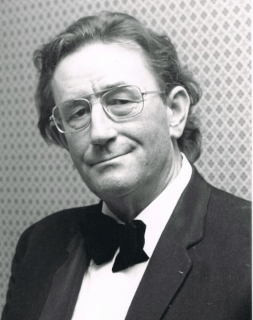
Brian Patrick Boydell, Irish composer whose works include orchestral pieces, chamber music, and songs, dies on November 8, 2000. He is Professor of Music at Trinity College Dublin for 20 years, founder of the Dowland Consort, conductor of the Dublin Orchestral Players, and a prolific broadcaster and writer on musical matters. He was also a prolific musicologist specialising in 18th-century Irish musical history.
Boydell is born on March 17, 1917, in Howth, County Dublin, into a prosperous Anglo-Irish family. His father James runs the family maltings business while his mother, Eileen Collins, is one of the first women graduates of Trinity College. Following their son’s birth, the Boydells move from Howth and live in a succession of rented houses before settling in Shankill, County Dublin. The young Boydell begins his formal education at Monkstown Park in Dublin and is subsequently sent to the Dragon School at Oxford, England. From there he goes to Rugby School, where he comes under the influence of Kenneth Stubbs, the music master. Although he later speaks of his resentment at the anti-Irish attitude he experiences at Rugby, he appreciates the very good education in science and music he receives there.
Having completed his secondary education, Boydell spends the summer of 1935 developing his musical knowledge at Heidelberg, Germany, where he writes his first songs and also studies organ. He wins a choral scholarship to Clare College, Cambridge, where, perhaps through parental pressure, he studies natural science, graduating in 1938 with a first-class degree.
Upon the outbreak of World War II, Boydell returns to Dublin and achieves further academic success in 1942 with a Bachelor of Music degree from Trinity College. He also takes further lessons in composition from John F. Larchet.
Boydell’s busy working life combines teaching, performing and composing. Following a brief stint in his father’s business, he plunges himself into Dublin’s classical music scene. In 1943, he succeeds Havelock Nelson as conductor of the Dublin Orchestral Players, beginning an association with the amateur orchestra that endures for a quarter of a century (until 1966). In 1944, he is appointed Professor of Singing at the Royal Irish Academy of Music, a position he holds for eight years. Along with fellow composers Edgar M. Deale, Aloys Fleischmann, and Frederick May he founds the Music Association of Ireland in 1948 as a vehicle to promote classical music throughout the country.
Boydell’s interest in Renaissance music, in particular the madrigal, leads in 1959 to founding the Dowland Consort, a vocal ensemble with which he performs for many years and records an LP. In 1962, having obtained a Doctorate in Music, he is appointed Professor of Music at Trinity College, a position he holds until 1982. He immediately revamps the course making it more relevant to the second half of the twentieth century. He also finds time to sit on the Arts Council throughout the 1960s, 70s, and early 80s.
Boydell’s communication skills combined with his infectious enthusiasm makes him a natural broadcaster. The appeal of his programmes on the history and performance of music, first on RTÉ Radio 1 and later on Telefís Éireann, go beyond a specialist audience and are, for many people, their introduction to a new world of aural pleasure.
Boydell has many interests beyond music. As a surrealist painter in the 1940s, having taken lessons from Mainie Jellett, he is a member of The White Stag Group. He is also passionate about cars and photography.
Following retirement from Trinity as Fellow Emeritus, Boydell devotes himself to musical scholarship, writing two books on the music of 18th century Dublin. He also contributes to The New Grove Dictionary of Music and Musicians.
Boydell dies at his home in Howth on November 8, 2000, at the age of 83 and in the company of his wife of 56 years, Mary (née Jones) and their sons, Cormac and Barra. A third son, Marnac, predeceases him.
Boydell is awarded several honorary titles in recognition of his services to music, including the Honorary Doctorate of Music from the National University of Ireland (1974), the Order of Merit of the Italian Republic (1983), the election to Aosdána, Ireland’s academy of creative artists (1984), and Honorary Fellowship of the Royal Irish Academy of Music (1990).
Potter is born in Belfast on September 22, 1918, to a Presbyterian family who, oddly, lives on the Falls Road, a republican (Catholic) stronghold. His father is a church organist and piano tuner who has been blind since childhood. His mother is, in Potter’s own words, “a raging alcoholic.” He escapes a rather grim childhood when he goes to live with an aunt in Kent, England.
Potter had already started composing chamber and vocal music before the war. Now, established in Dublin, he chooses the orchestra as his principal means of expression. His early pieces, such as Rhapsody under a High Sky and Overture to a Kitchen Comedy, show that he has absorbed Vaughan Williams’ pastoral style and his love of folk music. In 1952, both pieces are awarded Radio Éireann‘s “Carolan Prize” for orchestral composition by the adjudicatorArnold Bax. A year later Potter repeats this success when his Concerto da Chiesa, a concerto for piano and orchestra, also wins the Carolan Prize.
In 1955 Potter is appointed Professor of Composition at the Royal Irish Academy of Music, where he becomes an effective administrator and inspiring teacher.
In the 1960s, Potter turns to ballet, writing four orchestral scores for the Cork Ballet company. The first of these, Careless Love, becomes the composer’s own favourite of all his compositions. Several years later, following a successful battle with alcoholism, he writes what some regard as his magnum opus, Sinfonia “de Profundis” (1969). The première is given at the Gaiety Theatre, Dublin on March 23, 1969, in a performance by the RTÉ Symphony Orchestra under the baton of Albert Rosen. The Irish Times refers to the concert as a “major national event.” In December 1969, he receives a Jacob’s Award for the composition.
Potter’s last substantial work, an opera entitled The Wedding, receives its first public performance in Dublin in 1981, almost a year after his death.
Potter dies suddenly at his home in Greystones, County Wicklow on July 5, 1980, at the age of 61. He is buried in the nearby Redford cemetery.
Potter is born to a Presbyterian family who, oddly, lives on the Falls Road, a republican (Catholic) stronghold. His father is a church organist and piano tuner who has been blind since childhood. His mother is, in Potter’s own words, “a raging alcoholic.” He escapes a rather grim childhood when he goes to live with an aunt in Kent, England.
Potter had already started composing chamber and vocal music before the war. Now, established in Dublin, he chooses the orchestra as his principal means of expression. His early pieces, such as Rhapsody under a High Sky and Overture to a Kitchen Comedy, show that he has absorbed Vaughan Williams’ pastoral style and his love of folk music. In 1952, both pieces are awarded Radio Éireann‘s “Carolan Prize” for orchestral composition by the adjudicatorArnold Bax. A year later Potter repeats this success when his Concerto da Chiesa, a concerto for piano and orchestra, also wins the Carolan Prize.
In 1955 Potter is appointed Professor of Composition at the Royal Irish Academy of Music, where he becomes an effective administrator and inspiring teacher.
In the 1960s, Potter turns to ballet, writing four orchestral scores for the Cork Ballet company. The first of these, Careless Love, becomes the composer’s own favourite of all his compositions. Several years later, following a successful battle with alcoholism, he writes what some regard as his magnum opus, Sinfonia “de Profundis” (1969). The première is given at the Gaiety Theatre, Dublin on March 23, 1969 in a performance by the RTÉ Symphony Orchestra under the baton of Albert Rosen. The Irish Times refers to the concert as a “major national event.” In December 1969, he receives a Jacob’s Award for the composition.
Potter’s last substantial work, an opera entitled The Wedding, receives its first public performance in Dublin in 1981, almost a year after his death.
Potter dies suddenly at his home in Greystones, County Wicklow on July 5, 1980, at the age of 61. He is buried in the nearby Redford cemetery.