seamus dubhghaill

Promoting Irish Culture and History from Little Rock, Arkansas, USA


Leave a comment

Death of Noel Sheridan, Painter & Actor

Cecil Noel Sheridan, influential Irish painter, performance artistinstallation artist and actor, dies on July 12, 2006, in Perth, Western Australia. He is known for his abstract landscapes and conceptual art, with a significant impact on art institutions in Ireland and Australia.

Sheridan is born in Dublin on December 12, 1936, to Cecil Brinsley Sheridan, a noted comic actor, and Ann ‘Nan’ Doyle. He attends Synge Street CBS and later pursues a Bachelor of Commerce (BCom) at Trinity College Dublin, while also joining the Trinity Players drama group, reflecting his early interest in both theatre and visual arts. He later earns a Master of Fine Arts from Columbia University in New York City in 1967, where he is influenced by the emerging conceptual art movement.

Sheridan begins exhibiting in the late 1950s, participating in the annual Living Art exhibitions and the Biennale de Paris in 1960. He wins the Carroll Prize for Painting in 1965 and 1969. Initially focused on abstract landscapes, his work evolves to include conceptual, performance, and installation art, integrating multimedia elements. Notable works include Everybody Should Get Stones (1975) and On Reflection (2001).

Sheridan is also deeply engaged in the international art scene. He represents Ireland at the 1962 UNESCO Convention of Young Painters in Paris and contributes to avant-garde movements in Australia, including serving as the first Professor of Conceptual Arts in Sydney during the 1970s. He directs the Experimental Art Foundation in Adelaide from 1975 to 1980, introducing experimental and post-object art to Australian audiences.

From 1980 to 2002, Sheridan serves as Director of the National College of Art and Design (NCAD) in Dublin, with a four-year hiatus to direct the Perth Institute of Contemporary Arts in Australia. His leadership shapes art education in Ireland and helps modernize institutional structures, curricula, and multimedia practices.

Sheridan is also a member of Aosdána, an elite Irish association of artists, and a committee member of Rosc, an important art exhibition initiative in Ireland.

Sheridan’s early works consist of abstract and lyrical landscapes, which later expand to include conceptual and performance art, often engaging audience participation and multimedia formats. He is known for his wit, charisma, and generosity as both a teacher and an arts administrator, influencing a generation of artists in Ireland and Australia.

Sheridan’s art is represented in major institutions, including the Irish Museum of Modern Art and the Centro de Arte Moderna Gulbenkian in Lisbon, with numerous works having been sold at auction, achieving prices up to $7,624 USD for pieces like Window. Retrospectives of his work are held at the Royal Hibernian Academy in Dublin in 2001, accompanied by publications that compile his artistic philosophy and contributions.

Sheridan is married to Liz Murphy, and they have five children. His commitment to both art and education continues throughout his life until he dies on July 12, 2006, in Perth, Western Australia. Paul Durcan writes a poem in his honour after his death.

In summary, Sheridan’s career spans painting, performance, installation, and education. His innovative approach, international influence, and dedication to teaching and institutional development mark him as a pivotal figure in postwar and contemporary Irish art.

Leave a comment

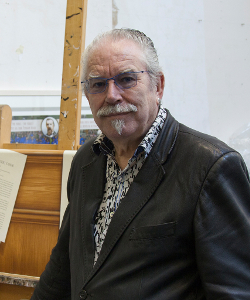
Birth of Robert Ballagh, Artist, Painter & Designer

Robert “Bobby” Ballagh, artist, painter and designer, is born in Dublin on September 22, 1943. His painting style is strongly influenced by pop art. He is particularly well known for his hyperealistic renderings of well-known Irish literary, historical or establishment figures.

Ballagh grows up in a ground-floor flat on Elgin Road in Ballsbridge, the only child of a Presbyterian father and a Catholic mother. He studies at Bolton Street College of Technology and becomes an atheist while attending Blackrock College. Before turning to art as a profession, he is a professional musician with the Irish showband Chessmen. He meets artist Michael Farrell during this period, and Farrell recruits him to assist with a large mural commission, which is painted at Ardmore Studios.

Ballagh represents Ireland at the 1969 Biennale de Paris. Among the theatre sets he has designed are sets for Riverdance, I’ll Go On, Gate Theatre (1985), Samuel Beckett‘s Endgame (1991) and Oscar Wilde‘s Salomé (1998). He also designs over 70 Irish postage stamps and the last series of Irish banknotes, “Series C,” before the introduction of the euro. He is a member of Aosdána and his paintings are held in several public collections of Irish painting including the National Gallery of Ireland, the Hugh Lane Gallery, the Ulster Museum, Trinity College, Dublin, and Nuremberg‘s Albrecht Dürer House.

In 1991, he co-ordinates the 75th anniversary commemoration of the 1916 Easter Rising, during which he claims he is harassed by the Special Branch of the Garda Síochána.

He is the president of the Ireland Institute for Historical and Cultural Studies, which promotes international republicanism. It is based at the new Pearse centre at 27 Pearse Street, Dublin, which is the birthplace of Pádraig Pearse in 1879.

In July 2011 it is reported that he might consider running for the 2011 Irish Presidential election with the backing of Sinn Féin and the United Left Alliance. A Sinn Féin source confirms there has been “very informal discussions” and that Ballagh’s nomination is “a possibility” but “very loose at this stage.” However, on July 25 Ballagh rules out running in the election, saying that he has never considered being a candidate. His discussions with the parties had been about the election “in general” and he has no ambitions to run for political office.

That same month, Ballagh breaks ranks with his colleagues in the travelling production of Riverdance in their decision to perform in Israel. He is an active member of the Ireland Palestine Solidarity Campaign, which insists that artists and academics participate in boycotts of Israeli businesses and cultural institutions.

In July 2012, Ballagh says he is “ashamed and profoundly depressed” at the en masse closure of Irish galleries and museums. He cites an example of some Americans and Canadians on holiday in Ireland. “They described most of the National Gallery as being closed along with several rooms in the Hugh Lane Gallery. I’m glad they didn’t bother going out to the Museum of Modern Art in Kilmainham because that’s closed too. At the point I met them, they were returning from Galway where they had found the Nora Barnacle Museum closed too.” He condemns the hypocrisy of political leaders, saying, “I know arts funding is not a big issue for people struggling to put food on the table, but we are talking about the soul of the nation.”