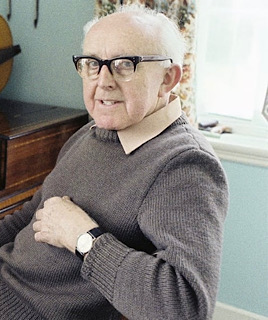
Cathal Gannon, harpsichord maker, a fortepiano restorer and an amateur horologist, dies on May 23, 1999.
Gannon is born on August 1, 1910, in Harold’s Cross, Dublin, into a craftsmen family of carpenters, many of whom worked in the famous Guinness Brewery. His education, in two local schools, is rudimentary and at the age of fifteen he starts working as an apprentice carpenter in the Guinness Brewery. His apprenticeship involves learning to make office furniture and attending evening classes in nearby colleges, where he is able to improve his education in a more congenial atmosphere. A love of music and the arts had been encouraged by two maiden aunts. His parents subsequently purchase an upright piano and he learns to play it at the Read Pianoforte School. When his apprenticeship is completed and he is on the dole for some years, he spends much of his spare time buying pictures, books, antiques and old clocks and watches in the various auction rooms and antique shops in Dublin.
During the mid-1930s, Gannon becomes a member of several Dublin-based societies, most notably the Old Dublin Society, and there befriends well-known people such as Grace Plunkett (née Gifford), the widow of Joseph Mary Plunkett, who had been executed following the Easter Rising of 1916. At around this time, he is also introduced to Carl Hardebeck, an arranger of Irish traditional music. At a later stage in his life, he meets Desmond Guinness and his wife Mariga, founders of the Irish Georgian Society, which he subsequently joins.
While reading a series of articles about Tibet in a magazine, Gannon stumbles across an article, which, he believes, is by Violet Gordon-Woodhouse, a British harpsichordist and clavichord player of the period. The article is about the revival of the harpsichord, which interests him. He asks permission to examine the harpsichords on display in the National Museum of Ireland, Dublin, but is given no encouragement by the staff. He is finally allowed to see the instruments when he is in his early twenties. Dismayed, he concludes that they are too expensive to buy and too complicated to make.
While on holidays in Glengarriff in the Beara Peninsula of County Cork during August 1936, Gannon meets his future wife, Margaret Key from Harrow, London. They marry in 1942.
In London with Margaret, who is visiting her parents, Gannon goes to the Benton Fletcher collection of keyboard instruments, which is then in Chelsea, and measures a harpsichord by Jacob and Abraham Kirckman. Back home, he makes a copy of the instrument in a tiny conservatory at the back of his house in the Dublin suburb of Rialto. The harpsichord is played by John S. Beckett for the first time in public in 1959 as the continuo for Johann Sebastian Bach‘s St. Matthew Passion and is praised in the national press. Beckett subsequently persuades the authorities in the Guinness Brewery to provide Gannon with a special workshop, in which he makes five harpsichords and restores several antique pianos. The first harpsichord made in the Brewery is donated to the Royal Irish Academy of Music in Dublin. The second is sold to Harrods of London, and the third is sold to Ireland’s national radio and television station RTÉ. This third instrument is used regularly by the RTÉ Symphony and Concert orchestras and also by the well-known composer and performer of Irish traditional music, Seán Ó Riada.
Gannon continues to make many more harpsichords and restore more pianos during the years to come. In all, he completes twenty harpsichords during his lifetime – the final four are completed by a friend, Patrick Horsley, in England. One of the harpsichords made by Gannon-Horsley returns to Ireland and is presented to NUI Maynooth. A piano of note that he restores is a Broadwood square piano owned by the poet and composer, Thomas Moore, which belonged to Lord and Lady Elveden (later Iveagh).
Gannon is the subject of several RTÉ radio programmes, three RTÉ television programmes (including The Late Late Show) and a television programme, Gallery, made by BBC Northern Ireland. He befriends a great many people, including the artist, writer and conservationist Peter Pearson, and regular musical evenings are held at the family home in Bryan Guinness‘s grounds in the suburbs of Dublin. Because of his interest in antique clocks and watches, he becomes a member of the Irish branch of the Antiquarian Horological Society, founded by his friend William Stuart.
In 1978, Trinity College Dublin (TCD) gives Gannon an honorary MA degree for his contribution to the authentic performance of early music in Ireland. Two years later, he is invited to travel with the New Irish Chamber Orchestra to China, where he tunes and maintains one of his harpsichords and celebrates his seventieth birthday. In 1989, a second honorary MA is given to him, this time by NUI Maynooth.
Following Gannon’s 80th birthday, which is attended by fifty people, he finally settles down to retirement. A series of minor strokes follow, which eventually lead to dementia and ultimately to his death, aged 88, on May 23, 1999.
The Cathal Gannon Early Music Room is opened in the Royal Irish Academy of Music in May 2003. It contains a harpsichord and clavichord made by Gannon, a Broadwood grand piano restored by him, and a square piano.
Part of a transmitted RTÉ programme, Nationwide (January 17, 2007), features archive footage of Gannon and his instruments. Three RTÉ radio programmes, Bowman: Sunday Morning, broadcast in November 2006, feature a 1983 interview with Gannon.