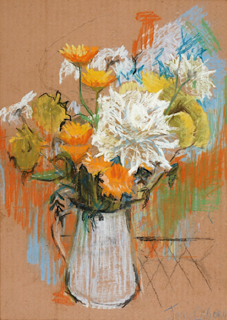
Osborne (née Meikle) is born on February 21, 1926 in Larne, County Antrim, the daughter of William Meikle who is a fitter at Harland & Wolff. She displays artistic talent from a young age, recognized at 20 by painter Paul Nietsche, and earns a scholarship from the Ministry of Education to pursue further studies. She trains at the Camberwell School of Arts & Crafts in London and later completes her National Diploma in Art and Design at the Belfast School of Art.
Osborne’s early career includes exhibitions in Belfast, London, and prominent Canadian galleries after she emigrates to Canada with her husband, fellow artist Dennis H. Osborne, in 1953. She exhibits works such as The Harmonica Player, a portrait of poet Barbara Hunter, and other pieces across Canada, gaining recognition for her skill in landscapes, portraits, and abstract forms.
Declining health due to a brain tumour forces Osborne to return to Northern Ireland in 1959. She settles first in Portadown and later in Lisburn, where she continues to paint despite her illness. She participates in exhibitions, including those of the Royal Ulster Academy of Arts and local art societies, maintaining her influence on the Northern Irish art scene.
Osborne dies at the age of 39 on July 9, 1965, in Lisburn Hospital due to complications from a brain tumour, which had been a long-standing health struggle. She leaves behind her husband, Dennis, and their daughter, Moya. Posthumously, her work is celebrated in memorial exhibitions, including those organized by the Arts Council of Northern Ireland and the Ulster Society of Women Artists, and several of her paintings, like Roots and Grief, are preserved in the Ulster Museum and Armagh County Museum.
Osborne is remembered as a gifted painter whose contributions to mid-20th-century art in both the United Kingdom and Canada reflect emotional depth, modernist abstraction, and a commitment to capturing natural forms, despite her life and career being cut tragically short.
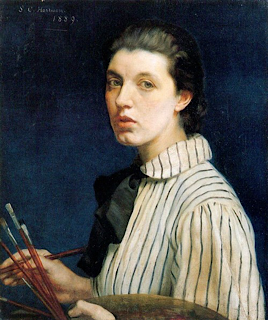
Harrison’s brother, Henry, is a supporter of Charles Stewart Parnell and a Member of Parliament for Mid Tipperary. She herself becomes the first female city councillor for Dublin Corporation in 1912. She campaigns to have poor relief extended to the able-bodied unemployed and works to promote women’s rights. She is closely involved in Hugh Lane‘s efforts to establish a gallery of modern art in Dublin.
For some 30 years Harrison is part of social reform and women’s rights in Ireland. In 1912 she is the first woman to be elected to the Dublin City Council. Here she works closely with Alderman Alfie Byrne. She is also recognised for her prominent place in the suffrage victory procession and escorting Anna Haslam to vote in the Williams Street Courthouse, Dublin, in the 1918 United Kingdom general election.
Following Hugh Lane’s death on the RMS Lusitania in 1915, Harrison claims that they had been engaged to be married. Her 1914 portrait of Lane is one of her best-known works. She never marries.
Harrison dies on July 23, 1941, in Drumcondra, Dublin. She is buried in Mount Jerome Cemetery, the inscription on her gravestone reads “Artist and Friend of the Poor.”
Elvery is the second among seven children of William Elvery , merchant, and Theresa Elvery (née Moss), singer and music teacher, whose parents are English Quakers. Her father’s ancestors were silk merchants from Spain, called Alvarez. Her early childhood is spent in Carrickmines, County Dublin. In 1896 the family moves to Foxrock and she attends the Dublin Metropolitan School of Art. Her mother’s family is artistic – one aunt is the artist Phoebe Anna Traquair – and she and her sisters are talented artists and singers. Her younger sister, Dorothy Kay, becomes a noted portrait painter in South Africa. At the age of sixteen, she wins a three-week scholarship to study at the Royal College of Art in South Kensington, London. Back in Dublin, she models for William Orpen, then teaching in the school. They become friends, and she regrets never studying painting under him. She concentrates on sculpture under John Hughes and has great success, winning the Taylor scholarship three years in a row (1901–03). The first year she wins, the judges, seeking evidence that she had worked unaided, asks her to model a head from life in their presence.
Elvery’s first exhibit in the Royal Hibernian Academy (RHA) is a bronze statuette of a boy in 1902. Thereafter she is a lifelong exhibitor with the RHA, showing almost annually until her death. Friendship with the older Sarah Purser introduces her to Dublin’s artistic milieu and to the arts and crafts movement. In the movement’s 1904 exhibition she shows ten items, including terracotta statuettes, a holy water stoup, and a plaster cast of a lectern, which is cast in bronze in Paris that year and placed in her former parish church in Carrickmines. The movement’s historian, Paul Larmour, calls this lectern “a remarkable piece of organic Art Nouveau . . . There is nothing else like it in Ireland.”
In 1904, after a brief period studying in Paris with her sister and fellow students Estella Solomons and Frances “Cissie” Beckett, Elvery takes lessons in stained glass from Alfred E. Child, and is then persuaded by Purser to join her Tower of Glass (An Túr Gloine) studio. She remains six years, executing windows for St. Stephen’s Church, Mount Street, Dublin; St. Nicholas Church, Carrickfergus; and a war memorial at the Church of Ireland church, Carrickmines. Although her work is generally well received, she does not rate her skill in the medium highly – “I never got the right feeling for glass or the detached, austere quality necessary for ecclesiastical art” – and her window for a Gortconvent leads to a critical review of Purser’s studio by W. B. Yeats. She does not, however, confine herself to glass but also designs for silversmiths and illustrated books for children. For Iosagán agus Sgealta Eile (1907), by Patrick Pearse, she provides a black-and-white frontispiece and four colour illustrations. For the Cuala Press, run by Lily and Elizabeth Yeats, she designs calendars, Christmas cards, and fifteen hand-coloured prints, which continue to be issued until after World War II.
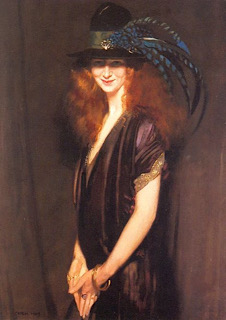
Elvery’s social life in Dublin is busy. An active member of the United Arts Club, she is called by Lady Gregory “the beautiful Miss Elvery,” and Orpen’s portrait, showing her long-necked, graceful, and vivacious, bears out this description. Tiring of glass, and wishing to become a painter, she leaves in 1910 for the Slade School of Fine Art in London. There Henry Tonks is less complimentary than her Dublin teachers. He finds her work facile: “The speed, the slickness, the skill. It is horrible!” Orpen also comes to this view: “her only fault was that the transmission of her thoughts from her brain to paper or canvas, clay or stained glass, became so easy to her that all was said in a few hours. Nothing on earth could make her go on and try to improve on her first translation of her thought.”
Back in Dublin, Elvery takes a studio in Kildare Street and teaches for a time in the Metropolitan School of Art, before her parents arrange a marriage with Charles Henry Gordon Campbell, eldest son of the future Lord Chancellor of Ireland, James Campbell. They marry on August 1, 1912, and move to London where he is called to the English bar. It is not initially a love match but they are well-suited – he likes artistic, Bohemian circles and they become friends with D. H. and Frieda Lawrence, the painter Mark Gertler, the publisher John Middleton Murry, and his wife, the writer Katherine Mansfield, who describes Campbell as “a queer mixture for she is loving and affectionate, and yet she is malicious.”
Campbell’s husband becomes secretary of the Department of Industry and Commerce in the Irish Free State and in 1922 the family moves to Clonard, Terenure, Dublin. His government position means that within six months the house is burned down by anti-Treatyites, who are, however, almost comically accommodating – local men, they express distress at the job and allow her to save the children’s Christmas presents. In 1931 she becomes Lady Glenavy after her husband succeeds to his father’s title, an important member of Dublin’s social and artistic scene. She helps establish the Dublin Drama League and assists Shelah Richards in the production of two plays in 1936. Her friendships are wide and varied and her conversation imaginative and engaged. Dressed in beige – what her son calls “variations on a theme of porridge” – she entertains constantly. Her house has what she terms a “caravanserai” character and is constantly full of people.
Appointed an associate of the RHA in 1932, Campbell becomes a full member in 1934 and takes her turn at teaching. She also joins the more radical Society of Dublin Painters and holds in February 1935 a one-person show at their premises, 7 Stephen’s Green, but she never shows with the Irish Exhibition of Living Art, though her work is more avant-garde than that of most academicians. At its best in still lifes and figure compositions, her work has “a sense of drama and an enigmatic or near-surrealist appearance.” Brian Kennedy notes that she is the first Irish painter to go surrealist (though she never thinks of herself in this way) and although she is serious about her work – taking lessons at an advanced age from Patrick Hennessy – she is also diffident. Her memoir does not trace her development as an artist and mentions only one work with approbation – The Intruder (exhibited at the RHA in 1932). Now in the National Gallery of Ireland, it depicts in bold, rich colours a female centaur beckoning a young man from a group of picnickers. It immediately attracts attention. Richard Orpen wants the academy to buy it, but they think it obscene.
About 1941 the Campbells move to a large Georgian house in Rathfarnham, and twenty years later they transfer to a smaller house in Sandycove. After her husband’s death in 1962, she publishes her memoirs, And Today We Will Only Gossip (1964). The title is well chosen as the book is not self-revelatory but full of characters she encountered. Monk Gibbon calls her a “unique mixture: of talent and diffidence; of gregariousness and contempt for the herd; of gentle consideration and a savage determination to wound. Only those who knew her well knew her at all; and even to them she remained something of a mystery” (The Irish Times, December 2, 1980).
Campbell dies in Dublin on May 21, 1970, and is survived by her two sons, the writer and humorist Patrick Campbell and the novelist Michael Campbell, and predeceased by her daughter, Bridget, an Irish international lacrosse player and talented scientist, who is killed by a bomb during the London blitz.
(From: “Campbell, Beatrice Moss” by Bridget Hourican and Pauric J. Dempsey, Dictionary of Irish Biography, http://www.dib.ie, October 2009 | Pictured: “Bridgit – a picture of Miss Elvery (Beatrice Elvery),” oil on canvas by William Orpen, 1909)
Conor is born on May 9, 1881, in Fortingale Street, Belfast, the third son and fourth child of William Connor, a tinsmith and sheet metal worker, who later becomes a gas fitter, and Mary Connor (née Wallace). He is educated at the Clifton Park central national school, where his artistic abilities are noticed by his music teacher. In 1894, he enrolls at the Belfast government school of design. He is a very successful student, and by 1903 has become an assistant teacher. He completes his studies in 1904, and begins an apprenticeship with the Belfast firm of lithographers, David Allen and Son. Through his work in the poster design department he develops an enthusiasm for using crayons on a textured surface. This becomes a characteristic feature of his later drawings. In these early years he first starts recording images of Belfast life, often sketched from behind a folded newspaper in the street. Influenced by the Gaelic revival, in the years 1907–9 he signs his name in several different ways such as “Liam” and “Liam Conor.” In later years he signs himself simply “Conor.”
Having abandoned his career as a lithographer around 1910, Conor concentrates his efforts on painting professionally. He begins exhibiting with the Belfast Art Society in 1910, and in the period that follows he spends time in Craigavad, County Down, the Blasket Islands in County Kerry, Dublin, and Donegal. During a visit to Paris, which he later recalls as being in 1912 and 1913, he meets the painter André Lhote. After his return to Belfast he is elected to the committee of the Belfast Art Society in 1913. On the outbreak of World War I, he is commissioned by the British government to record the everyday activities of munitions workers and soldiers in Ulster. His pictures mostly show soldiers in training and various scenes from the home front, including the work of women in munitions factories and hospitals. Described as “vigorous and personable, if rather folksy . . . effectively uniformed versions of the tinkers and shipyard workers for which he subsequently became known,” these paintings are exhibited and subsequently, in 1916, auctioned for the Ulster Volunteer Patriotic Fund. His long association with the Royal Hibernian Academy (RHA) begins in 1918 and he shows up to 200 works at the academy over the next forty-nine years.
In 1921, Conor moves to London, where he becomes acquainted with, among others, Sir William Orpen, Sir John Lavery, and Augustus John. He becomes a member of the Chelsea Arts Club, and contributes four paintings to the National Portrait Society as part of its spring exhibition in 1921. His friendship with Lavery is significant. Through him Conor receives a commission to paint the opening of the first Northern Ireland parliament in June 1921. He goes on to exhibit with a variety of influential bodies, including the Royal Academy of Arts, the Société Nationale des Beaux-Arts in Paris, and the Royal Society of Portrait Painters. In 1922, The Twelfth, executed c.1918, is shown in the Galerie Barbazanges in Paris, under the title Le cortège Orangiste à Belfast, as part of the World Congress of the Irish Race. He is represented at the Paris salon in 1923 and the following year he has a successful exhibition at the St. Stephen’s Green Gallery, Dublin.
In 1926, Conor travels to Philadelphia and New York, where, during his nine-month stay, he receives numerous commissions for portraits and has work shown in the Babcock Galleries, the Brooklyn Art Gallery, and the American Irish Historical Society. In 1932, he designs the costumes for the principals in the Pageant of St. Patrick, which marks the 1,500th anniversary of the saint’s coming to Ireland. That year also sees the unveiling of his muralUlster Past and Present at the Belfast Municipal Museum and Art Gallery. Measuring 2.8 by 7.4 metres, it is at the time the largest mural in the country. During World War II he is again appointed an official war artist and his work is represented at the exhibition of war artists at the National Gallery, London, in 1941. His book The Irish Scene is published in 1944, and though it sells well, the subsequent bankruptcy of his publishers mean that Conor receives no royalties. He also provides the illustrations for books by Lynn C. Doyle, the pseudonym of his friend Leslie Montgomery.
Although Conor is best known for his depictions of the everyday life of people in his native Belfast, in which he attempts to capture the “flash of humour which lightens their daily toil,” he also produces landscapes and portraits. His sitters included Douglas Hyde, St. John Greer Ervine, Charles D’Arcy, and Charles Vane-Tempest-Stewart, 7th Marquess of Londonderry. The Council for the Encouragement of Music and the Arts organises several successful Conor exhibitions. Their one-man show of 1945 becomes the first to tour the province, while their exhibition of his work in 1954 has an attendance in excess of 2,800. Conor closes his long-established studio on Stranmillis Road in 1960 but continuea to exhibit, notably with the Bell Gallery in 1964, 1966, and 1967.
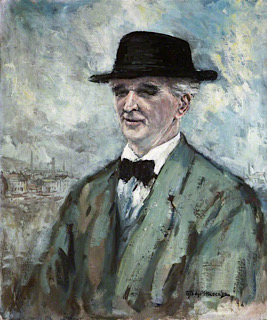
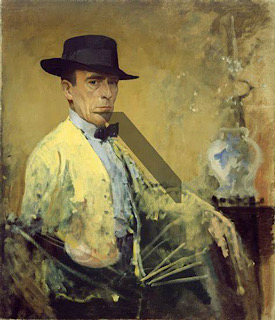
(From: “Conor, William” by Frances Clarke, Dictionary of Irish Biography, http://www.dib.ie, October 2009 | Pictured: “William Conor,” oil on canvas by Gladys Maccabe, Ulster Folk Museum)
Marrinan becomes ill with infantile paralysis at the age of five, and as a result is tutored privately. He has no formal training in art but is largely influenced by his reading matter, particularly the American comic strips of Bud Fisher. The variety of facial expressions that Fisher can achieve, with only a pencil, intrigues and inspires him. Likewise, the images evoked by Celtic mythology and religious art also contributes to his visual language, and many hours are spent in the Belfast Museum and Art Gallery studying the paintings in their collection.
Marrinan exhibits with the Ulster Academy of Arts from an address at 524 Donegall Road, Belfast, entering “The Wee Gate, Earl Street, Belfast” (1931) and “The Painter’s Father” and the “Apache” (1934), which is judged “picture of the year.” He last exhibits with a landscape, “Connemara,” along with four other works in 1949.
Marrinan paints and sketches portraits of many notable Irish figures, among which is the charcoal drawing of northern Fenian Robert Johnston (1934; National Gallery of Ireland) and a sketch of the Donegal storyteller Niall Duffy (University College Dublin). His literary portraits include one of Brian Friel. He holds a one-man show in 1951 at 55a Donegall Place, Belfast, where he exhibits a bust of John McLaverty. He takes an interest in sculpture although painting and drawing remain his preferred form of expression. Important commissions are for a memorial portrait (completed 1952) of Éamonn Ceannt for Ceannt Barracks officers’ mess, Curragh Camp, County Kildare, and for a portrait of Vice-brigadier Peadar Clancy for Clancy Barracks, Dublin. He paints two memorial portraits of PresidentJohn F. Kennedy, one of which is in the Irish Club, London.
Marrinan is an honorary member of the Royal Ulster Academy and exhibits with them every year from 1950 onward, showing a portrait of Mrs. Padraig Marrinan in 1967 (no other details of his marriage are known). He is preparing for an exhibition to be held at the Irish Club, London, in 1974, but dies on October 25, 1973, at Tyrone County Hospital in Omagh. He is then living at James Street, Omagh.
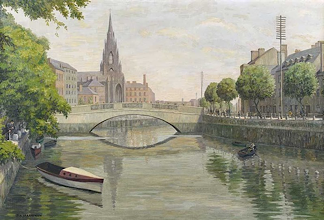
(From: “Marrinan, Padraig H.” by Ruth Devine, Dictionary of Irish Biography, http://www.dib.ie, October 2009 | Pictured: “The River Lee, Cork City, Ireland” by Padraig Marrinan, oil on canvas)
Whelan is awarded many prizes in the Royal Dublin Society (RDS) Taylor art competitions, including one in 1912 for a portrait of his sister Lena, entitled On the Moors, rendered in a strongly academic technique. In 1916, he wins the Taylor scholarship for the Royal Hibernian Academy (RHA) schools for his finest early work, The Doctor’s Visit, an adroitly executed composition of contrasting shadows and light. Typical of many of his genre interiors, the painting depicts a room in the family home, with relatives as models: Whelan’s mother sits by the bed watching over his ill cousin, while his sister, dressed in a Mater hospital nurse’s uniform, is in the background opening the door for the doctor. The subtly evoked atmosphere of restrained emotion foreshadowed a hallmark of his mature style.
Whelan exhibits annually at the RHA for forty-five years (1911–56), averaging six works per year. He is elected an RHA associate in 1920, becoming a full member in 1924. He participates in the Exposition d’art irlandais at the Galerie Barbazanges in Paris in 1922. A visiting teacher at the RHA schools in 1924, he also teaches in the DMSA for a time. He has studios at 64 Dawson Street (1914–27) and 7 Lower Baggot Street (1931–56). Beginning in the 1910s, he receives regular commissions for portraits, constituting his primary source of income. Having become the family’s main breadwinner following his parents’ deaths in the 1920s, he concentrates most of his production on this lucrative activity, portraying numerous leading figures in the spheres of politics, academia, religion, society, medicine, and law.
Situated securely in the academic tradition, in most of his portraits Whelan favours a sombre, restricted palette, with the sitter placed, in grave demeanour, against a monotone background with few accessories. In a 1943 interview he asserts that twentieth-century portraiture suffers from the drabness of modern costume, for which the artist must compensate by careful rendition of the subject’s hands. He tends to depart from his prevailing portrait style when painting women, whom he characteristically depicts in meticulously observed interiors, a notable example being his portrait of Society hostess Gladys Maccabe (c.1946; NGI).
Whelan’s commercial concentration on portraiture notwithstanding, he expresses his true talent in genre compositions, especially kitchen interiors, in which he emulates the technique of the Dutch painter Johannes Vermeer. Two of the most accomplished of these depict his sister Frances in the basement kitchen of the family home: The Kitchen Window (1927; Crawford Art Gallery, Cork) demonstrates a particularly skillful use of light, while Interior of a Kitchen (1935) is notable for the dexterous handling of objects of varied shapes and textures. His genre works include both urban and rural scenes, with a distinctive interest in portraying occupations and other activities. Gypsy (1923), an Orpenesque composition of a shawled woman in a west-of-Ireland landscape with a caravan in the background, receives wide contemporary critical acclaim. Jer (c.1925), depicting a man seated by the fire in a cottage interior, is reproduced in J. Crampton Walker’s Irish Art and Landscape (1927). The Fiddler (c.1932), a naturalistic, sensitively characterised study, is first shown at an Ulster Academy exhibition at Stranmillis, Belfast. A Kerry Cobbler is reproduced in Twelve Irish Artists (1940), introduced by Thomas Bodkin, as among the works denoting the development of a distinctively Irish school of painting.
In 1929, Whelan designs the first Irish Free State commemorative stamp, a portrait of Daniel O’Connell for the centenary of Catholic emancipation. Commissioned by the Thomas Haverty trust to paint an incident from the life of Saint Patrick for the 1932 Eucharistic Congress, he executes The Baptism by St. Patrick of Ethna the Fair and Fedelmia the Ruddy, Daughters of the Ard Rí Laoghaire, a work highly conservative in style. He rapidly completes an oil study of the papal legate, Lorenzo Lauri, also for the Eucharistic Congress. He is represented in the art competitions at the 1932 Summer Olympics in Los Angeles. His depiction of Saint Brigid, shown at the Academy of Christian Art exhibition (1940), becomes a familiar image owing to the wide circulation of reproductions.
Whelan’s political portraits are influential in creating a strong, assured image of the newly formed Irish state, and thus retain an historical significance. His posthumous portrait, The Late General Michael Collins, exhibited at the RHA in 1943 and now held in Leinster House, is an iconic, heroic image of the fallen leader. His portraits of Arthur Griffith and Kevin O’Higgins – commissioned posthumously, as is the Collins, by Fine Gael – also hang in Leinster House, while that of John A. Costello, exhibited at the RHA in 1949, is now held in the King’s Inns, Dublin. He paints two presidents, Douglas Hyde and Seán T. O’Kelly, both works currently in Áras an Uachtaráin. A portrait of Éamon de Valera, painted in 1955 when the sitter is Leader of the Opposition, is in Leinster House. In 1954, he designs a second commemorative stamp, picturing a reproduction of a portrait bust of John Henry Newman, to mark the centenary of the Catholic University of Ireland.
Whelan is elected an honorary academician of both the Ulster Academy of Arts (1931), and the Royal Ulster Academy (1950). He becomes a member of the United Arts Club in 1934. As a representative of the RHA, he sits on the board of governors of the National Gallery of Ireland for many years, and is on the advisory committee of the Municipal Gallery of Modern Art. Unmarried, he resides until his death at the Eccles Street address, with two sisters who continue to manage the family hotel. He dies on November 6, 1956, from leukemia at the Mater private nursing home in Dublin. He is buried in Glasnevin Cemetery.
(From: “Whelan, (Michael) Leo,” by Carmel Doyle, Dictionary of Irish Biography, http://www.dib.ie, October 2009)
Charles Jervas, Irish portrait painter, translator, and art collector of the early 18th century, dies at his home at Cleveland Court, London, on November 2, 1739.
Born in Shinrone, County Offaly, around 1675, Jervas is one of seven children (five sons and two daughters) of John Jervas of Clonlisk, Shinrone, and his wife Elizabeth, daughter of Captain John Baldwin, High Sheriff of County Offaly, of Shinrone. He studies in London as an assistant under Sir Godfrey Kneller between 1694 and 1695.
After selling a series of small copies of the Raphael Cartoons around 1698 to Dr. George Clarke of All Souls College, Oxford, the following year, he travels to Paris and Rome (while financially supported by Clarke and others) remaining there for most of the decade before returning to London in 1709 where he finds success as a portrait painter.
Painting portraits of the city’s intellectuals, among them such personal friends as Jonathan Swift and the poet Alexander Pope, both of which are now in the National Portrait Gallery, London, Jervas becomes a popular artist often referred to in the works of literary figures of the period.
Jervas gives painting lessons to Pope at his house in Cleveland Court, St. James’s, which Pope mentions in his poem, To Belinda on the Rape of the Lock, written in 1713 and published in 1717 in Poems on Several Occasions.
Pope’s verse Epistle to Mr. Jervas, written around 1715, is published in the 1716 edition of John Dryden‘s 1695 translation of Fresnoy’s Art of Painting (Charles Alphonse du Fresnoy‘s De arte graphica, 1668). In it, Pope refers to Jervas’s skill as an artist:
O, lasting as those colours may they shine, Free as they stroke, yet faultless as thy line; New graces yearly like thy works display, Soft without weakness, without glaring gay!
With his growing reputation, Jervas succeeds Kneller as Principal Painter in Ordinary to King George I in 1723, and subsequently King George II. In 1727 he marries Penelope Hume, a wealthy widow with a supposed fortune of £20,000, and moves to Hampton, London. He continues to live in London until his death on November 2, 1739.
Jervas’s translation of Miguel de Cervantes‘s novel Don Quixote, published posthumously in 1742 as being made by Charles “Jarvis” due to a printer’s error, has since come to be known as “the Jarvis translation.” He is first to provide an introduction to the novel including a critical analysis of previous translations of Don Quixote. It has been highly praised as the most accurate translation of the novel up to that time, but also strongly criticised for being stiff and humourless, although it goes through many printings during the 19th century.
As principal portraitist to the King of England, Jervas is known for his vanity and luck, as mentioned in the Imperial Biographical Dictionary, “He married a widow with $20,000; and his natural self-conceit was greatly encouraged by his intimate friend [Alexander] Pope, who has written an epistle full of silly flattery.”
According to one account, after comparing a painting he had copied from Titian, Jervas is said to have stated, “Poor little Tit, how he would starve!”
Upon being told that Jervas had set up a carriage with four horses, Godfrey Kneller replies, “Ach, mein Gott, if his horses do not draw better than he does, he will never get to his journey’s end.”
Crilley is born in Newry, County Down, (present-day Northern Ireland), on August 1, 1884, one of six children of Patrick Crilley. Her date of birth is often given as July 29, 1888, though local records do not support this, suggesting she is born four years earlier. Having initially trained at Newry technical school with her sister Mary, intending to become a teacher, in 1905, she wins a scholarship to attend the Dublin Metropolitan School of Art. There she studies under William Orpen, who regards her as one of his most promising students. She completes her studies in 1911 attaining an Art Teacher’s Certificate and begins working as Orpen’s assistant.
In 1914, Crilley marries her fellow student Harry Clarke, much to the surprise of their family and acquaintances. The couple moves into a flat at 33 North Frederick Street. They have three children, Michael, David and Ann. Harry’s brother, Walter, marries Margaret’s sister, Mary, in 1915.
Clarke first exhibits with the Royal Hibernian Academy in 1913 and goes on to exhibit over 60 artworks in the forty years until 1953, the majority being portraits. Among the portrait commissions she receives are ones for Dermod O’Brien, President Éamon de Valera, ArchbishopJohn Charles McQuaid, and Lennox Robinson. She spends a great deal of time on the Aran Islands with fellow artist Seán Keating and her husband, from which she produces a number of landscapes and smaller studies.
Clarke becomes the director of the Harry Clarke Stained Glass Studios following the death of her husband in 1931.
A critic notes in 1939 that Clarke produces “remarkable drawings in which individuality is caught in a few swift economical lines.” Over her lifetime she wins many awards including the Tailteann gold, silver and bronze medals in 1924, and another Tailteann bronze in both 1928 and 1932. She is elected an Associate of the Royal Hibernian Academy (ARHA) in 1926, and a full RHA member in 1927. Upon the founding of the Irish Exhibition of Living Art in 1943, she is appointed a member of the executive committee.
Clarke dies in Dublin on 31 October 31, 1961, and is buried in the Redford Cemetery, Greystones, County Wicklow. She is commemorated with a blue plaque at her birthplace in Newry.
Shawcross studies at Bolton College of Art from 1955 to 1958, and Lancaster College of Art from 1958 to 1960, before moving to Belfast in 1962 to take up a part-time lecturer’s post at the Belfast College of Art, becoming full-time in 1968. He continues to lecture there until his retirement in 2004.
Shawcross has exhibited nationally, with one-man shows in London, Manchester, Dublin and Belfast, and internationally in Hong Kong and the United States, and his work is found in many private and corporate collections.
Shawcross is elected an Associate of the Royal Ulster Academy of Art in 1975, and is made a full Academician in 1977. He wins the Academy’s Conor Award in 1975, its gold medal in 1978, 1982, 1987, 1994, 1997 and 2001, and its James Adam Prize in 1998. He is also a member of the Royal Hibernian Academy (RHA). He is awarded the Gallaher Portrait Prize in 1966.
In 2010, the Merrion Hotel, Dublin, hosts a private collection of the works of Shawcross. In 2015, he exhibits a collection of six foot tall book covers inspired by original Penguin paperbacks at the National Opera House in Wexford, County Wexford. In 2018, he donates to Belfast City Council a collection of 36 paintings dedicated to ‘Writers of Belfast’ in a show of appreciation to his adopted home city. A major retrospective of his works are exhibited at the F.E. McWilliam Gallery and Studio, Banbridge, County Down, in the same year.
Shawcross is a Patron of the charity YouthAction Northern Ireland. He lives in Hillsborough, County Down, Northern Ireland.
Ganly also studies painting in the Royal Hibernian Academy School where she has Margaret Clarke and Seán O’Sullivan as teachers. She is made an associate of the Royal Hibernian Academy (RHA) in 1928 and becomes a member in 1935 though, in 1969, resigns her membership in protest of the lack of young artists being given the opportunity to exhibit. In 1972 she is made an honorary member and returns.
Ganly is a representational artist and while known as a portrait artist, she also paints landscapes, interiors and may be best known for her still lifes. Some of her best works are portraits of her husband, her sister Ethel, her father, and her friend Sheila Pim. She illustrates the book-jackets of Sheila Pim’s works. She has many exhibitions, with the RHA and the Water Colour Society of Ireland. There is a retrospective of her life in 1998 at the Hugh Lane Gallery and her works are in the collections there. She is also in the collections of the Waterford Municipal Gallery, Crawford Art Gallery, Cork and in The National Self-Portrait Collection of Ireland. She is part of the 2014 exhibition ‘Irish Women Artists: 1870-1970.’
Ganly’s sister-in-law is Kitty Wilmer O’Brien with whom she often exhibits. She marries Andrew Ganly, a dental surgeon and writer with a strong involvement in theatre, in 1936. He dies in 1982. They have two children, Eoghan and Phillida.
Brigid Ganly dies on March 25,2002.
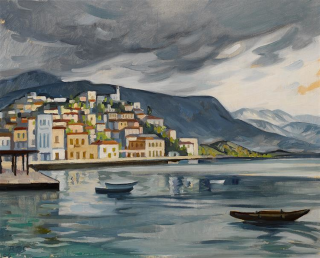
(Pictured: “Storm Over Poros” (1964) by Rosaleen Brigid Ganly, HRHA)