seamus dubhghaill

Promoting Irish Culture and History from Little Rock, Arkansas, USA


Leave a comment

The Capture of Bandon

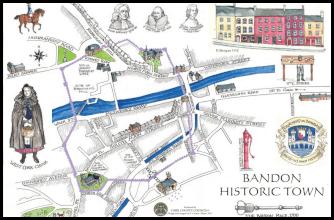
The Capture of Bandon begins on February 23, 1689, when the town of Bandon, County Cork, is forcibly seized from its rebellious Protestant inhabitants by force of Irish Army troops under Justin McCarthy. The skirmishing at the town takes place during the early stages of the Williamite War in Ireland. The Jacobite success at Bandon helps suppress any chance of a general Munster uprising against the rule of James II similar to that which occurs in Ulster the same year. The slogan “No Surrender!” is believed to have been first used at Bandon and subsequently taken up, more famously, by the defenders at the Siege of Derry later in the year.

In 1685, the Catholic James II comes to the throne. This leads to a sharp reversal of government policy in Ireland, which had previously favoured the Protestant inhabitants. This is quickly changed by James’ representative Richard Talbot, 1st Earl of Tyrconnell. Under Talbot’s administration, the army and civil government are mostly purged of Protestants, who are replaced by Catholics. In Bandon, the previous town burgesses are replaced by Catholic nominees.

Talbot’s actions lead to a growing hostility amongst the Protestant inhabitants across the island toward the King and his Irish government. Bandon is a historic centre of Protestants, dating back to the Plantation of Munster in the Elizabethan era and is a natural focus of dissent against James’s rule. In 1688, a similar opposition in England leads to the Glorious Revolution, in which William III successfully invades with a Dutch Army. Many Protestants now believe William to be their rightful King while Catholics, and some Protestants, remain loyal to James. During the growing turmoil, many rural County Cork Protestants come to shelter in Bandon.

Fearing a potential outbreak of rebellion in Bandon will occur, the government sends a detachment of the Irish Army under Captain Daniel O’Neill to take the town. They reportedly enter on a Sunday morning while the inhabitants are attending church services. The following day, February 24, sometimes referred to as “Black Monday,” the townspeople rise and attack the soldiers. Various sources say between three and eight of the redcoats are killed and the remainder are driven out of the town. Using their captured weapons, the Protestants then make an effort to prepare Bandon to withstand an assault.

Having received word about the growing rebellion in the county, Talbot in Dublin has already dispatched six companies of infantry under Justin McCarthy, an experienced Irish Catholic soldier. Instead of immediately assaulting Bandon, McCarthy first seizes nearby Cork, another major centre of Protestants in the south of the country and clamps down on other potential dissidents. He then proceeds to Bandon with his troops, plus some cavalry and artillery. Although they had previously hung out a banner proclaiming “No Surrender,” the defenders negotiate a surrender in exchange for generous conditions. Despite the usual punishment for rebellion being death, the town corporation is fined £1,000 and the walls are ordered to be demolished.

The comparatively light terms imposed on the town are part of a wider attempt by King James to convince Protestants of his goodwill toward them. It angers more hardline Catholics, including McCarthy’s nephew, Donough MacCarthy, 4th Earl of Clancarty, who wants a harsher punishment for the rebels.

The fighting at Bandon is part of a succession of defeats of locally raised Protestant troops both across Munster (at Castlemartyr) and Ireland as a whole, with the Ulster-raised Army of the North suffering heavy defeats at the Break of Dromore and the Battle of Cladyford. The advance of the mainly Catholic Jacobite Army is halted by the successful Protestant defence of Enniskillen and Derry. The arrival of large-scale reinforcements under Frederick Schomberg and King William reverse the tide, and Dublin is captured following the Battle of the Boyne in 1690. The same year, Bandon is re-taken by Protestant forces following John Churchill, 1st Duke of Marlborough‘s successful Siege of Cork. The walls are not rebuilt, as they are becoming increasingly militarily obsolete.


Leave a comment

King William III, William of Orange, Arrives in Belfast

William of Orange, King of Holland, and recently declared King William III of England, arrives with his fleet in Belfast on June 14, 1690. He remains for twelve days, departing on June 26. For his part he likes what he sees. “This country is worth fighting for,” he says.

William’s departure from London is held up by parliamentary business until the end of May, when he announces that he can wait no longer and adjourns Parliament. He sets out early in the morning of June 4, reaching Northampton before nightfall. On Sunday, June 8, he attends divine service in Chester Cathedral and goes on to inspect the ships at Hoylake on the tip of the Wirral Peninsula.

For two days the wind is contrary, but on June 11 he embarks on board the yacht “Mary” with a fleet escorted by Sir Cloudesley Shovell‘s squadron. On June 14 the hills of Ireland come in sight and in the afternoon the fleet casts anchor off Carrickfergus. He is rowed ashore in the Rear Admiral’s barge and at about 3:30 p.m. lands at the Old Quay under the shadow of the great Norman Castle.

The Garrison of the Castle has drawn up a Guard of Honour and the townspeople add their applause. The chosen spokesman is a Quaker, whose principles forbid him to doff his hat or use such titles as Sir and Majesty. He gets around the difficulty by taking off his hat and laying it on a stone and then stepping forward and saying “William, thou art welcome to thy Kingdom” which pleases the King so much that he replies, “You are the best-bred gentleman I have met since I came to England.” With these words he mounts his horse and sets off for Belfast.

Halfway along the shore is the little port of Whitehouse, where most of the army disembarks. The Commander-in-Chief, Frederick Schomberg, 1st Duke of Schomberg, and his senior commanders are waiting here to welcome the King. To cover the disembarkation, earthworks have been thrown up by the engineers at Fort William and garrisoned by troops ready for action.

In 1690 Belfast consists of about 300 houses in five streets. It has two churches, the Parish Church, where St. George’s Church still stands in the High Street, and the Presbyterian Meeting House in Rosemary Lane. The town had been surrounded by a rampart in 1642 and had been captured by Colonel Robert Venebles for Oliver Cromwell after a four-day siege and an assault on the North Gate in 1649.

It is at the North Gate that King William enters Belfast where North Street now crosses Royal Avenue. Here he is welcomed by the magistrates and burgesses in their robes and by the Rev. George Walker, now Bishop-elect of Derry. A Royal Salute is fired from the Castle and is echoed and re-echoed by the guns which Schomberg had placed at wide intervals for the purpose of conveying signals from post to post. Wherever it is heard it is known that King William has come. Before midnight all the heights of Antrim and Down are blazing with bonfires.

The next day being Sunday, William attends church at the Corporation Church, now St. George’s Church. On Monday, June 16, addresses of loyalty are presented on behalf of the Church of Ireland and Presbyterian Church clergy, the civic authorities of the city of Londonderry, the town of Belfast and by the Sheriffs, Justices of the Peace and Gentlemen of the Counties of Down and Antrim. The next two days are spent in military preparation.

In the previous season Schomberg had conducted a slow and cautious campaign but William says he has not come to Ireland to let the grass grow under his feet. He orders a general muster of the army in the Parish of Aghaderg which includes Scarvagh and on Thursday, June 19, begins his southward march from Belfast Castle.

The line of march continues along Upper Malone by the Old Coach Road and past the ruins of both Drumbeg and Lambeg Parish Churches which had been burned down in 1641. William reaches Schomberg’s headquarters in Lisburn Castle for lunch on the same day that he left Belfast Castle. The afternoon and evening are spent inspecting troops on Blaris Moor, and then on to Hillsborough Castle for the night.

The cavalcade moves on through the little round hills of County Down, crosses the Upper Bann between Huntly and Ballievey by ford over the hill of Banbridge and on to the rendezvous on the northwest of Loughbrickland.

After the disappointments of the previous season and the appalling loss of life through disease, Schomberg had dispersed his army into winter quarters all over Ulster. The Derry and Enniskillen men had gone home to pick up the threads of their lives. Now the farmers among them have the crop in and are recalled to the colours and ready to be reviewed. There are four regiments of Enniskillen men – Wynns, Tiffins, Lloyds and Cunninghams, one of foot and three of horse. There is only one regiment of Derry men, St. John’s, commanded by Mitchelburne with Rev. George Walker as chaplain.

On June 22, William sits in the saddle for hours reviewing his 36,000 men. Marching past are 10,000 Danes, some of whom came from Norway and Sweden, and even Finland, 7,000 Dutch and Brandenburgers, 2,000 French Huguenots, 11,000 English and Scots, 800 Derrymen, 4,500 Inniskilleners and two companies from Bandon, County Cork.

On June 24, an advance party reaches beyond Newry to the edge of Dundalk and brings intelligence that the deposed King James II has fallen back on Ardee. The following day the main army advances to Newry and camps on the side of a hill. On June 25, with the King at their head, wearing an Orange colour sash, they go through the Moyry Gap and pass out of Ulster en route to the Boyne.

(From: “History of Orangeism: King William in Ulster,” Museum of Orange Heritage, http://www.orangeheritage.co.uk)