
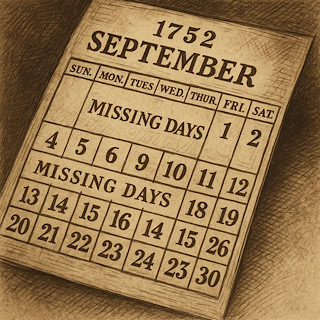
On September 2, 1752, the British Empire — including Ireland and its American colonies — adopts the Gregorian calendar, aligning its dating system with most of Western Europe, which had made the change over a century earlier.
The Julian calendar, introduced by Julius Caesar in 45 BCE, has a leap year rule that adds a day every four years. This makes the average year 365.25 days long, about 11 minutes and 14 seconds longer than the true solar year. Over centuries, this small error accumulates, causing the calendar to drift out of sync with the seasons. By 1752, the Julian calendar is 11 days ahead of the equinoxes, affecting the date of Easter and other seasonal events.
The Calendar (New Style) Act 1750 mandates the switch. To correct the drift, the Act declares that Wednesday, September 2, 1752, is immediately followed by Thursday, September 14, 1752 — effectively skipping September 3–13. This also adjusts the leap year rules to match the Gregorian system, omitting leap years in century years not divisible by 400.
The change is controversial. Britain and Ireland have been on the Julian calendar since 1582, with the New Year starting on March 25 (Lady Day). Adopting the Gregorian system means shortening 1751 to 282 days (March 25 to December 31) and aligning with Continental Europe, which had already made the switch in the 16th century.
Political debates, especially between the Whigs and Tories, reflect fears of losing sovereignty and of embracing “Popery.” While there are rumors of “calendar riots” demanding the return of the “lost” 11 days, these are likely exaggerated.
There are several impacts with making the change. There is historical confusion as dual dating (e.g., “Feb 10, 1750/51”) is common for decades. There are economic and social effects as birthdays, rent payments, and holidays are thrown off. The change also allows for international alignment as the change facilitates trade and communication with Europe.
The 1752 switch marks a turning point in British and Irish history, bringing the calendar into line with most of Europe and setting the stage for the Gregorian calendar’s eventual global dominance. Today, the Gregorian calendar is the world’s standard civil calendar, a legacy of this 18th-century reform.

