
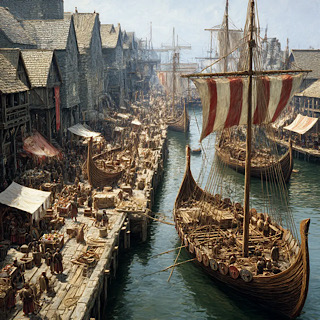
On September 21, 1170, the Kingdom of Dublin, a Norse-Gaelic stronghold established by Viking settlers in the 9th century, falls to a combined force of Diarmait Mac Murchada (Dermot MacMurrough), the deposed King of Leinster, and Norman mercenaries led by Richard de Clare, 2nd Earl of Pembroke (“Strongbow”).
In 1167, MacMurrough is ousted from Leinster by the High King of Ireland, Ruaidrí Ua Conchobair, and seeks help from King Henry II of England to regain his throne. In 1169, Strongbow lands in Ireland with Anglo-Norman and Cambro-Norman troops, initially capturing Wexford and Waterford. Dublin is a key Norse-Gaelic power center and a major trading hub, making it a prime objective for Norman expansion.
After securing Wexford and Waterford, MacMurrough and Strongbow march on Dublin, bypassing an Irish force under Ruaidrí Ua Conchobair positioned south of the city. They take a northern route, attacking from an unexpected direction, catching the defenders off guard. The assault is swift and decisive, leading to the capture of Dublin.
Ascall mac Ragnaill, King of Dublin, and many Norse inhabitants flee by sea to the Hebrides or the Isle of Man. The fall marks the effective end of centuries of Norse political dominance in Ireland.
Dublin becomes a Norman stronghold, facilitating further expansion into Ireland and setting the stage for Henry II’s 1171 invasion to assert English control. The conquest introduces Norman feudalism, chivalry, and Roman Catholicism to Ireland, altering its political, cultural, and religious landscape for centuries.
This event is a turning point in Irish history, symbolizing the close of the Viking era and the dawn of Norman influence on the island.

