seamus dubhghaill

Promoting Irish Culture and History from Little Rock, Arkansas, USA


Leave a comment

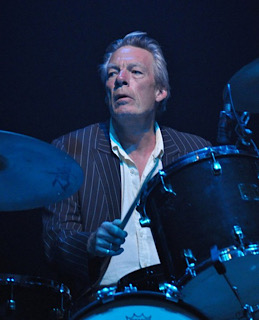
Birth of Andrew Ranken, Drummer for The Pogues

Andrew Ranken, English drummer who plays with several bands including the Pogues, is born on November 13, 1953, in the Ladbroke Grove area of London. He plays with the Pogues from 1983 until their second breakup in 2014.

Ranken spends his early childhood listening to his parents’ jazz records before moving to Abbots Langley when he is five and Heathfield, East Sussex, a year later. He attends Priory School, Lewes, where he is in the same year as Pete Thomas and Wreckless Eric, and is inspired by the Beatles and the Rolling Stones. He becomes a musician after an older cousin gives him a guitar he has tired of trying to learn and becomes a drummer after being given a pair of bongos. At the age of 14, he joins a blues rock band, Joshua Bagmat, which is led by Stephen Warbeck, features Thomas, and disbands when the members leave school. Ranken subsequently works with Warbeck and Paul Bradley as part of The hKippers.

After leaving school, Ranken moves to London to spend a year at the Central School of Art and Design, where he forms the band Lola Cobra with three members of the sculpture department including Lene Lovich and her boyfriend Les Chappell. After losing interest in the course, he drops out and sells his drum kit to fund a series of travels with the intention of writing a book of writings and drawings. He settles first to a squat in Amsterdam, which he leaves after it is ransacked, followed by a tent in a campsite in suburban Holland, where he spends several weeks while working in a peanut factory. He then moves to France and then Italy, where his manuscript is stolen. He develops a dental abscess after returning to France and returns to his parents, now living in Epsom.

Ranken becomes the singer for a new wave and R&B band while living with his parents called The Stickers and later moves to Islington with a bandmember. He has a number of unpleasant jobs including spells as a painter and decorator, a builder, a screw factory operative, and a porter at St. Bartholomew’s Hospital. After his temp agency assigns him to work the incinerator at St. Leonard’s Hospital in Hackney, he walks out after finding a half-burnt Alsatian that smelled like bacon. He subsequently decides to take a three-year course in media studies and sociology at Goldsmiths in 1980. The Stickers disband around this time after it becomes impossible to keep members in the band, prompting Ranken to become the singer for The Operation with numerous friends and family members. He then moves into a squat in Huntley Street with his girlfriend and then to the Hillview Estate following an eviction.

In March 1983, Ranken joins the Pogues, then known as Pogue Mahone, replacing John Hasler on drums. He juggles both the Operation and the Pogues for a while until leaving the former to concentrate on the latter. With the Pogues, he spends the first two and a half years playing the drums while standing up, until he contracts blood poisoning and has to play one-handed while he recovers. He plays on every song from their 1984 debut Red Roses for Me, on which he is credited as The Clobberer, until their 1996 album Pogue Mahone, including on “Fairytale of New York” and “The Irish Rover.” Their 1991 compilation album, The Best of The Pogues, is dedicated to Ranken’s long-term partner Deborah Korner, who died earlier in the year from an aneurysm. Two songs on subsequent albums are also dedicated to Korner.

Ranken also performs with the Pogues from their reunion in 2001 until their official break up in 2014. Ranken releases the charity single “Take Me Down to St. Joe’s” in July 2023 with The Mysterious Wheels, a band containing two of Korner’s brothers. The single is released in support of St. Joseph’s Hospice in Hackney following Ranken’s own diagnosis of chronic obstructive pulmonary disease (COPD). Health issues cause Ranken to withdraw from The Pogues’ 2024 tour.

Ranken dies on February 10, 2026, at the age of 72. He had been married with two children.


Leave a comment

Birth of Singer-Songwriter Sinéad O’Connor

Sinéad Marie Bernadette O’Connor, Irish singer-songwriter dubbed the first superstar of the 1990s by Rolling Stone magazine, is born on December 8, 1966, in Dublin. During her career she attracts publicity not only for her voice, which is alternately searing and soothing, but also for her controversial actions and statements.

O’Connor is born at the Cascia House Nursing Home on Baggot Street in Dublin, the third of five children of John Oliver “Seán” O’Connor, a structural engineer later turned barrister and chairperson of the Divorce Action Group, and Johanna Marie O’Grady, who marry in 1960 at the Church of Our Lady of Good Counsel, Drimnagh, Dublin. She is named Sinéad after Sinéad de Valera, the mother of Éamon de Valera, Jnr., the doctor who presides over her delivery, and Bernadette in honour of Saint Bernadette of Lourdes. An older brother is the novelist, Joseph O’Connor. She attends Dominican College Sion Hill school in Blackrock, Dublin.

O’Connor’s parents divorce when she is eight years old, and she and her siblings are sent to live with their abusive mother, who beats the children on a regular basis. Eventually, she leaves to live with her father and stepmother, but the child, who habitually shoplifts, proves to be too troublesome for the couple, and they send her to reform school. Although she hates the reform school, it is there that she makes her first contacts with the music world. A teacher introduces her to the drummer of a local band, In Tua Nua, and for a brief period she works with the band and even cowrites one of their hit singles. After a year and a half at the reform school, she is transferred to a boarding school in Waterford, but it proves unbearable. She eventually returns to Dublin, where she attempts to start her own music career.

In Dublin O’Connor eventually joins the pub rock band Ton Ton Macoute. In 1985, while singing with the group, she attracts the attention of the London-based record label Ensign Records, which asks her for a demo tape. Soon afterward she signs a contract with the label and begins work on her debut album, The Lion and the Cobra, which is released in 1987 to critical praise. She follows the album with the largely autobiographical I Do Not Want What I Haven’t Got (1990). The album is propelled to the top of the U.S. pop charts on the strength of the number one single “Nothing Compares 2 U”—a transcendent cover of a 1985 Prince song.

In the following year O’Connor attracts attention not only for her singing but also for a series of controversial statements, actions, and appearances, including refusing to appear on NBC’s Saturday Night Live because of objections to the week’s guest host, boycotting the 1991 Grammy Awards ceremony and declining to sing there, and refusing to allow the U.S. national anthem to be played before one of her performances. She also attracts criticism for her public support of the Irish Republican Army (IRA) and for tearing up a picture of Pope John Paul II on Saturday Night Live in 1992. Nevertheless, she wins the Grammy Award for Best Alternative Music Album in 1991 for “I Do Not Want What I Haven’t Got” and continues to be highly regarded for her musical abilities.

In 1992 O’Connor releases an album of torch songs, Am I Not Your Girl?, which receives only minor publicity, and she releases a fourth album, Universal Mother, in 1994. Soon afterward she takes a hiatus from public life, spending time with her children and attending therapy in order to work through problems that linger from her harsh childhood. Her struggles with mental health continue throughout her life.

O’Connor occasionally actes, appearing in such films as Hush-a-Bye Baby (1990), Emily Brontë’s Wuthering Heights (1992; as novelist Emily Brontë), and The Butcher Boy (1997; as the Virgin Mary). She is ordained a priest in a controversial religious group led by Bishop Michael Cox, the leader of a religious sect that has broken off from the Roman Catholic Church. In 2000 she releases her fifth album, Faith and Courage, which includes the hit song “No Man’s Woman.” The album is praised by several music reviewers as one of the best albums of the year. Subsequent albums include Sean-Nós Nua (2002), Throw Down Your Arms (2005), Theology (2007), How About I Be Me (and You Be You)? (2012), and I’m Not Bossy, I’m the Boss (2014).

In 2018 O’Connor announces that she has converted to Islam and changes her name to Shuhadāʾ Sadaqat, although she states that she will continue to perform as Sinéad O’Connor. Her memoir, Rememberings (2021), receives broad critical praise, and she is the subject of the documentary Nothing Compares (2022).

O’Connor’s sudden death in her flat in Herne Hill, south London, at the age of 56 on July 26, 2023, prompts a massive outpouring of public grief. Irish President Michael D. Higgins praises her for her “beautiful, unique voice.” A year later, upon the registration of her death certificate, it is revealed that she had died of chronic obstructive pulmonary disease and bronchial asthma.

(From: “Sinéad O’Connor,” written and fact checked by The Editors of Encyclopedia Britannica, http://www.britannica.com, last updated September 30, 2024)