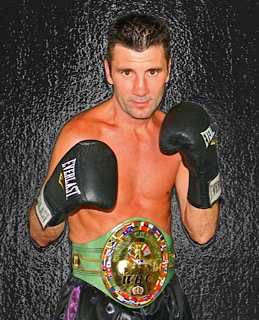
McCullough turns professional in 1993, moving to Las Vegas, Nevada, to train under legendary coach Eddie Futch. Less than 2½ years after his debut, he captures the WBC bantamweight title on July 30, 1995, by defeating Yasuei Yakushiji in Japan, becoming the first Irish or UK boxer to win a world title there. He successfully defends the WBC belt twice before moving up in weight. He challenges for championships in super bantamweight and featherweight, including notable bouts against Daniel Zaragoza, Naseem Hamed, Erik Morales, and Oscar Larios. He is renowned for his relentless attacking style and exceptional durability, never being knocked down in his professional career.
McCullough’s career record consists of 34 professional bouts with 27 wins (18 by knockout) and 7 losses. He retires after a bout against Juan Ruiz in June 2008 due to injury, ending a career spanning 15 years.
McCullough marries Cheryl Rennie in 1993, and they have a daughter, Wynona, pursuing a career in entertainment. During his career, he faces mental health challenges, including depression and suicidal thoughts, which he overcomes with the support of his family and faith. He becomes a United States citizen in 2005.
After retiring, McCullough becomes a trainer for amateur and professional fighters and works to promote goodwill in sports as WBC World Ambassador for Peace. He is also involved in mixed martial artspublic relations and founds his charity initiative, IHOW. He publishes his autobiography, Pocket Rocket: Don’t Quit, in 2005. In 2019, he is inducted into the Nevada Boxing Hall of Fame for his contributions to the sport.
McCullough’s courage, low knockdown susceptibility, and international successes have cemented him as a revered figure in boxing, both in Ireland and globally. His story is one of triumph, resilience, and overcoming personal and professional adversity.
Sinéad Marie Bernadette O’Connor, Irish singer-songwriter dubbed the first superstar of the 1990s by Rolling Stone magazine, is born on December 8, 1966, in Dublin. During her career she attracts publicity not only for her voice, which is alternately searing and soothing, but also for her controversial actions and statements.
O’Connor’s parents divorce when she is eight years old, and she and her siblings are sent to live with their abusive mother, who beats the children on a regular basis. Eventually, she leaves to live with her father and stepmother, but the child, who habitually shoplifts, proves to be too troublesome for the couple, and they send her to reform school. Although she hates the reform school, it is there that she makes her first contacts with the music world. A teacher introduces her to the drummer of a local band, In Tua Nua, and for a brief period she works with the band and even cowrites one of their hit singles. After a year and a half at the reform school, she is transferred to a boarding school in Waterford, but it proves unbearable. She eventually returns to Dublin, where she attempts to start her own music career.
In Dublin O’Connor eventually joins the pub rock band Ton Ton Macoute. In 1985, while singing with the group, she attracts the attention of the London-based record label Ensign Records, which asks her for a demo tape. Soon afterward she signs a contract with the label and begins work on her debut album, The Lion and the Cobra, which is released in 1987 to critical praise. She follows the album with the largely autobiographical I Do Not Want What I Haven’t Got (1990). The album is propelled to the top of the U.S. pop charts on the strength of the number one single “Nothing Compares 2 U”—a transcendent cover of a 1985 Prince song.
In the following year O’Connor attracts attention not only for her singing but also for a series of controversial statements, actions, and appearances, including refusing to appear on NBC’s Saturday Night Live because of objections to the week’s guest host, boycotting the 1991 Grammy Awards ceremony and declining to sing there, and refusing to allow the U.S. national anthem to be played before one of her performances. She also attracts criticism for her public support of the Irish Republican Army (IRA) and for tearing up a picture of Pope John Paul II on Saturday Night Live in 1992. Nevertheless, she wins the Grammy Award for Best Alternative Music Album in 1991 for “I Do Not Want What I Haven’t Got” and continues to be highly regarded for her musical abilities.
In 1992 O’Connor releases an album of torch songs, Am I Not Your Girl?, which receives only minor publicity, and she releases a fourth album, Universal Mother, in 1994. Soon afterward she takes a hiatus from public life, spending time with her children and attending therapy in order to work through problems that linger from her harsh childhood. Her struggles with mental health continue throughout her life.
In 2018 O’Connor announces that she has converted to Islam and changes her name to Shuhadāʾ Sadaqat, although she states that she will continue to perform as Sinéad O’Connor. Her memoir, Rememberings (2021), receives broad critical praise, and she is the subject of the documentary Nothing Compares (2022).
(From: “Sinéad O’Connor,” written and fact checked by The Editors of Encyclopedia Britannica, http://www.britannica.com, last updated September 30, 2024)


 seamus dubhghaill