The RMS Royal Adelaide, captained by John Batty, leaves Cork fully laden with cargo and about 250 passengers on Wednesday, March 27,1850, touching off at Plymouth, Devon, England, on Thursday evening. By the time the ship leaves Plymouth for London at 3:00 a.m. on Friday, March 29, there are almost three hundred deck passengers.
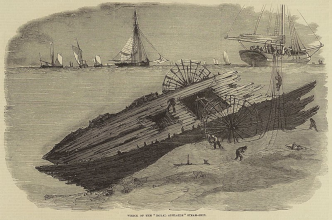
The ship is totally lost at about 11:00 p.m. on Saturday, March 30 on Tongue Sands north of Margate, Kent, England, with the loss of all on board. News only reaches London late on Sunday as the river pilot waiting for the ship happens to meet a Deal, Kent, pilot, Charles Gillham, who reports seeing a ship of a similar description in distress the previous evening (The Illustrated London News, April 6 and 13, 1850).
The dead include more than one hundred fifty deck passengers from Ireland, during a time when the Great Famine is at its height.
(Pictured: “The Wreck of the Royal Adelaide,” illustration for The Illustrated London News, April 13, 1850)
In 1895, the City of Dublin Steam Packet Company orders four steamers for Royal Mail service, named for four provinces of Ireland: RMS Leinster, RMS Connaught, RMS Munster, and RMS Ulster. The RMS Leinster is a 3,069-ton packetsteamship with a service speed of 23 knots. The vessel, which is built at Cammell Laird‘s in Birkenhead, England, is driven by two independent four-cylinder triple-expansion steam engines. During World War I, the twin-propellered ship is armed with one 12-pounder and two signal guns.
The ship’s log states that she carries 77 crew and 694 passengers on her final voyage under the command of Captain William Birch. The ship had previously been attacked in the Irish Sea but the torpedoes missed their target. Those on board include more than 100 British civilians, 22 postal sorters and almost 500 military personnel from the Royal Navy, British Army and Royal Air Force. Also aboard are nurses from the UK, Ireland, Australia, New Zealand, Canada and the United States.
Just before 10:00 AM as it is sailing east of the Kish Bank in a heavy swell, passengers see a torpedo approach from the port side and pass in front of the bow. A second torpedo follows shortly afterwards, and strikes the ship forward on the port side in the vicinity of the mail room. Captain Birch orders the ship to make a U-turn in an attempt to return to Kingstown as it begins to settle slowly by the bow. It sinks rapidly, however, after a third torpedo strikes her, causing a huge explosion.
Captain Birch who is wounded in the initial attack, drowns when his lifeboat is swamped in heavy seas and capsizes while attempting to transfer survivors to HMS Lively. Several of the military personnel who die are buried in Grangegorman Military Cemetery.
One of the rescue ships is the armed yacht and former fishery protection vessel HMY Helga. Stationed in Kingstown harbour at the time of the sinking, she had shelled Dublin during the 1916 Easter Rising in Dublin two years earlier. She was later bought and renamed the Muirchú by the Irish Free State government as one of its first fishery protection vessels.
At October 18, 1918 at 9:10 AM SM UB-125, outbound from Germany, picks up a radio message requesting advice on the best way to get through the North Seaminefield. The sender is Oberleutnant zur See Robert Ramm aboard SM UB-123. Extra mines have been added to the minefield since SM UB-123 had made her outward voyage from Germany. As SM UB-125 had just come through the minefield, Vater radios back with a suggested route. SM UB-123 acknowledges the message and is never heard from again.
The following day, ten days after the sinking of the RMS Leinster, SM UB-123 accidentally detonates a mine while trying to cross the North Sea and return to base in Imperial Germany. It is October 19, 1918. Oberleutnant zur See Robert Ramm, who has a wife and children, never returns to them. Thirty-five other German families are similarly bereaved. No bodies are ever found.
In 1991, the anchor of the RMS Leinster is raised by local divers. It is placed near Carlisle Pier and officially dedicated on January, 28, 1996.
Queen Victoria is built by Wilson shipbuilders of Glasgow, Scotland in 1838 for The City of Dublin Steam Packet Company. She has a wooden hull, is 150 feet long and is powered by a two-cylinder steam engine.
The Queen Victoria leaves Liverpool on the night of February 14, 1853, with cargo and approximately 100 passengers. As it approaches the Irish coast at Howth it is hit by a snowstorm. It strikes Howth Head around 2:00 AM on February 15. The captain backs the ship away from the Head in hopes of being able to navigate into the harbor. The damage to the ship is more extensive than the captain thinks, and it quickly begins to fill with water. It drifts, dead in the water, and strikes below the Baily Lighthouse. It sinks 100 yards south of the lighthouse within 15 minutes of the second hit. Approximately 83 passengers and crew perish, including the captain. One lifeboat, with 17 passengers, makes it to shore.
A subsequent Board of Trade inquiry blames the ship’s captain and first officer, as well as the lighthouse crew. A fog bell is supposed to have been installed in the lighthouse in 1846, seven years earlier, but is delayed due to costs of other construction projects. The bell is finally installed in April 1853, as a result of the Queen Victoria shipwreck and the subsequent inquiry.
At least one attempt to raise the ship is made afterwards, which fails, and the ship is salvaged where she lay. The wreck is still in place.
Members of the Marlin Sun Aqua Club, Dublin discover the wreck in 1983. They report their discovery to the authorities and are in part responsible for having the first Underwater Preservation Order placed on a shipwreck in Irish waters. They also carry out the first underwater survey on such a wreck. The wreck is the first to be protected by The National Monuments Act (Historic Wreck), when the order is granted in 1984, thanks to representations made by Kevin Crothers, IUART, and the Maritime Institute of Ireland.
(Pictured: PS Queen Victoria’s shipwreck as depicted in The Nation)



 seamus dubhghaill