

The Statute of Westminster 1931, an act of the Parliament of the United Kingdom that sets the basis for the relationship between the Dominions (now called Commonwealth realms) and the Crown, receives royal assent on December 11, 1931.
The statute increases the sovereignty of the self-governing Dominions of the British Empire from the United Kingdom. It also binds them all to seek each other’s approval for changes to monarchical titles and the common line of succession. The statute is effective either immediately or upon ratification. It thus becomes a statutory embodiment of the principles of equality and common allegiance to the Crown set out in the Balfour Declaration of 1926. As the statute removes nearly all of the British parliament’s authority to legislate for the Dominions, it is a crucial step in the development of the Dominions as separate, independent, and sovereign states.
The Irish Free State never formally adopts the Statute of Westminster, its Executive Council (cabinet) taking the view that the Anglo-Irish Treaty of 1921 has already ended Westminster‘s right to legislate for the Irish Free State. The Constitution of the Irish Free State gives the Oireachtas “sole and exclusive power of making laws.” Hence, even before 1931, the Irish Free State does not arrest British Army and Royal Air Force deserters on its territory, even though the UK believes post-1922 British laws give the Free State’s Garda Síochána the power to do so. The UK’s Irish Free State Constitution Act 1922 says, however, “[n]othing in the [Free State] Constitution shall be construed as prejudicing the power of [the British] Parliament to make laws affecting the Irish Free State in any case where, in accordance with constitutional practice, Parliament would make laws affecting other self-governing Dominions.”
Motions of approval of the Report of the Commonwealth Conference had been passed by Dáil Éireann and Seanad Éireann in May 1931 and the final form of the Statute of Westminster includes the Irish Free State among the Dominions the British Parliament cannot legislate for without the Dominion’s request and consent. Originally, the UK government wants to exclude from the Statute of Westminster the legislation underpinning the 1921 treaty, from which the Free State’s constitution had emerged. Executive Council President (Prime Minister) W. T. Cosgrave objects, although he promises that the Executive Council will not amend the legislation unilaterally. The other Dominions back Cosgrave and, when an amendment to similar effect is proposed at Westminster by John Gretton, parliament duly votes it down. When the statute becomes law in the UK, Patrick McGilligan, the Free State Minister for External Affairs, states, “It is a solemn declaration by the British people through their representatives in Parliament that the powers inherent in the Treaty position are what we have proclaimed them to be for the last ten years.” He goes on to present the statute as largely the fruit of the Free State’s efforts to secure for the other Dominions the same benefits it already enjoys under the treaty. The Statute of Westminster has the effect of granting the Irish Free State internationally recognised independence.
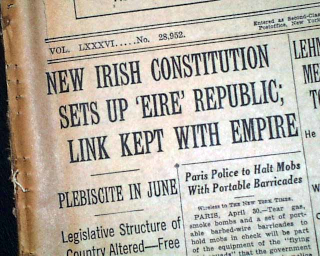
Éamon de Valera leads Fianna Fáil to victory in the 1932 Irish general election on a platform of republicanising the Free State from within. Upon taking office, he begins removing the monarchical elements of the Constitution, beginning with the Oath of Allegiance. De Valera initially considers invoking the Statute of Westminster in making these changes, but John J. Hearne advises him to not do so. Abolishing the Oath of Allegiance in effect abrogates the 1921 treaty. Generally, the British believe that this is morally objectionable but legally permitted by the Statute of Westminster. Robert Lyon Moore, a Southern Unionist from County Donegal, challenges the legality of the abolition in the Irish Free State’s courts and then appeals to the Judicial Committee of the Privy Council (JCPC) in London. However, the Free State has also abolished the right of appeal to the JCPC. In 1935, the JCPC rules that both abolitions are valid under the Statute of Westminster. The Irish Free State, which in 1937 is renamed Ireland, leaves the Commonwealth in 1949 upon the coming into force of The Republic of Ireland Act 1948.
The Statute of Westminster’s modified versions are now domestic law in Australia and Canada. It has been repealed in New Zealand and implicitly in former Dominions that are no longer Commonwealth realms.
 seamus dubhghaill