By 1947, de Valera’s government has begun drafting legislation to repeal the Act. Initially, the bill does not mention a republic, but by January 1948 it includes a reference to the state as a republic. Costello, as Taoiseach, introduces the bill in November 1948, citing irritation over the British invitation to King George VI to open the Canadian Parliament — seen as a slight to Irish sovereignty.
On September 7, 1948, Costello tells reporters in Ottawa that Ireland will repeal the External Relations Act, thereby ending the Crown’s role in Irish external affairs. The British government is not informed until a month later, and relations remain cordial until Ireland formally leaves the Commonwealth in April 1949.
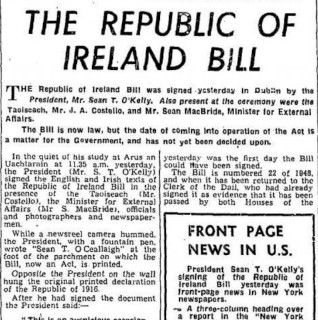
The Republic of Ireland Act 1948 is passed by the Oireachtas in December 1948 and signed by PresidentSeán T. O’Kelly on December 21, 1948. It repeals the External Relations Act 1936, declares the state’s description as the Republic of Ireland and vests executive power in the President for external relations on the advice of the Government. The Act takes effect on April 18, 1949 (Easter Monday), marking the symbolic completion of Ireland’s transition from dominion to republic.
The Parliament of the United Kingdom passes the Ireland Act 1949, acknowledging Ireland’s new status, preserving Northern Ireland’s constitutional position, and maintaining rights of Irish citizens in Britain. This ensures continuity in trade, travel, and citizenship without major disruption.
The significance of the 1948–1949 process is a definitive assertion of Irish sovereignty, aligning Ireland’s legal framework with its de facto republican governance. It ends the last constitutional vestige of the British monarchy in Ireland and marks Ireland’s formal departure from the Commonwealth.
Costello is born on June 20, 1891, in Fairview, Dublin, the younger son of John Costello senior, a civil servant, and Rose Callaghan. He is educated at St. Joseph’s, Fairview, and then moves to O’Connell School, for senior classes, and later attends University College Dublin (UCD), where he graduates with a degree in modern languages and law. He studies at King’s Inns to become a barrister, winning the Victoria Prize there in 1913 and 1914. He is called to the Irish Bar in 1914, and practises as a barrister until 1922.
In 1922, Costello joins the staff at the office of the Attorney General in the newly established Irish Free State. Three years later he is called to the inner bar, and the following year, 1926, he becomes Attorney General of Ireland, upon the formation of the Cumann na nGaedheal government, led by W. T. Cosgrave. While serving in this position he represents the Free State at Imperial Conferences and League of Nations meetings.
Costello is also elected a Bencher of the Honourable Society of King’s Inns. He loses his position as Attorney General of Ireland when Fianna Fáil comes to power in 1932. The following year, however, he is elected to Dáil Éireann as a Cumann na nGaedheal TD. Cumann na nGaedheal soon merges with other parties to form Fine Gael.
During the Dáil debate on the Emergency Powers Act 1939, Costello is highly critical of the Act’s arrogation of powers, stating that “We are asked not merely to give a blank cheque, but to give an uncrossed cheque to the Government.” He loses his seat at the 1943 Irish general election but regains it when Éamon de Valera calls a snap election in 1944. From 1944 to 1948, he is the Fine Gael front-bench Spokesman on External Affairs.
In 1948, Fianna Fáil has been in power for sixteen consecutive years and has been blamed for a downturn in the economy following World War II. The 1948 Irish general election results show Fianna Fáil short of a majority, but still by far the largest party, with twice as many seats as the nearest rival, Fine Gael. It appears that Fianna Fáil is headed for a seventh term in government. However, the other parties in the Dáil realise that between them, they have only one seat fewer than Fianna Fáil, and if they band together, they would be able to form a government with the support of seven Independent deputies. Fine Gael, the Labour Party, the National Labour Party, Clann na Poblachta and Clann na Talmhan join to form the first inter-partygovernment in the history of the Irish state.
While it looks as if cooperation between these parties will not be feasible, a shared opposition to Fianna Fáil and Éamon de Valera overcomes all other difficulties, and the coalition government is formed.
Since Fine Gael is the largest party in the government, it has the task of providing a suitable candidate for Taoiseach. Naturally, it is assumed that its leader, Richard Mulcahy, will be offered the post. However, he is an unacceptable choice to Clann na Poblachta and its deeply republican leader, Seán MacBride. This is due to Mulcahy’s record during the Irish Civil War. Instead, Fine Gael and Clann na Poblachta agree on Costello as a compromise candidate. Costello had never held a ministerial position nor was he involved in the Civil War. When told by Mulcahy of his nomination, Costello is appalled, content with his life as a barrister and as a part-time politician. He is persuaded to accept the nomination as Taoiseach by close non-political friends.
During the campaign, Clann na Poblachta had promised to repeal the Executive Authority (External Relations) Act 1936 but does not make an issue of this when the government is being formed. However, Costello and his Tánaiste, William Norton of the Labour Party, also dislike the act. During the summer of 1948, the cabinet discusses repealing the act, however, no firm decision is made.
In September 1948, Costello is on an official visit to Canada when a reporter asks him about the possibility of Ireland leaving the British Commonwealth. For the first time, he declares publicly that the Irish government is indeed going to repeal the External Relations Act and declare Ireland a republic. It has been suggested that this is a reaction to offence caused by the Governor General of Canada at the time, Harold Alexander, 1st Earl Alexander of Tunis, who is of Northern Irish descent and who allegedly arranges to have placed symbols of Northern Ireland in front of Costello at an official dinner. Costello makes no mention of these aspects on the second reading of the Republic of Ireland Bill on November 24 and, in his memoirs, claims that Alexander’s behaviour had in fact been perfectly civil and could have had no bearing on a decision which had already been made.
The news takes the Government of the United Kingdom and even some of Costello’s ministers by surprise. The former had not been consulted and following the declaration of the Republic in 1949, the UK passes the Ireland Act that year. This recognises the Republic of Ireland and guarantees the position of Northern Ireland within the United Kingdom for so long as a majority there want to remain in the United Kingdom. It also grants full rights to any citizens of the Republic living in the United Kingdom. Ireland leaves the Commonwealth on April 18, 1949, when The Republic of Ireland Act 1948 comes into force. Frederick Henry Boland, Secretary of the Department of External Affairs, says caustically that the affair demonstrates that “the Taoiseach has as much notion of diplomacy as I have of astrology.” The British envoy, John Maffey, 1st Baron Rugby, is equally critical of what he calls a “slipshod and amateur” move.
Many nationalists now see partition as the last obstacle on the road to total national independence. Costello tables a motion of protest against partition on May 10, 1949, without result.
In 1950, the independent-minded Minister for Health, Noël Browne, introduces the Mother and Child Scheme. The scheme would provide mothers with free maternity treatment and their children with free medical care up to the age of sixteen, which is the normal provision in other parts of Europe at that time. The bill is opposed by doctors, who fear a loss of income, and Roman Catholic bishops, who oppose the lack of means testing envisaged and fear the scheme could lead to birth control and abortion. The cabinet is divided over the issue, many feeling that the state cannot afford such a scheme priced at IR£2,000,000 annually. Costello and others in the cabinet make it clear that in the face of such opposition they will not support the Minister. Browne resigns from the government on April 11, 1951, and the scheme is dropped. He immediately publishes his correspondence with Costello and the bishops, something which had hitherto not been done. Derivatives of the Mother and Child Scheme are introduced in Public Health Acts of 1954, 1957 and 1970.
The Costello government has a number of noteworthy achievements. A new record is set in housebuilding, the Industrial Development Authority and Córas Tráchtála are established, and the Minister for Health, Noel Browne, with the then new Streptomycin, bring about an advance in the treatment of tuberculosis. Ireland also joins a number of organisations such as the Organization for European Economic Co-operation and the Council of Europe. However, the government refuses to join NATO, allegedly because the British remain in Northern Ireland. The scheme to supply electricity to even the remotest parts of Ireland is also accelerated.
While the “Mother and Child” incident does destabilise the government to some extent, it does not lead to its collapse as is generally thought. The government continues; however, prices are rising, a balance of payments crisis is looming, and two TDs withdraw their support for the government. These incidents add to the pressure on Costello and so he decides to call a general election for June 1951. The result is inconclusive but Fianna Fáil returns to power. Costello resigns as Taoiseach. It is at this election that his son Declan is elected to the Dáil.
Over the next three years while Fianna Fáil is in power a dual-leadership role of Fine Gael is taking place. While Richard Mulcahy is the leader of the party, Costello, who has proved his skill as Taoiseach, remains as parliamentary leader of the party. He resumes his practice at the Bar. In what is arguably his most celebrated case, the successful defence of The Leader against a libel action brought by the poet Patrick Kavanagh, dates from this period. Kavanagh generously praises Costello’s forensic skill, and the two men become friends.
At the 1954 Irish general election Fianna Fáil loses power. A campaign dominated by economic issues results in a Fine Gael-Labour Party-Clann na Talmhan government coming to power. Costello is elected Taoiseach for the second time.
The government can do little to change the ailing nature of Ireland’s economy, with emigration and unemployment remaining high, and external problems such as the Suez Crisis compounding the difficulty. Measures to expand the Irish economy such as export profits tax relief introduced in 1956 would take years have sizable impact. Costello’s government does have some success with Ireland becoming a member of the United Nations in 1955, and a highly successful visit to the United States in 1956, which begins the custom by which the Taoiseach visits the White House each Saint Patrick’s Day to present the U.S. President with a bowl of shamrock. Although the government has a comfortable majority and seems set for a full term in office, a resumption of Irish Republican Army (IRA) activity in Northern Ireland and Great Britain causes internal strains. The government takes strong action against the republicans.
In spite of supporting the government from the backbenches, Seán MacBride, the leader of Clann na Poblachta, tables a motion of no confidence, based on the weakening state of the economy and in opposition to the government’s stance on the IRA. Fianna Fáil also tables its own motion of no confidence, and rather than face almost certain defeat, Costello again asks PresidentSeán T. O’Kelly to dissolve the Oireachtas. The general election which follows in 1957 gives Fianna Fáil an overall majority and starts another sixteen years of unbroken rule for the party. Some of his colleagues questioned the wisdom of his decision to call an election. The view is expressed that he was tired of politics and depressed by his wife’s sudden death the previous year.
Following the defeat of his government, Costello returns to the bar. In 1959, when Richard Mulcahy resigns the leadership of Fine Gael to James Dillon, he retires to the backbenches. He could have become party leader had he been willing to act in a full-time capacity. He remains as a TD until 1969, when he retires from politics, being succeeded as Fine Gael TD for Dublin South-East by Garret FitzGerald, who himself goes onto to become Taoiseach in a Fine Gael-led government.
During his career, Costello is presented with a number of awards from many universities in the United States. He is also a member of the Royal Irish Academy from 1948. In March 1975, he is made a freeman of the city of Dublin, along with his old political opponent Éamon de Valera. He practises at the bar until a short time before his death at the age of 84, in Ranelagh, Dublin, on January 5, 1976. He is buried at Dean’s Grange Cemetery in Dublin.
The statute increases the sovereignty of the self-governing Dominions of the British Empire from the United Kingdom. It also binds them all to seek each other’s approval for changes to monarchical titles and the common line of succession. The statute is effective either immediately or upon ratification. It thus becomes a statutory embodiment of the principles of equality and common allegiance to the Crown set out in the Balfour Declaration of 1926. As the statute removes nearly all of the British parliament’s authority to legislate for the Dominions, it is a crucial step in the development of the Dominions as separate, independent, and sovereign states.
The Irish Free State never formally adopts the Statute of Westminster, its Executive Council (cabinet) taking the view that the Anglo-Irish Treaty of 1921 has already ended Westminster‘s right to legislate for the Irish Free State. The Constitution of the Irish Free State gives the Oireachtas “sole and exclusive power of making laws.” Hence, even before 1931, the Irish Free State does not arrest British Army and Royal Air Force deserters on its territory, even though the UK believes post-1922 British laws give the Free State’s Garda Síochána the power to do so. The UK’s Irish Free State Constitution Act 1922 says, however, “[n]othing in the [Free State] Constitution shall be construed as prejudicing the power of [the British] Parliament to make laws affecting the Irish Free State in any case where, in accordance with constitutional practice, Parliament would make laws affecting other self-governing Dominions.”
Motions of approval of the Report of the Commonwealth Conference had been passed by Dáil Éireann and Seanad Éireann in May 1931 and the final form of the Statute of Westminster includes the Irish Free State among the Dominions the British Parliament cannot legislate for without the Dominion’s request and consent. Originally, the UK government wants to exclude from the Statute of Westminster the legislation underpinning the 1921 treaty, from which the Free State’s constitution had emerged. Executive Council President (Prime Minister) W. T. Cosgrave objects, although he promises that the Executive Council will not amend the legislation unilaterally. The other Dominions back Cosgrave and, when an amendment to similar effect is proposed at Westminster by John Gretton, parliament duly votes it down. When the statute becomes law in the UK, Patrick McGilligan, the Free State Minister for External Affairs, states, “It is a solemn declaration by the British people through their representatives in Parliament that the powers inherent in the Treaty position are what we have proclaimed them to be for the last ten years.” He goes on to present the statute as largely the fruit of the Free State’s efforts to secure for the other Dominions the same benefits it already enjoys under the treaty. The Statute of Westminster has the effect of granting the Irish Free State internationally recognised independence.
Éamon de Valera leads Fianna Fáil to victory in the 1932 Irish general election on a platform of republicanising the Free State from within. Upon taking office, he begins removing the monarchical elements of the Constitution, beginning with the Oath of Allegiance. De Valera initially considers invoking the Statute of Westminster in making these changes, but John J. Hearne advises him to not do so. Abolishing the Oath of Allegiance in effect abrogates the 1921 treaty. Generally, the British believe that this is morally objectionable but legally permitted by the Statute of Westminster. Robert Lyon Moore, a Southern Unionist from County Donegal, challenges the legality of the abolition in the Irish Free State’s courts and then appeals to the Judicial Committee of the Privy Council (JCPC) in London. However, the Free State has also abolished the right of appeal to the JCPC. In 1935, the JCPC rules that both abolitions are valid under the Statute of Westminster. The Irish Free State, which in 1937 is renamed Ireland, leaves the Commonwealth in 1949 upon the coming into force of The Republic of Ireland Act 1948.
The Statute of Westminster’s modified versions are now domestic law in Australia and Canada. It has been repealed in New Zealand and implicitly in former Dominions that are no longer Commonwealth realms.
Costello is the younger son of John Costello senior, a civil servant, and Rose Callaghan. He is educated at St. Joseph’s, Fairview, and then moves to O’Connell School, for senior classes, and later attends University College Dublin (UCD), where he graduates with a degree in modern languages and law. He studies at King’s Inns to become a barrister, winning the Victoria Prize there in 1913 and 1914. He is called to the Irish Bar in 1914, and practises as a barrister until 1922.
In 1922, Costello joins the staff at the office of the Attorney General in the newly established Irish Free State. Three years later he is called to the inner bar, and the following year, 1926, he becomes Attorney General of Ireland, upon the formation of the Cumann na nGaedheal government, led by W. T. Cosgrave. While serving in this position he represents the Free State at Imperial Conferences and League of Nations meetings.
Costello is also elected a Bencher of the Honourable Society of King’s Inns. He loses his position as Attorney General of Ireland when Fianna Fáil comes to power in 1932. The following year, however, he is elected to Dáil Éireann as a Cumann na nGaedheal TD. Cumann na nGaedheal soon merges with other parties to form Fine Gael.
During the Dáil debate on the Emergency Powers Act 1939, Costello is highly critical of the Act’s arrogation of powers, stating that “We are asked not merely to give a blank cheque, but to give an uncrossed cheque to the Government.” He loses his seat at the 1943 Irish general election but regains it when Éamon de Valera calls a snap election in 1944. From 1944 to 1948, he is the Fine Gael front-bench Spokesman on External Affairs.
In 1948, Fianna Fáil has been in power for sixteen consecutive years and has been blamed for a downturn in the economy following World War II. The 1948 Irish general election results show Fianna Fáil short of a majority, but still by far the largest party, with twice as many seats as the nearest rival, Fine Gael. It appears that Fianna Fáil is headed for a seventh term in government. However, the other parties in the Dáil realise that between them, they have only one seat fewer than Fianna Fáil, and if they band together, they would be able to form a government with the support of seven Independent deputies. Fine Gael, the Labour Party, the National Labour Party, Clann na Poblachta and Clann na Talmhan join to form the first inter-partygovernment in the history of the Irish state.
While it looks as if cooperation between these parties will not be feasible, a shared opposition to Fianna Fáil and Éamon de Valera overcomes all other difficulties, and the coalition government is formed.
Since Fine Gael is the largest party in the government, it has the task of providing a suitable candidate for Taoiseach. Naturally, it is assumed that its leader, Richard Mulcahy, will be offered the post. However, he is an unacceptable choice to Clann na Poblachta and its deeply republican leader, Seán MacBride. This is due to Mulcahy’s record during the Irish Civil War. Instead, Fine Gael and Clann na Poblachta agree on Costello as a compromise candidate. Costello had never held a ministerial position nor was he involved in the Civil War. When told by Mulcahy of his nomination, Costello is appalled, content with his life as a barrister and as a part-time politician. He is persuaded to accept the nomination as Taoiseach by close non-political friends.
During the campaign, Clann na Poblachta had promised to repeal the Executive Authority (External Relations) Act 1936 but does not make an issue of this when the government is being formed. However, Costello and his Tánaiste, William Norton of the Labour Party, also dislike the act. During the summer of 1948, the cabinet discusses repealing the act, however, no firm decision is made.
In September 1948, Costello is on an official visit to Canada when a reporter asks him about the possibility of Ireland leaving the British Commonwealth. For the first time, he declares publicly that the Irish government is indeed going to repeal the External Relations Act and declare Ireland a republic. It has been suggested that this is a reaction to offence caused by the Governor General of Canada at the time, Harold Alexander, 1st Earl Alexander of Tunis, who is of Northern Irish descent and who allegedly arranges to have placed symbols of Northern Ireland in front of Costello at an official dinner. Costello makes no mention of these aspects on the second reading of the Republic of Ireland Bill on November 24 and, in his memoirs, claims that Alexander’s behaviour had in fact been perfectly civil and could have had no bearing on a decision which had already been made.
The news takes the Government of the United Kingdom and even some of Costello’s ministers by surprise. The former had not been consulted and following the declaration of the Republic in 1949, the UK passes the Ireland Act that year. This recognises the Republic of Ireland and guarantees the position of Northern Ireland within the United Kingdom for so long as a majority there want to remain in the United Kingdom. It also grants full rights to any citizens of the Republic living in the United Kingdom. Ireland leaves the Commonwealth on April 18, 1949, when The Republic of Ireland Act 1948 comes into force. Frederick Henry Boland, Secretary of the Department of External Affairs, says caustically that the affair demonstrates that “the Taoiseach has as much notion of diplomacy as I have of astrology.” The British envoy, John Maffey, 1st Baron Rugby, is equally critical of what he calls a “slipshod and amateur” move.
Many nationalists now see partition as the last obstacle on the road to total national independence. Costello tables a motion of protest against partition on May 10, 1949, without result.
In 1950, the independent-minded Minister for Health, Noël Browne, introduces the Mother and Child Scheme. The scheme would provide mothers with free maternity treatment and their children with free medical care up to the age of sixteen, which is the normal provision in other parts of Europe at that time. The bill is opposed by doctors, who fear a loss of income, and Roman Catholic bishops, who oppose the lack of means testing envisaged and fear the scheme could lead to birth control and abortion. The cabinet is divided over the issue, many feeling that the state cannot afford such a scheme priced at IR£2,000,000 annually. Costello and others in the cabinet make it clear that in the face of such opposition they will not support the Minister. Browne resigns from the government on April 11, 1951, and the scheme is dropped. He immediately publishes his correspondence with Costello and the bishops, something which had hitherto not been done. Derivatives of the Mother and Child Scheme are introduced in Public Health Acts of 1954, 1957 and 1970.
The Costello government has a number of noteworthy achievements. A new record is set in housebuilding, the Industrial Development Authority and Córas Tráchtála are established, and the Minister for Health, Noel Browne, with the then new Streptomycin, bring about an advance in the treatment of tuberculosis. Ireland also joins a number of organisations such as the Organization for European Economic Co-operation and the Council of Europe. However, the government refuses to join NATO, allegedly because the British remain in Northern Ireland. The scheme to supply electricity to even the remotest parts of Ireland is also accelerated.
While the “Mother and Child” incident does destabilise the government to some extent, it does not lead to its collapse as is generally thought. The government continues; however, prices are rising, a balance of payments crisis is looming, and two TDs withdraw their support for the government. These incidents add to the pressure on Costello and so he decides to call a general election for June 1951. The result is inconclusive but Fianna Fáil returns to power. Costello resigns as Taoiseach. It is at this election that his son Declan is elected to the Dáil.
Over the next three years while Fianna Fáil is in power a dual-leadership role of Fine Gael is taking place. While Richard Mulcahy is the leader of the party, Costello, who has proved his skill as Taoiseach, remains as parliamentary leader of the party. He resumes his practice at the Bar. In what is arguably his most celebrated case, the successful defence of The Leader against a libel action brought by the poet Patrick Kavanagh, dates from this period. Kavanagh generously praises Costello’s forensic skill, and the two men become friends.
At the 1954 Irish general election Fianna Fáil loses power. A campaign dominated by economic issues results in a Fine Gael-Labour Party-Clann na Talmhan government coming to power. Costello is elected Taoiseach for the second time.
The government can do little to change the ailing nature of Ireland’s economy, with emigration and unemployment remaining high, and external problems such as the Suez Crisis compounding the difficulty. Measures to expand the Irish economy such as export profits tax relief introduced in 1956 would take years have sizable impact. Costello’s government does have some success with Ireland becoming a member of the United Nations in 1955, and a highly successful visit to the United States in 1956, which begins the custom by which the Taoiseach visits the White House each St. Patrick’s Day to present the U.S. President with a bowl of shamrock. Although the government has a comfortable majority and seems set for a full term in office, a resumption of Irish Republican Army (IRA) activity in Northern Ireland and Great Britain causes internal strains. The government takes strong action against the republicans.
In spite of supporting the government from the backbenches, Seán MacBride, the leader of Clann na Poblachta, tables a motion of no confidence, based on the weakening state of the economy and in opposition to the government’s stance on the IRA. Fianna Fáil also tables its own motion of no confidence, and rather than face almost certain defeat, Costello again asks PresidentSeán T. O’Kelly to dissolve the Oireachtas. The general election which follows in 1957 gives Fianna Fáil an overall majority and starts another sixteen years of unbroken rule for the party. Some of his colleagues questioned the wisdom of his decision to call an election. The view is expressed that he was tired of politics and depressed by his wife’s sudden death the previous year.
Following the defeat of his government, Costello returns to the bar. In 1959, when Richard Mulcahy resigns the leadership of Fine Gael to James Dillon, he retires to the backbenches. He could have become party leader had he been willing to act in a full-time capacity. He remains as a TD until 1969, when he retires from politics, being succeeded as Fine Gael TD for Dublin South-East by Garret FitzGerald, who himself goes onto to become Taoiseach in a Fine Gael-led government.
During his career, Costello is presented with a number of awards from many universities in the United States. He is also a member of the Royal Irish Academy from 1948. In March 1975, he is made a freeman of the city of Dublin, along with his old political opponent Éamon de Valera. He practises at the bar until a short time before his death at the age of 84, in Ranelagh, Dublin, on January 5, 1976. He is buried at Dean’s Grange Cemetery in Dublin.
MacBride is born in Paris on January 26, 1904. He is the son of Major John MacBride and Maud Gonne. After his father’s execution for his participation in the Easter Rising of 1916, MacBride is sent to school at Mount St. Benedict’s, Gorey, County Wexford in Ireland. In 1919, at the age of 15, he joins the Irish Volunteers, which fights as part of the Irish Republican Army, and takes part in the Irish War of Independence. He is imprisoned by the Irish Free State but is released in 1924 and resumes his IRA activities. He returns to Dublin in 1927 and becomes the Director of Intelligence of the IRA.
Toward the end of the 1920s, after many supporters have left the IRA to join Fianna Fáil, some members start pushing for a more left-wing agenda. After the IRA Army Council votes down the idea, MacBride launches a new movement, Saor Éire (“Free Ireland”), in 1931. Although it is a non-military organisation, Saor Éire is declared unlawful along with the IRA, Cumann na mBan, and nine other organizations.
In 1936, MacBride becomes Chief of Staff of the IRA after Moss Twomey is sent to prison for three years. At the time, the movement is in a state of disarray, with conflicts between several factions and personalities. In 1937, he is called to the bar and then resigns from the IRA when the Constitution of Ireland is enacted later that year. As a barrister, he frequently defends IRA political prisoners, but is not unsuccessful in stopping the execution of Charlie Kerins in 1944 who is convicted of killing Garda Detective Dennis O’Brien in 1942. In 1946, during the inquest into the death of Seán McCaughey, he embarrasses the authorities by forcing them to admit that the conditions in Portlaoise Prison are inhumane.
In 1946, MacBride founds the republican/socialist party Clann na Poblachta, hoping it would replace Fianna Fáil as Ireland’s major political party. In October 1947, he wins a seat in Dáil Éireann at a by-election in the Dublin County constituency. However, at the 1948 Irish general election Clann na Poblachta wins only ten seats.
Clann na Poblachta is reduced to only two seats after the 1951 Irish general election. MacBride keeps his seat and is re-elected again at the 1954 Irish general election. Opposing the internment of IRA suspects during the Border Campaign (1956–62), he contests both the 1957 and 1961 Irish general elections but fails to be elected both times. He then retires from politics but continues practicing as a barrister. He expresses interest in running as an independent candidate in the 1983 Irish presidential election, but does not receive sufficient backing and ultimately does not enter the contest.
Throughout the 1950s, 1960s, and 1970s, MacBride works tirelessly for human rights worldwide. He is a founding member of Amnesty International and serves as its International chairman from 1961 until 1975. During the 1980s, he initiates the Appeal by Lawyers against Nuclear War which is jointly sponsored by the International Peace Bureau and the International Progress Organization.
MacBride is awarded the Nobel Peace Prize in 1974 as a man who “mobilised the conscience of the world in the fight against injustice.” He later receives the Lenin Peace Prize (1975–76) and the UNESCO Silver Medal for Service (1980).
In his later years, MacBride lives in his mother’s home, Roebuck House, that served as a meeting place for many years for Irish nationalists, as well as in the Parisian arrondissement where he grew up with his mother, and enjoyed strolling along boyhood paths. In 1978, he receives the Golden Plate Award of the American Academy of Achievement.
MacBride dies in Dublin on January 15, 1988, just eleven days shy of his 84th birthday. He is buried in a simple grave in Glasnevin Cemetery, Dublin, with his mother, and wife who died in 1976.
The Republic of Ireland Act 1948 is an Act of the Oireachtas which declares that Ireland may be officially described as the Republic of Ireland, and vests in the President of Ireland the power to exercise the executive authority of the state in its external relations, on the advice of the Government of Ireland. The Act is signed into law on December 21, 1948 and comes into force on April 18, 1949, Easter Monday, the 33rd anniversary of the beginning of the Easter Rising.
The Act repeals the External Relations Act 1936. Under that Act, King George VI acts as the Irish head of state in international relations by accredited ambassadors and on the State’s behalf accepts credentials appointing foreign ambassadors to the State. The Republic of Ireland Act removes this last remaining practical role from the King and vests it instead in the President of Ireland, making the then President of Ireland, Seán T. O’Kelly, unambiguously the Irish head of state.
In 1945, when asked if he plans to declare a Republic, the then TaoiseachÉamon de Valera replies, “we are a republic.” He also insists that Ireland has no king, but simply uses an external king as an organ in international affairs. However, that is not the view of constitutional lawyers including de Valera’s Attorneys General, whose disagreement with de Valera’s interpretation only come to light when the state papers from the 1930s and 1940s are released to historians. Nor is it the view in the international arena, who believe that Ireland does have a king, George VI, who had been proclaimed King of Ireland in December 1936, and to whom they accredit ambassadors to Ireland. King George, in turn, as “King of Ireland” accredits all Irish diplomats. All treaties signed by the Irish Taoiseach or Minister for External Affairs are signed in the name of King George.
In October 1947, de Valera asks his Attorney General, Cearbhall Ó Dálaigh, to draft a bill to repeal the External Relations Act. By 1948 a draft of the bill includes a reference to the state as being a republic. In the end, the draft bill is never submitted to the Oireachtas for approval.
The bill to declare Ireland a republic is introduced in 1948 by the new Taoiseach, John A. Costello of the Fine Gael party. Costello makes the announcement that the bill is to be introduced when he is in Ottawa, during an official visit to Canada. David McCullagh suggests that it is a spur of the moment reaction to offence caused by the Governor General of Canada, Lord Alexander, who is of Northern Irish descent, who allegedly places loyalist symbols before an affronted Costello at a state dinner. What is certain is that an agreement that there be separate toasts for the King and for the President of Ireland is broken. The Irish position is that a toast to the King, instead of representing both countries, would not include Ireland. Only a toast to the King is proposed, to the fury of the Irish delegation. Shortly afterwards Costello announces the plan to declare the republic.
However, according to all but one of the ministers in Costello’s cabinet, the decision to declare a republic had already been made before Costello’s Canadian visit. Costello’s revelation of the decision is because the Sunday Independent had discovered the fact and was about to “break” the story as an exclusive. The evidence of what really happens remains ambiguous. There is no record of a prior decision to declare a republic before Costello’s Canadian trip.
At any rate, the Act is enacted with all parties voting for it. De Valera does suggest that it would have been better to reserve the declaration of the republic until Irish unity had been achieved, a comment hard to reconcile with his 1945 claim that the Irish state was already a republic. Speaking in Seanad Éireann Costello tells senators that as a matter of law, the King is indeed “King of Ireland” and Irish head of state and the President of Ireland is in effect no more than first citizen and a local notable, until the new law comes into force.
The United Kingdom responds to the Republic of Ireland Act by enacting the Ireland Act 1949. This Act formally asserts that the Irish state had, when the Republic of Ireland Act came into force, ceased “to be part of His Majesty’s dominions” and accordingly is no longer within the Commonwealth. Nonetheless the United Kingdom statute provides that Irish citizens will not be treated as aliens under British nationality law. This, in effect, grants them a status similar to the citizens of Commonwealth countries.