seamus dubhghaill

Promoting Irish Culture and History from Little Rock, Arkansas, USA


Leave a comment

Birth of Máire Mhac an tSaoi, Diplomat, Poet & Memoirist

Máire Mhac an tSaoi, Irish civil service diplomat, writer of Modernist poetry in the Dingle Peninsula dialect of Munster Irish, a memoirist, and a highly important figure within modern literature in Irish, is born Máire MacEntee in Dublin on April 4, 1922. Along with Seán Ó Ríordáin and Máirtín Ó Direáin, she is, in the words of Louis de Paor, “one of a trinity of poets who revolutionised Irish language poetry in the 1940s and 50s.” She has a lifelong passion for the Irish language and is one of the leading authorities on Munster Irish.

Mhac an tSaoi’s father, Seán MacEntee, is born in Belfast and is a veteran of the Irish Volunteers during the 1916 Easter Rising and the subsequent Irish War of Independence, and of the Anti-Treaty Irish Republican Army (IRA) during the Irish Civil War. He is also a founding member of Fianna Fáil, a long-serving TD and Tánaiste in the Dáil. Her mother, Margaret Browne (or de Brún) of County Tipperary, is also an Irish republican and a distinguished Celticist who teaches courses in Irish literature in the Irish language at Alexandra College and University College Dublin (UCD).

Mhac an tSaoi is influenced by her stays in the Dingle Peninsula in County Kerry with her uncle, Monsignor De Brún, at his parish of Dún Chaoin. Monsignor de Brún, similarly to his sister, is a distinguished linguist and Celticist, the literary translator of Homer, Dante Alighieri, Sophocles, and Jean Racine into Modern Irish, “and one of the most distinguished literary figures of his time.”

Mhac an tSaoi studies Modern Languages and Celtic Studies at UCD, before going to further research at the Dublin Institute for Advanced Studies and at the University of Paris. She writes the famous work of Christian poetry in Munster Irish, Oíche Nollag (“Christmas Eve”), when she is only 15-years of age.

Mhac an tSaoi spends two years studying in post-war Paris (1945–47) before joining the Irish diplomatic service and is working at the Irish embassy in Madrid when she commits herself to writing poetry in Irish following her discovery of the works of Federico García Lorca.

She remains a prolific poet and is credited, along with Seán Ó Ríordáin and Máirtín Ó Direáin, with reintroducing literary modernism into Irish literature in the Irish language, where it had been dormant since the 1916 execution of Patrick Pearse, in the years and decades following World War II. Her poetry draws on the vernacular spoken by the native Irish speakers of the Munster Gaeltacht of West Kerry during the first half of the twentieth century. Formally, she draws on the song metres of the oral tradition and on older models from the earlier literary tradition. In later work, she explores looser verse forms but continues to draw on the remembered dialect of Dún Chaoin and on a scholarly knowledge of the older literature.

Mhac an tSaoi is elected to Aosdána in 1996 but resigns in 1997 after Francis Stuart is elevated to the position of Saoi. She had voted against Stuart because of his role as an Abwehr spy and in radio propaganda broadcasts from Nazi Germany aimed at neutral Ireland during World War II.

In 2001, she publishes an award-winning novel A Bhean Óg Ón… about the relationship between the 17th-century County Kerry poet and Irish clan chief Piaras Feiritéar and Meg Russell, the woman for whom he composed some of the greatest works of love poetry ever written in the Irish language.

Her poems Jack and An Bhean Óg Ón are both featured on the Leaving Certificate Irish course, at both Higher and Ordinary Levels, from 2006 to 2010. Her literary translation of Rainer Maria Rilke‘s Duino Elegies from Austrian German into the Irish language is published in 2013.

Mhac an tSaoi marries Irish politician, writer, and historian Conor Cruise O’Brien in a Roman Catholic wedding Mass in Dublin in 1962. This makes her the stepmother to O’Brien’s children from his 1939 civil marriage. Her mother is deeply embarrassed by the exposure of the relationship and staunchly opposes the match, as she has long been a close friend of O’Brien’s Presbyterian first wife. Despite their subsequent marriage, the exposure of their extramarital relationship ends Mhac an tSaoi’s diplomatic and civil service career. They later adopted two children, Patrick and Margaret.

She then lives with her husband in New York City, where he becomes a professor at New York University (NYU) after the Congo Crisis destroys O’Brien’s diplomatic career. He is long blamed by the United Nations for the escalation of the Congo Crisis.

Mhac an tSaoi and her husband, who is then serving as Albert Schweitzer Professor of the Humanities at NYU, are both staunchly opposed to the Vietnam War. They are both arrested by the New York City Police Department (NYPD), along with Dr. Benjamin Spock and Beat Generation poet Allen Ginsberg, during an allegedly violent protest outside a United States military induction centre in New York City on December 5, 1967. Afterward, during an interview with The New York Times, she accuses the NYPD of using excessive force both during and after her husband’s arrest.

She later returns with O’Brien to live in Dublin, where she attends another protest rally against the Vietnam War along O’Connell Street in 1969.

Mhac an tSaoi dies peacefully at the age of 99 on October 16, 2021, at home where she has been cared for by her daughter Margaret.

Leave a comment

Birth of Pat Quinlan, Irish Army Officer

Patrick Quinlan, Irish Army officer who commands the Irish UN force that fights at the Siege of Jadotville in Katanga in 1961, is born in Reeneragh, Caherdaniel, County Kerry, on December 30, 1919.

Quinlan goes to school in nearby Loher. He and his wife Carmel have a son, Leo, who is sixteen when his father serves in the Congo, and later becomes a commandant, the same rank his father held when in Katanga, although the father retires with the higher rank of colonel.

The Siege of Jadotville (modern Likasi) takes place in September 1961, during the United Nations intervention in the Katanga conflict in Congo-Léopoldville, in Central Africa.

“A” Company, 35th Battalion (UN service) of the Irish Army United Nations Operation in the Congo (ONUC) contingent, commanded by Quinlan, is attacked by Katangese Gendarmerie troops loyal to President Moïse Tshombe and the State of Katanga. Quinlan’s lightly armed company is besieged in Jadotville, and resists Katangese assaults for six days. A relief force of Irish, Indian and Swedish troops is unsuccessful in their attempts to reach Quinlan’s position.

Quinlan’s company suffers five wounded in action during the six-day siege. On the other hand, up to 300 Katangese troops are killed, including thirty mercenaries, and an indeterminate number are wounded, with figures ranging from 300 to 1,000. Quinlan, however, has no access to resupply and reinforcements and, with his transport destroyed by Katanga’s Fouga Magister jet, a breakout is virtually impossible. In the end, with his position untenable, without any clear orders or promise of assistance, having run out of ammunition and food and low on water, he accepts a second offer to surrender to the Katangese.

Although suffering no loss of life, Quinlan’s company are held as prisoners of war and hostages for approximately one month. The Katangese barter the Irish soldiers for prisoners in the custody of the Congolese government. After being released, “A” Company are returned to their base in Elisabethville (now Lubumbashi). Some weeks later, Quinlan finds himself involved in active combat again, this time with his company in support of Swedish UN troops. Eventually they are reinforced with fresh troops from Ireland. After weeks of fighting and their six-month tour of duty now complete, “A” Company is rotated home to Ireland that December.

In its immediate aftermath, the Irish state does not give much recognition to the Battle of Jadotville, and no Irish soldier receives any decoration for actions at Jadotville. This may have been because of a perceived shame that “A” Company had surrendered and an unwillingness to highlight political or strategic errors at higher levels by the UN mission. Quinlan, however, recommends a number of his men for the Military Medal for Gallantry (MMG), Ireland’s highest award for military valour, for their actions during the battle.

Quinlan never serves overseas again and retires as a full colonel after forty years with the Irish Army.

Quinlan dies on August 27, 1997, unaware that his reputation will be restored nine years after his death. His wife does not live to see his official rehabilitation either, dying two years after her husband.

The veterans of Jadotville are dissatisfied with the Irish Defence Forces‘ refusal to acknowledge the battle and the implied black mark on the reputation of their commander. Following a long campaign for recognition, in 2004 the then Minister for Defence, Willie O’Dea, agrees to hold a review of the battle. An inquiry by the Defence Forces clears Quinlan and “A” Company of allegations of soldierly misconduct. A commemorative stone recognising the soldiers of “A” Company is erected on the grounds of Custume Barracks in Athlone in 2005. A commissioned portrait of Quinlan is installed in the Congo Room of the Irish Defence Forces’ UN School.

In 2016, the Irish government awards a Presidential Unit Citation to “A” Company, the first in the State’s history. In October 2017, a plaque commemorating Quinlan is unveiled by former Taoiseach Enda Kenny at Coomakista Pass, County Kerry.

In November 2020, an Independent Review Group commissioned by Irish Defence Minister Simon Coveney recommends that Quinlan receive the Distinguished Service Medal (DSM).

Quinlan’s tactics at Jadotville influence subsequent training programmes, and are, according to RTÉ, “cited in military textbooks worldwide as the best example of the use of the so-called perimeter defence.”

Quinlan is played by Jamie Dornan in the film The Siege of Jadotville (2016), which is adapted from Declan Power‘s book, The Siege at Jadotville: The Irish Army’s Forgotten Battle (2005). His wife Carmel is played by Fiona Glascott. Colonel Quinlan’s son, Commandant Leo Quinlan, says that Dornan bears an uncanny resemblance to his father, and gets everything about him right except his County Kerry accent, which is so strong that “if he had done my father’s accent, you’d need subtitles.” Quinlan’s grandson Conor is a member of the film’s cast.


Leave a comment

The Siege of Jadotville

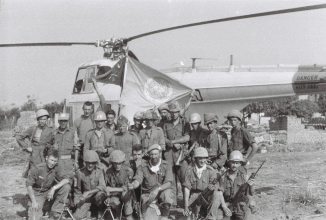
As part of the larger Congo Crisis (1960–1964), the siege of Jadotville begins on September 13, 1961, lasting for five days. While serving under the United Nations Operation in the Congo (Opération des Nations Unies au Congo, ONUC), a small contingent of the Irish Army‘s 35th Battalion, designated “A” Company, are besieged at the UN base near the mining town of Jadotville (modern-day Likasi) by Katangese forces loyal to the secessionist State of Katanga. The siege takes place during the seven-day escalation of hostilities between ONUC and Katangese forces during Operation Morthor. Although the contingent of 156 Irish soldiers repels attacks by a 3,000-strong Katangese force, they are eventually forced to surrender after running out of ammunition and water. “A” Company is subsequently held as prisoners of war for approximately one month, before being released on October 15 as part of a prisoner exchange. The Irish forces inflict approximately 1,300 casualties (including up to 300 killed) on the Katangan force, with no deaths amongst “A” Company.

On the morning of Wednesday, September 13, 1961, the soldiers stationed at Jadotville are informed of Operation Morthor by UN Headquarters at Elisabethville. At 07:40 twenty Katangese troops attack while many of the UN Irish troops of A Company are attending an open-air Mass. Expecting to take the men off-guard, the first attackers move in rapidly. However, they are spotted by an Irish sentry, and a warning shot by Private Billy Ready alerts the company to the threat. Ready is wounded in a later exchange of fire.

The paramilitary Katangese Gendarmerie, which is a combined force of mercenaries, Belgian settlers and local tribesmen, attack the Irish company. The attackers have a strength of 3,000–5,000 men – consisting of mostly Katangese and settlers, but with many Belgian, French and Rhodesian mercenaries armed with a mix of weapons. Additionally, these forces have limited air support from a Fouga CM.170 Magister trainer-light ground attack jet fitted with a pair of underwing bombs and twin 7.5 mm machine guns, which repeatedly attacks the UN position. The Irish soldiers are armed with personal weapons, several water-cooled Vickers machine guns, 60 mm mortars and two Irish-built Ford Mark VI armoured cars under the command of Lieutenant Kevin Knightly.

The Katangese attack in waves of 600 or so, preceded by bombardment from 81 mm mortars and a French 75mm field gun. The Irish Support Platoon of “A” Company knocks out most of the Katangese mortar and artillery positions, including the 75mm gun, with counter-battery fire from 60mm mortars. The fire from the UN Irish positions proves accurate and effective. Mercenary officers are reportedly observed shooting native gendarmes to stem the rout caused in Katangese lines.

The 500 Irish and Swedish UN troops based in Kamina, and Indian army Gurkhas make several attempts to relieve the besieged Irish soldiers. The supporting force of mercenaries beat back these efforts. They have been brought in by Moïse Tshombe, Katanga’s premier, whose secessionist government has been supported by Belgium.

Attempting to reach the besieged “A” Company, the relief column, named “Force Kane” after its commander Commandant John Kane, is stymied in a series of battles at a pinch point called the Lufira Bridge. It carries the Jadotville-to-Elisabethville Highway across the Lufira River. The Katangese forces dig in here and bring heavy and sustained ground and air fire onto the relief column, killing three Indian UN troops, injuring a number of Irish UN troops and ultimately forcing the column off the bridge. Additionally, during the effort to reach the trapped company, the Katanga forces set off charges on the railway bridge to impede potential relief efforts.

On September 14, the Katangan Fouga jet flies passes over the battlefield, dropping bombs that rendered the Company’s vehicles inert and cause injuries to Privates Tahaney and Gormley.

During the siege, the Irish radio to their headquarters: “We will hold out until our last bullet is spent. Could do with some whiskey.”

On September 16, a second attempt to reach the Irish Company is made but fails with another three Indian troops being killed and a further eight soldiers suffering injuries. The Katangese ask Commandant Pat Quinlan for a ceasefire, as their own forces have been seriously diminished. By this time their effective strength may have been reduced to 2,000 men. Later that same day, a ceasefire agreement is reached between Commandant Quinlan and the Burgomaster of the Katangan forces, enabling the Irish troops to re-supply with water. The Gendarmerie retreat from their positions surrounding the UN.

Quinlan lacks any clear direction or communication from his superiors, and the Katangese gradually infringe on the ceasefire agreement to undermine “A” Company’s position. With his position untenable, without any clear orders or promise of assistance, having run out of ammunition and food and being low on water, Quinlan accepts their second offer to surrender. On September 17, Quinlan meets with Katanga Minister Munongo, in which a formal written ceasefire and surrender agreement is made, which contains the proviso that the Irish Company will keep their weapons and be unharmed.

“A” Company, 35th Battalion, suffers five wounded in action during the siege. The Katangese suffered up to 300 killed, including 30 mercenaries and an indeterminate number of wounded, with figures ranging from 300 to 1,000.

The Irish soldiers are held as hostages for approximately one month, in an effort to extort terms of ceasefire that are embarrassing to the United Nations.

After being released, the troops are returned to their base in Elisabethville. Some weeks later, however, “A” Company finds itself in active combat again, this time with the support of Swedish UN troops. Eventually, they are reinforced with fresh troops from Ireland, their replacement being the 36th Battalion. After weeks of fighting and their six-month tour of duty now complete, “A” Company is rotated out of the battle zone and are home in Ireland that December.

In 2016, the Irish government awards a Presidential Unit Citation to “A” Company, the first in the State’s history. In October 2017, a plaque commemorating Quinlan is unveiled in his native County Kerry, by former Taoiseach Enda Kenny. The decision of the State to honour individually the soldiers of Jadotville or their next of kin is one of the last decisions taken by Kenny before he retires as Taoiseach in June 2017. They are presented with newly designed Siege of Jadotville Medals in Athlone on December 2, 2017.

(Pictured: No.3 Platoon, A Company, 35th Battalion, pose in front of a UN relief helicopter, September 17, 1961)