seamus dubhghaill

Promoting Irish Culture and History from Little Rock, Arkansas, USA


Leave a comment

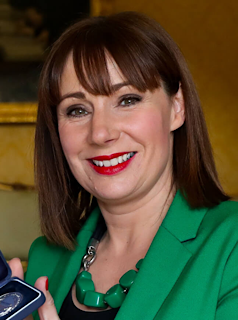
Birth of Josepha Madigan, Fine Gael Politician

Josepha Madigan, former Fine Gael politician, is born in Dublin on May 21, 1970. She serves as Chair of the Committee on Budgetary Oversight from July 2016 to November 2017, Minister for Culture, Heritage, and the Gaeltacht from November 2017 to June 2020, and as Minister of State at the Department of Education from July 2020 to March 2024. She serves as a Teachta Dála (TD) for the Dublin Rathdown constituency from 2016 to 2024.

Madigan attends Mount Anville Secondary School and Trinity College Dublin (TCD). She is married to Finbarr Hayes, and they have two children. Her father, Patrick Madigan, was a Fianna Fáil County Councillor in Dublin, and her mother, Patricia Madigan, was a barrister who had a background in Fine Gael. She and her family live in Mount Merrion, Dublin. She is a survivor of sexual assault.

Madigan is a qualified solicitor, who practises in family law for twenty years, prior to her election to Dáil Éireann. She is also certified as a mediator by the Mediators’ Institute of Ireland (MII) and is a previous Council member of the MII. She is a former Specialist Liaison Officer for Family Mediation in the MII.

Madigan is the author of the first book in Ireland on mediation: Appropriate Dispute Resolution in Ireland, a handbook for family lawyers and their clients (Jordan Publishing, 2012). She has also self-published a novel called Negligent Behaviour.

Madigan serves as a councillor for the local electoral area of Stillorgan on Dún Laoghaire–Rathdown County Council, from May 2014 until her election as a TD in 2016.

Madigan issues a leaflet in 2014 claiming that providing accommodation for Travellers in her constituency would be “a waste of valuable resources.” When asked about this later, she claims, “Some people won’t want to live beside people in halting sites […] there might be more crime, that there might be anti-social behaviour.”

Madigan is elected to the 32nd Dáil at the 2016 Irish general election as a Fine Gael TD for the Dublin Rathdown constituency, defeating sitting Fine Gael TD Alan Shatter by nearly 1,000 votes. She is appointed Chair of the Committee on Budgetary Oversight in July 2017. She is a member of the Public Accounts Committee. She introduces a private member’s bill to reduce the waiting time for divorce in Ireland from four years to two, which is passed by the Dáil.

On November 30, 2017, Madigan is appointed to the cabinet as Minister for Culture, Heritage and the Gaeltacht, in a reshuffle following the resignation of the Tánaiste Frances Fitzgerald.

On March 29, 2018, Fine Gael leader Leo Varadkar appoints Madigan as the coordinator for the party’s Yes campaign in the referendum to repeal the Eighth Amendment.

In 2019, Madigan receives widespread coverage for her role in the personal injury legal claim of Fine Gael politician, Maria Bailey. It is alleged that her law practice, Madigan Solicitors, advised Bailey on her claim, however, Madigan refuses to make any comments on this citing client-solicitor confidentiality. In July 2019, an internal unpublished Fine Gael probe into the affair clears Madigan of any wrongdoing in regard to the claim. In late July 2019, the Irish Independent reports that “it is now known that she advised Ms. Bailey in the early stages of the claim.” It is also reported that her firm would earn €11,500 in fees if the Maria Bailey case were successful.

Madigan is re-elected at the 2020 Irish general election, taking the third seat behind Green Party Deputy Leader Catherine Martin and party colleague Neale Richmond. On July 1, 2020, she is appointed by the new government as Minister of State at the Department of Education with special responsibility for special education and inclusion. On January 14, 2021, she comes under fire for describing children without additional needs as “normal” while speaking in the Dáil. “We all know that even for normal children remote teaching is difficult but for children who have additional needs it is particularly difficult,” she says. Later that day on Twitter, she says she “sincerely apologises for the language she used. It is absolutely not what I meant to say.”

On January 20, 2021, speaking on RTÉ‘s Today with Claire Byrne, Madigan compares children with additional needs not attending school to the mother and baby homes. “We’ve spent the last week talking about mother and baby homes, where our most vulnerable were left to their own devices in less than satisfactory conditions and we’re now allowing further anxiety and upset to be placed on the shoulders of parents whose children desperately need to go back to school.” The Final Report of the Commission of Investigation into Mother and Baby Homes and Related Matters is published the week prior to her comments. She later apologises in a statement: “I am, as are all involved in supporting these children [children with additional needs], passionate about vindicating their rights and in reaching for an analogy I chose poorly. I apologise fully.”

Shortly after the first report of the Creeslough explosion on October 7, 2022, Madigan tweets that she hopes “they find the culprits” and, after being criticised as irresponsible and insensitive, she quickly deletes the tweet.

On March 22, 2024, Madigan announces that she will resign as Minister of State and will not contest the next general election.


Leave a comment

Birth of Henry Armstrong, Northern Irish Barrister & Politician

Henry Bruce Wright Armstrong, Northern Irish barrister and politician, Ulster Unionist Party Member of Parliament (MP) for Mid Armagh from June 1921 until 1922, is born on July 27, 1844, at Hull House in Sholden, a small village adjacent to the seaside town of Deal, Kent, South East England.

Armstrong is the second surviving son of William Jones Wright Armstrong of County Armagh and Frances Elizabeth, widow of Sir Michael McCreagh, and daughter of Major Christopher Wilson. He is educated at The Royal School, Armagh and Trinity College, Cambridge, gaining a BA (2nd Class Law Tripos) in 1867 and an MA in 1870. Admitted at the Inner Temple in 1866, he is called to the Bar in 1868.

In 1883, Armstrong marries Margaret Leader, daughter of William Leader of Rosnalea, County Cork. They have five sons and three daughters, of whom C. W. Armstrong also becomes a politician.

Armstrong is appointed High Sheriff of Armagh for 1875 and High Sheriff of Longford for 1894. He is a County Councillor for Armagh from 1899 to 1920, and a Member of the Irish Convention in 1917–18. Vice-Lieutenant of County Armagh in 1920, he is a Senator of Queen’s University Belfast from 1920 to 1937.

Armstrong is returned unopposed to the House of Commons of the United Kingdom for Mid Armagh in a by-election in 1921, at the advanced age of 76, becoming one of the oldest first-time MPs whose birth date is recorded. Certainly, he immediately becomes the oldest member of the current House of Commons. He is a Senator of Northern Ireland from 1921 to 1937, and Lord Lieutenant of Armagh from 1924 to 1939. For 25 years he is a member of the Representative Body of the Church of Ireland. He is Chairman of the County Armagh Education Committee from 1925 to 1931, and President of the Association of Education Committees of Northern Ireland. In 1932 he is made a Privy Councillor for Northern Ireland, and in 1938 he serves as a Justice for the Government of Northern Ireland in the absence of the Governor.

Armstrong dies at the age of 99 on December 4, 1943, at his home in Dean’s Hill, County Armagh.


Leave a comment

Birth of Mary O’Rourke, Former Fianna Fáil Politician

Mary O’Rourke (née Lenihan), former Fianna Fáil politician, is born in Athlone, County Westmeath, on May 31, 1937.

O’Rourke is educated at St. Peter’s in Athlone, Loreto Bray Convent in County Wicklow, University College Dublin and St. Patrick’s College, Maynooth. She works as a secondary school teacher before beginning her political career.

O’Rourke begins her political career in local politics, serving on Athlone Urban District Council between 1974 and 1987 and on Westmeath County Council between 1979 and 1987. She is elected to Seanad Éireann in 1981 as a Senator for the Cultural and Educational Panel. She stands unsuccessfully for the Dáil at the February 1982 Irish general election but is subsequently re-elected to the Seanad. At the November 1982 Irish general election, she is first elected to Dáil Éireann as a Fianna Fáil TD for the Longford–Westmeath constituency, and from 1992 for the new Westmeath constituency.

In 1987, O’Rourke is appointed Minister for Education by Charles Haughey. She and her brother, Brian Lenihan Snr, become the first brother and sister in Irish history to serve in the same cabinet. In the November 1991 cabinet reshuffle, she becomes Minister for Health. In February 1992, Charles Haughey resigns as Taoiseach and Fianna Fáil leader, and she contests the subsequent leadership election along with Michael Woods and Albert Reynolds. Reynolds wins the election, and she is subsequently dropped from her ministerial position, but is appointed to a junior ministry as Minister of State for Labour Affairs at the Departments of Industry and Commerce, and later Enterprise and Employment.

In 1994, Bertie Ahern becomes party leader, and he appoints O’Rourke as deputy leader of Fianna Fáil, serving in the position until 2002. Following Ahern’s election as Taoiseach in June 1997, she becomes Minister for Public Enterprise, holding this position until she loses her Dáil seat at the 2002 Irish general election. This follows a vote management strategy from Fianna Fáil head office which restricts her from campaigning in her traditional areas around Kilbeggan, in an attempt to win 2 of the 3 seats in Westmeath. The loss of her Dáil seat is also attributed to her association with and the championing of, the privatisation of Telecom Éireann, which proves a financial disaster for many small investors, due to the share price falling radically, post privatisation. During this term as Minister, she also becomes the subject of public criticism by Ryanair chief executive Michael O’Leary. Following the loss of her Dáil seat, she is nominated to Seanad Éireann as a Senator by Taoiseach Bertie Ahern where she becomes Leader of the Seanad and leader of Fianna Fáil in the Seanad.

In January 2006, O’Rourke receives the party nomination to stand at the 2007 Irish general election. She narrowly defeats her nearest rival and Dáil election running mate, Kevin “Boxer” Moran of Athlone Town Council, causing a controversy when she thanks her election team for working “like blacks.” She is re-elected to the Dáil at the May 2007 Irish general election, with her highest ever vote.

In November 2008, during a march against the re-introduction of college fees, students from the Athlone Institute of Technology lay a funeral wreath at the door of O’Rourke’s constituency office. The card in the wreath states “Sincere sympathies on the death of free fees. We will remember this.” She describes the act as “heinous.” The wreath is placed there because she is not speaking at a rally against the fees.

In July 2010, O’Rourke concedes that she does not expect the party to be in power after the next general election. On RTÉ Radio‘s Today with Pat Kenny programme, she says the government is taking tough decisions to steer the country through the financial crisis and this will make it easy for the opposition. She says there is a general air of “crossness” within the Fianna Fáil party over their standing in the polls, but nobody is harboring leadership ambitions to challenge Brian Cowen.

In November 2010, O’Rourke says there is then more to unite her party and Fine Gael than to divide them. She points to the common approach of the two parties to Northern Ireland, Europe and the current financial crisis. In an address to the 1916–1921 Club in Dublin Castle, she says that most voters no longer defined themselves in terms of Civil War politics.

O’Rourke’s senior years lead her to often being referred to as the “Mammy of the Dáil.”

O’Rourke contests the 2011 Irish general election but is defeated on the poll. She had been critical of former Taoiseach Brian Cowen, saying that he should have resigned after his infamous “congested” radio interview. She supports the attack on Cowen by her nephew, former Finance Minister Brian Lenihan Jnr, who says he is “disappointed” by Cowen’s performance, and he had to provide the leadership when the Taoiseach did not.

As well as being a well-known politician, O’Rourke makes regular appearances in the media in a non-political capacity. She has been a contestant on RTÉ‘s reality series Celebrity Bainisteoir, as well as other shows such as Sex & Sensibility. She has guest presented Tonight with Vincent Browne.

In 2012, Just Mary: My Memoir is published. It wins the 2012 Irish Book Award in the “Listeners’ Choice” category.

O’Rourke comes from a strong political family, her father Patrick Lenihan serves as a TD for Longford–Westmeath from 1965 to 1970. Her brother Brian Lenihan is a senior government Minister and Tánaiste. Another brother, Paddy Lenihan, is a County Councillor in Roscommon, but resigns from Fianna Fáil in 1983 and becomes associated with Neil Blaney‘s Independent Fianna Fáil party. Two of her nephews, Brian Lenihan Jnr and Conor Lenihan, both sons of her brother Brian, serve as Ministers. Brian Lenihan Jnr is the Minister for Finance. Conor Lenihan is a Minister of State.

O’Rourke is widowed in January 2001, following the death of her husband, Enda. She has two sons. Aengus O’Rourke, her adopted son, runs for Athlone Town Council in 2009. The other son, Feargal O’Rourke, becomes Managing Partner of PricewaterhouseCoopers in Ireland in 2015 and is considered the “grand architect” of the Double Irish tax system, a major contributor to Ireland’s economic success in attracting U.S. multinationals to Ireland.