seamus dubhghaill

Promoting Irish Culture and History from Little Rock, Arkansas, USA


Leave a comment

Founding of North Tipperary County Council

North Tipperary County Council (Irish: Comhairle Contae Thiobraid Árann Thuaidh) is established on April 1, 1899, under the Local Government (Ireland) Act 1898 for the administrative county of Tipperary, North Riding. It is the local authority of the county of North Tipperary from 1899 to 2014. The head of the council has the title of Cathaoirleach. The county town was Nenagh.

North Tipperary County Council succeeds the judicial county of the North Riding of County Tipperary, except for the district electoral divisions of Cappagh, Curraheen, and Glengar, which become part of South Tipperary.

Originally, North Tipperary County Council holds its meetings in Nenagh Courthouse. The county council relocates to a new facility, known as the Civic Offices, in 2005.

The Local Government (Ireland) Act 1919 introduces the electoral system of proportional representation by means of the single transferable vote (PR-STV) for the 1920 Irish local elections. Tipperary North Riding is divided into five county electoral areas to elect the twenty members of the council.

Under the Local Government Act 2001, North Tipperary County Council is allocated twenty-one seats. The 2009 North Tipperary County Council election is the last election to the council.

On July 26, 2011, Phil Hogan, the Minister for the Environment, Community and Local Government, announces the proposed merger of North Tipperary County Council and South Tipperary County Council. Following implementation of the Local Government Reform Act 2014, it is dissolved on June 1, 2014, and succeeded by Tipperary County Council.

Leave a comment

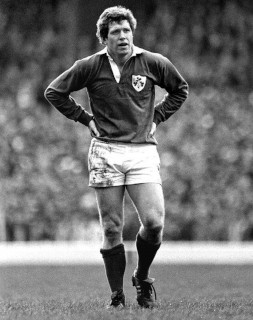
Birth of Fergus Slattery, Rugby Union Player

John Fergus Slattery, former rugby union player who represented Ireland, is born in Dún Laoghaire, the county town of Dún Laoghaire–Rathdown, on February 12, 1949.

Slattery plays club rugby for Blackrock College and University College Dublin before embarking on an international career that takes in 61 caps for Ireland, 18 as captain, and four for the British and Irish Lions. He makes his international debut in a draw against South Africa at Lansdowne Road in 1970.

In 1971, Slattery first tours with the British and Irish Lions squad that toured New Zealand, missing out on a start in the third Test due to illness. With the back-row berths claimed by John Taylor, Peter Dixon and Mervyn Davies and still being a newcomer at international level he has to wait until 1974 for his shot at a Lions Test jersey. In the meantime, he plays for the Barbarian F.C. in the famous 1973 game against the All Blacks in Cardiff.

Slattery tours with the Lions again in 1974, playing in all four Tests and captaining the side for two provincial matches. In South Africa he is an invaluable member of the touring party that comes to be known as “the invincibles.” He starts all four Tests as the Lions win the series 3-0 and skippers the side twice during midweek tour matches.

For Ireland, Slattery captains their hugely successful touring side in Australia in 1979 when they win seven of the eight matches including the two Tests in Brisbane and Sydney. In 1982 he starts all four games of Ireland’s Triple Crown season, being denied the Grand Slam by France in the final game of the Five Nations Championship.

Slattery is inducted into the International Rugby Hall of Fame in 2007.


Leave a comment

Groundbreaking for the West Clare Railway

File source: http://commons.wikimedia.org/wiki/File:CIE_F502_(17156275240).jpg

Charles Stewart Parnell turns the first sod for the construction of the West Clare Railway (WCR) on January 27, 1885, although actual work on the line had begun in November 1884. The line is opened on July 2, 1887.

At the end of the Great Famine there is a new growth in local businesses. The British Government determines that an improved railway system is necessary to aid in the recovery of the West of Ireland. The West Clare Railway and the South Clare Railway are built by separate companies, but in practice the West Clare Railway operates the entire line. The lines meet at Milltown Malbay. In due course the entire line becomes known as the West Clare Railway.

The West Clare Railway originally operates in County Clare between 1887 and 1961. The 3-foot narrow gauge railway runs from the county town of Ennis, via numerous stopping points along the West Clare coast to two termini, at Kilrush and Kilkee, with the routes diverging at Moyasta Junction. The system is the last operating narrow gauge passenger system in Ireland and connects with the mainline rail system at Ennis, where a station still stands today for bus and train services to Limerick and Galway. Intermediate stops include Ennistymon, Lahinch and Milltown Malbay.

On 27 September 27, 1960, CIÉ gives notice of its intending closure with effect from February 1, 1961, despite the dieselisation of passenger services in 1952 and freight in 1953. CIÉ says that the West Clare is losing £23,000 per year, despite the considerable traffic it handles. In December 1960 it is announced that the line would close completely on January 1, 1961 although actual closure does not take place until January 31, 1961. CIÉ begins dismantling the line the following day.

A preservation society maintains a railway museum at Moyasta Junction station, and successfully re-opens a section of the railway as a passenger carrying heritage line with diesel traction in the 1990s, and with steam motive power from 2009.