seamus dubhghaill

Promoting Irish Culture and History from Little Rock, Arkansas, USA


Leave a comment

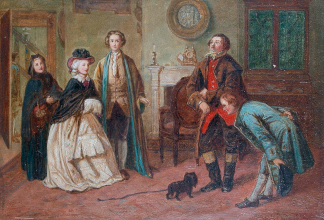
Premiere of Oliver Goldsmith’s Play “The Good-Natur’d Man”

The Good-Natur’d Man, a play written by Oliver Goldsmith in 1768, is first performed at Central London’s Covent Garden on January 29, 1768. The play is written in the form of a comedy with Mary Bulkley as Miss Richland. It is released at the same time as Hugh Kelly‘s False Delicacy, staged at Drury Lane Theatre. The two plays go head-to-head, with Kelly’s proving the more popular. Goldsmith’s play is a middling success, and the printed version of the play becomes popular with the reading public.

Although his birth date and year and birthplace are not known with any certainty, it is believed that Goldsmith is born on November 10, 1728, in Kilkenny West, County Westmeath. He is an Anglo-Irish essayist, poet, novelist, dramatist, and eccentric, made famous by such works as the series of essays The Citizen of the World, or, Letters from a Chinese Philosopher (1762), the poem The Deserted Village (1770), the novel The Vicar of Wakefield (1766), and the play She Stoops to Conquer (1773).

Goldsmith is the son of an Anglo-Irish clergyman, the Rev. Charles Goldsmith, curate in charge of Kilkenny West. At about the time of his birth, the family moves into a substantial house at nearby Lissoy, where he spends his childhood. Much has been recorded concerning his youth, his unhappy years as an undergraduate at Trinity College Dublin, where he received the BA degree in February 1749, and his many misadventures before he leaves Ireland in the autumn of 1752 to study in the medical school at Edinburgh. By this time his father has died, but several of his relations support him in his pursuit of a medical degree. Later on, in London, he comes to be known as Dr. Goldsmith, Doctor being the courtesy title for one who holds the Bachelor of Medicine, but he takes no degree while at Edinburgh nor, so far as anyone knows, during the two-year period when, despite his meagre funds, which are eventually exhausted, he somehow manages to make his way through Europe. The first period of his life ends with his arrival in London, bedraggled and penniless, early in 1756.

Goldsmith’s rise from total obscurity is a matter of only a few years. He works as an apothecary‘s assistant, school usher, physician, and as a hack writer, reviewing, translating, and compiling. Much of his work is for Ralph Griffiths‘s Monthly Review. It remains amazing that this young Irish vagabond, unknown, uncouth, unlearned, and unreliable, is yet able within a few years to climb from obscurity to mix with aristocrats and the intellectual elite of London. Such a rise is possible because he has one quality, soon noticed by booksellers and the public, that his fellow literary hacks do not possess – the gift of a graceful, lively, and readable style.

Goldsmith’s rise begins with the Enquiry into the Present State of Polite Learning in Europe (1759), a minor work. Soon he emerges as an essayist, in The Bee and other periodicals, and above all in his Chinese Letters. These essays are first published in the journal The Public Ledger and are collected as The Citizen of the World in 1762. The same year brings his The Life of Richard Nash. Already he is acquiring those distinguished and often helpful friends whom he alternately annoys and amuses, shocks and charms – Samuel Johnson, Sir Joshua Reynolds, Thomas Percy, David Garrick, Edmund Burke, and James Boswell.

The obscure drudge of 1759 becomes in 1764 one of the nine founder-members of the famous The Club, a select body, including Reynolds, Johnson, and Burke, which meets weekly for supper and talk. Goldsmith can now afford to live more comfortably, but his extravagance continually runs him into debt, and he is forced to undertake more hack work. He thus produces histories of England and of ancient Rome and Greece, biographies, verse anthologies, translations, and works of popular science.

Goldsmith’s premature death on April 4, 1774, may be partly due to his own misdiagnosis of a kidney infection. He is buried in Temple Church in London. A monument is originally raised to him at the site of his burial, but this is destroyed in an air raid in 1941. A monument to him survives in the centre of Ballymahon, also in Westminster Abbey with an epitaph written by Samuel Johnson.

Among Goldsmith’s papers is found the prospectus of an encyclopedia, to be called the Universal dictionary of the arts and sciences. He wishes this to be the British equivalent of the Encyclopédie and it is to include comprehensive articles by Samuel Johnson, Edmund Burke, Adam Smith, Edward Gibbon, Sir Joshua Reynolds, Sir William Jones, Charles James Fox and Dr. Charles Burney. The project, however, is not realised due to Goldsmith’s death.

(Pictured: “Mr Honeywell introduces the bailiffs to Miss Richland as his friends,”a scene from the play “The Good-Natur’d Man” by Oliver Goldsmith, oil on panel by William Powell Frith)
Leave a comment

Birth of Stage Actress George Anne Bellamy

george-anne-bellamy

George Anne Bellamy, English actress whose stage career and personal life are, in their irregularity, not entirely atypical of her era, is born in County Fingal on April 23, 1727. Her best performances are in such tragic roles as Desdemona in Othello and Juliet in Romeo and Juliet.

Bellamy is the illegitimate daughter of a Quaker lady who elopes from boarding school with the diplomat James O’Hara, 2nd Baron Tyrawley. She is named George Anne through a mishearing of the name Georgiana at her christening. Though her mother marries a Captain Bellamy in Lisbon, Bellamy is acknowledged by Tyrawley as his daughter and he provides for her needs, including her education at a convent in Boulogne-sur-Mer. While living with her mother in London, she meets the theatrical manager John Rich and other leading stars of the stage, and she soon determines to pursue an acting career.

Bellamy’s early roles at Covent Garden, beginning about 1744, are as Miss Prue in Love for Love and with James Quin in The Orphan. Her reputation as an actress rests largely on her good looks and her “soft” feminine manner. Her career reaches its pinnacle when, in 1750, her performance of Juliet to David Garrick’s Romeo at Theatre Royal, Drury Lane is said to surpass the work of the revered Susannah Cibber in a rival production of the play at Covent Garden.

Riotous living, including a legal and a bigamous marriage, takes its toll on Bellamy’s beauty and her appeal to managers. Her later life is marred by ill health and credit troubles. Her last appearance is at Drury Lane on May 24, 1785, at her own benefit concert. She is unable to act but speaks briefly to the audience.

In the same year Bellamy publishes “An Apology for the Life of George Anne Bellamy” in six volumes. The salacious work is said to be ghost written by Alexander Bicknell.

George Anne Bellamy dies in poverty on February 16, 1788, in London.

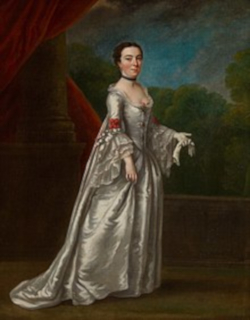
(Pictured: George Anne Bellamy by F Lindo exhibited in 1833 now owned by Garrick Club)


Leave a comment

Birth of Actress Margaret “Peg” Woffington

peg-woffington

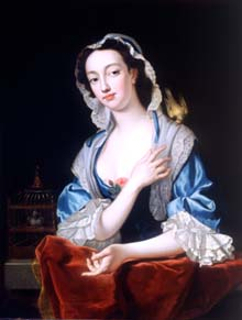
Margaret “Peg” Woffington, well-known Irish actress in Georgian London, is born of humble origins in Dublin on October 18, 1720.

Woffington’s father is believed to have been a bricklayer, and, after his death, the family becomes impoverished. Her mother is obliged to take in washing while Peg sells watercress door to door. It is said that she is walking through a marketplace as a pre-teen and happens upon Madame Signora Violante, a famous tightrope walker. Violante is so immediately enthralled by Peg’s beautiful face that she accompanies her home and asks her mother permission to take her in as her apprentice.

Around 1730, Violante features Woffington as Polly Peachum in a production of John Gay’s The Beggar’s Opera. This serves as a springboard for her fame in Dublin, and she continues dancing and acting in the area playing Dorinda in an adaptation of The Tempest at the Theatre Royal, Dublin in 1735 and joining the Smock Alley Theatre to perform with well-known actor David Garrick.

Woffington dances and acts at various Dublin theaters until her success as Sir Harry Wildair in The Constant Couple leads to her being given her London debut at Covent Garden. She becomes well known as an actress thereafter.

Woffington enjoys success in the role of Sylvia in The Recruiting Officer. She performs at Drury Lane for several years and later returns to Dublin, appearing in a variety of plays. Her most well-received performances are in comic roles, such as elegant women of fashion like Lady Betty Modish and Lady Townley, and breeches roles. She is impeded in the performance of tragedy by a harsh tone in her voice that she strives to eliminate.

Woffington lives openly with David Garrick, the foremost actor of the day, and her other love affairs are numerous and notorious. She becomes friend and mentor to the socialite/actress sisters, Elizabeth and Maria Gunning, and also shares the stage with the likes of Charles Macklin, Kitty Clive, and the tragedienne Susannah Maria Arne.

Though Woffington is popular with society figures, she is not always favored by her competition. She tends to create rivalries with similar-type actresses at Drury Lane and Covent Garden. Her fiercest rivalry is with “equally peppery” actress Kitty Clive. According to Garrick biographer Thomas Davies, “No two women in high life ever hated each other more unreservedly than these two great dames of the stage.” When she returns to Covent Garden, rivalries with these women and with the manager, John Rich, eventually send her back to Dublin, where she is unrivaled and celebrated at the Smock Alley Theatre.

Rich decides to start a Beefsteak Club in 1749, also known as the Sublime Society of Steaks or “the Club.” Some of its members include Garrick and William Hogarth, as well as many other London celebrities. Not only is Woffington the first female member of the all-male dining club, in 1750 she becomes president of the club by election. She also educates and supports her sister and cares for and pensions her mother.

For whatever reason, Woffington leaves Garrick in about 1744 and moves to Teddington, into a house called Teddington Place. In 1754 she becomes the beneficiary of the will of the Irish impresario Owen Swiny. In 1756, she performs the part of Lady Randolph in Douglas, a part which finds a later exponent in Sarah Siddons.

On May 3, 1757, Woffington is playing the part of Rosalind in As You Like It when she collapses on stage. She rallies but would never act again, lingering with a wasting illness. She dies in Queen Square, Westminster on March 28, 1760. She is buried in St. Mary with St. Alban, the parish church in Teddington.


Leave a comment

Birth of Irish Writer Arthur Murphy

arthur-murphy

Arthur Murphy, Irish writer also known by the pseudonym Charles Ranger, is born at Cloonyquin, County Roscommon, on December 27, 1727, the son of Richard Murphy and Jane French.

Murphy studies at Saint-Omer in France, and is a gifted student of the Latin and Greek classics. He works as an actor in the theatre, becomes a barrister, a journalist and finally a playwright. He edits Gray’s Inn Journal between 1752 and 1754. As Henry Thrale‘s oldest and dearest friend, he introduces Samuel Johnson to the Thrales in January 1765. He is appointed Commissioner of Bankruptcy in 1803.

Murphy is known for his translations of Tacitus in 1753, which are still published as late as 1922. He also writes three biographies – Fielding‘s Works (1762), An Essay on the Life and Genius of Samuel Johnson (1792), and Life of David Garrick (1801).

An example of Murphy’s theatrical writings is The Citizen, a farce, first produced at Drury Lane in 1761. Philpot, a wealthy skinflint, has bargained with Sir Jasper Wilding for his son Young Philpot to marry Maria Wilding, and for his daughter Sally to marry Wilding’s son, for settlements and twenty thousand pounds paid to Sir Jasper. Young Philpot has lost a fortune, but borrows money from his father and embarks on an insurance fraud involving shipwrecked goods. Maria plans to marry Beaufort, who loves her. As Young Philpot tries to propose, she convinces him she is half-witted, and he spurns her. In the second act, Philpot senior is visiting Corinna, a lady of loose virtue, but hides under the table when his son calls upon her. He overhears as Young Philpot tells her how he has cajoled the money out of his father. Maria’s brother surprises them, and old Philpot is also discovered, to their mutual shame. In the final scene Sir Jasper with a lawyer obtains Philpot’s signature to the agreements, but meanwhile Maria, an educated girl, shows her strong character to Young Philpot and he again refuses to propose. Having signed away his rights old Philpot offers to marry her, but the lawyer reveals himself as Beaufort, and explains that he has swapped the deeds, so that Philpot has unwittingly signed his agreement for Maria to marry Beaufort.

Murphy is thought to have coined the legal term “wilful misconstruction” whilst representing the Donaldson v. Becket appeal to the House of Lords in 1774 against the perpetual possession of copyright.

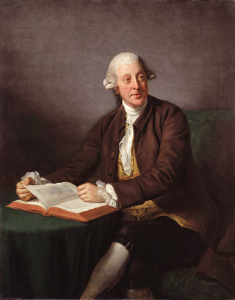
Arthur Murphy dies at Knightsbridge, London, on June 18, 1805, and is buried at Hammersmith, London. A biography is written in 1811 by Dr. Jesse Foot. Nathaniel Dance-Holland paints Murphy’s portrait which is thought to now be in the Irish National Portrait Collection.

(Pictured: 1777 portrait of Arthur Murphy by Nathaniel Dance-Holland)


2 Comments

Birth of Irish Actor Spranger Barry

spranger-barry

Spranger Barry, actor, is born in Skinner’s Row, Dublin, on November 23, 1719. Barry is the son of a silversmith, to whose business he is brought up. He takes over the business but is not successful.

His first appearance on the stage is at the Theatre Royal, Smock Alley, Dublin, on the February 5, 1744, and this engagement at once increases its prosperity. His first London appearance is made in 1746 as Othello at the Theatre Royal, Drury Lane. Here his talents are speedily recognized, and in Hamlet and Macbeth he alternates with David Garrick, arousing the latter’s jealousy by his success as Romeo. This results in his leaving Drury Lane for the Covent Garden Theatre in 1750, accompanied by Susannah Maria Cibber, his Juliet. Both houses simultaneously put on Romeo and Juliet for a series of rival performances, and Barry’s Romeo is preferred by the critics to Garrick’s.

In 1758, Barry opens the Crow Street theatre in Dublin, and later a new theatre in Cork. He stages many successful productions but seems to have lived beyond his means. In 1767 he returns to London to play at the Haymarket Theatre, then under the management of Samuel Foote. As his second wife, he marries in 1768 the actress Ann Street Dancer, and he and Mrs. Barry play under Garrick’s management, Barry appearing in 1767, after ten years absence from the London stage, in Othello, his greatest part. In 1774 they both move to Covent Garden, where Barry remains until his death on January 10, 1777.