
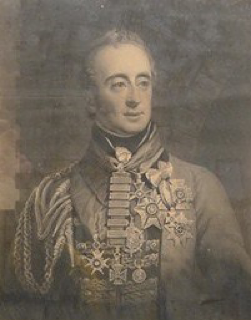
Sir Denis Pack, British Army major general who serves in the French Revolutionary and Napoleonic Wars, dies in London on July 24, 1823.
Pack is born on October 7, 1775 in Kilkenny, County Kilkenny, the younger son of Rev. Thomas Pack, Dean of Ossory, and Catherine Pack (née Sullivan), of St. Andrew’s parish, Dublin. In June 1790, he enters Trinity College Dublin (TCD), aged 15, but does not take his degree. His elder brother, Thomas Pack, previously attends TCD, but dies in December 1786.
Pack enters the army in November 1791, being commissioned as a cornet in the 14th Light Dragoons, and serves with this regiment in Flanders in 1794 as part of Francis Rawdon-Hastings‘s expedition. Transferring to the 8th Light Dragoons, he is promoted to lieutenant In March 1795 and takes part in the expedition to Quiberon Bay. He is promoted to captain in February 1796 and serves with the 5th Dragoon Guards in Ireland during the Irish Rebellion of 1798. Promoted to major In August 1798, he is attached to the 4th Royal Irish Dragoon Guards, and after the surrender of the French expeditionary force at Ballinamuck, County Longford, on September 8, 1798 he commands the troops that escort General Jean Joseph Amable Humbert and the other French officers to Dublin.
Promoted to lieutenant colonel in December 1800, Pack commands the 71st (Highland) Regiment of Foot and takes part in the expedition to the Cape of Good Hope in 1806. He then takes part in General John Whitelocke‘s expedition to South America and is captured after an unsuccessful attack on Montevideo. His fellow-prisoner is William Carr Beresford, later 1st Viscount Beresford, and the two men remain friends for the rest of their lives. Refusing to give their parole to General Santiago de Liniers, they escape from La Plata in a boat, meeting a British cruiser at sea. Pack later takes part in the successful attack on Montevideo on February 9, 1807.
Pack is posted to Portugal in 1808 and is present at the Battle of Roliça on August 17 and the Battle of Vimeiro on August 21. In 1809, he takes part in the Walcheren Campaign and, promoted to colonel in July 1810, he is made aide-de-camp to George III. Returning to Portugal in 1810, he serves under Beresford, commanding a Portuguese brigade, and takes part in the Battle of Bussaco on September 27, 1810. Promoted to brigadier general in January 1812, he takes part in the Siege of Ciudad Rodrigo and is present at the Battle of Salamanca on July 22, 1812. In June 1813, he is promoted to major general and later is present at the battles of Vitoria (June 21, 1813), Nivelle (November 10, 1813), Nive (December 10-13, 1813), Orthez (February 27, 1814) and the final French defeat at Toulouse (April 10, 1814). In January 1815, he is made a Knight Commander of the Order of the Bath (KCB) in recognition of his services in the Peninsula.
During the Waterloo campaign of 1815, Pack commands one of the brigades in General Sir Thomas Picton‘s division. Present at the Battle of Quatre Bras (June 16, 1815), he plays a prominent part in the Battle of Waterloo, bringing his brigade forward at a crucial moment to stop the advance of the French 3rd Division under General Pierre-Louis Binet de Marcognet. During the course of his career he is wounded several times and is awarded numerous honours including the Peninsular Gold Cross (with seven clasps), the Military Order of the Tower and Sword (Portugal) and the Order of Saint Vladimir (Russia). In 1819, he is appointed Lieutenant-Governor of Plymouth, and is later made honorary colonel of the 84th (York and Lancaster) Regiment of Foot in 1822.
In July 1816, Pack marries Lady Elizabeth Louisa de la Poer Beresford, daughter of George Beresford, 1st Marquess of Waterford. They have two sons and two daughters. His descendants adopted “Pack-Beresford” as their family name. He dies on July 24, 1823, at Lord Beresford’s house in Upper Wimpole Street, London. A monument to him is later erected in St. Canice’s Cathedral, Kilkenny. A portrait by G. L. Saunders is in family possession; another by Charles Turner, showing Pack wearing his numerous orders and decorations, is in the National Portrait Gallery, London. A collection of his papers is held by the University of Southampton.

 seamus dubhghaill