
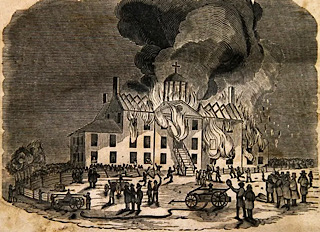
Shortly after midnight on August 12, 1834, a Protestant mob attacks and burns the Ursuline Convent School in Charlestown, Massachusetts (now part of Somerville), an act that becomes a flashpoint in the region’s anti-Catholic tensions.
The Ursuline Convent, founded in 1820 by Bishop Jean-Louis Lefebvre de Cheverus, is a Catholic school for girls established to educate the poor. It is built on a 24-acre estate with brick structures, gardens, and a chapel, attracting both Catholic and Protestant students. By the early 1830s, about 50–60 Protestant girls from wealthy families attend, alongside Catholic students.
Rev. Lyman Beecher helps to incite the mob hours earlier, giving three anti-Catholic diatribes at three different churches in Boston. Beecher, whose children include educator Catharine and abolitionist and author of Uncle Tom’s Cabin, Harriet Beecher Stowe, later expresses regret over the arson but, as is often the case, violent speech leads to violent action.
The riots are sparked by rumors and gossip about a nun, Elizabeth Harrison (Sister Mary St. John), who had left the convent for 24 hours on July 28 to visit a student’s family and then returned. Her decision to leave and return is framed by anti-Catholic sympathizers as evidence of instability or even “insanity,” feeding existing prejudices. These rumors are amplified by the “Know Nothing” nativist movement, which is gaining traction in Massachusetts.
In the early morning hours of August 12, 1834, a Protestant mob—largely poor Yankee laborers hostile to Irish Catholic immigrants—sack the convent. The nuns and their students flee for their lives, and the convent is set ablaze. The destruction is swift and complete, leaving only the ruins.
The burning reflects deep-seated anti-Catholic sentiment in New England, rooted in colonial-era restrictions on Catholic worship and reinforced by Irish immigration and Protestant revivalism. It foreshadows the more violent nativist uprisings of the 1850s, such as the Know Nothing Party’s later attacks on Catholic institutions.
Those arrested for the outrage are quickly found not guilty and become heroes in Boston. After failed attempts to get the Commonwealth of Massachusetts to pay for the damages, and amid threats of further violence, the nuns eventually move to Canada, driven from the country by bigotry and hate.
The convent is never rebuilt, and the event becomes a symbol of sectarian violence. Survivors and the community face legal and social challenges, and the incident is widely reported in newspapers, fueling further anti-Catholic rhetoric.
In short, the 1834 Charlestown convent burning is both a localized mob attack and a harbinger of the intense anti-Catholic nativism that defines much of antebellum America.

