seamus dubhghaill

Promoting Irish Culture and History from Little Rock, Arkansas, USA


Leave a comment

The Ursuline Convent Riots in Massachusetts

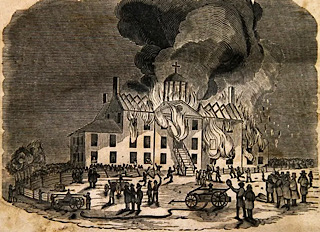
Shortly after midnight on August 12, 1834, a Protestant mob attacks and burns the Ursuline Convent School in Charlestown, Massachusetts (now part of Somerville), an act that becomes a flashpoint in the region’s anti-Catholic tensions.

The Ursuline Convent, founded in 1820 by Bishop Jean-Louis Lefebvre de Cheverus, is a Catholic school for girls established to educate the poor. It is built on a 24-acre estate with brick structures, gardens, and a chapel, attracting both Catholic and Protestant students. By the early 1830s, about 50–60 Protestant girls from wealthy families attend, alongside Catholic students.

Rev. Lyman Beecher helps to incite the mob hours earlier, giving three anti-Catholic diatribes at three different churches in Boston. Beecher, whose children include educator Catharine and abolitionist and author of Uncle Tom’s Cabin, Harriet Beecher Stowe, later expresses regret over the arson but, as is often the case, violent speech leads to violent action.

The riots are sparked by rumors and gossip about a nun, Elizabeth Harrison (Sister Mary St. John), who had left the convent for 24 hours on July 28 to visit a student’s family and then returned. Her decision to leave and return is framed by anti-Catholic sympathizers as evidence of instability or even “insanity,” feeding existing prejudices. These rumors are amplified by the “Know Nothingnativist movement, which is gaining traction in Massachusetts.

In the early morning hours of August 12, 1834, a Protestant mob—largely poor Yankee laborers hostile to Irish Catholic immigrants—sack the convent. The nuns and their students flee for their lives, and the convent is set ablaze. The destruction is swift and complete, leaving only the ruins.

The burning reflects deep-seated anti-Catholic sentiment in New England, rooted in colonial-era restrictions on Catholic worship and reinforced by Irish immigration and Protestant revivalism. It foreshadows the more violent nativist uprisings of the 1850s, such as the Know Nothing Party’s later attacks on Catholic institutions.

Those arrested for the outrage are quickly found not guilty and become heroes in Boston. After failed attempts to get the Commonwealth of Massachusetts to pay for the damages, and amid threats of further violence, the nuns eventually move to Canada, driven from the country by bigotry and hate.

The convent is never rebuilt, and the event becomes a symbol of sectarian violence. Survivors and the community face legal and social challenges, and the incident is widely reported in newspapers, fueling further anti-Catholic rhetoric.

In short, the 1834 Charlestown convent burning is both a localized mob attack and a harbinger of the intense anti-Catholic nativism that defines much of antebellum America.


Leave a comment

The Broad Street Riot

The Broad Street Riot, a massive brawl between Irish Americans and Yankee firefighters, occurs in Boston, Massachusetts, on June 11, 1837. At the time of this particular riot, nearly all of Boston’s firefighters are volunteers.

Boston is a major center for immigration in the 19th century due to its large seaport. Nativist and anti-Catholic sentiment is strong, especially among working-class men whose jobs and wages are threatened by an influx of poor Irish immigrants. On Broad Street, it is common for groups of nativist Yankees to vandalize Irish homes and attack lone Irishmen.

At about 3:00 PM on Sunday, June 11, 1837, Fire Engine Company 20 returns to their station on East Street from a fire at the Boston Neck. Some of the men go straight home from there, however most stop at a nearby pub for drinks. The pub is apparently operating illegally as it is a Sunday and, in Massachusetts, blue laws are then in effect.

The men have just emerged from the pub “in a more or less bellicose mood,” when they collide with a crowd of about a hundred Irishmen who are on their way to join a large funeral procession on Sea Street. Nearly all of the firefighters pass through the crowd without incident, however, when 19-year-old George Fay, who has reportedly had too much to drink, insults or shoves several of the Irishmen, and a fight breaks out. Fay’s friends rush to his aid, but the firemen are outnumbered and are badly beaten. Their foreman, W.W. Miller, orders them back into the firehouse.

By some accounts, the Irishmen then take over the firehouse. According to others, the crowd had begun to disperse, and the matter might have ended there had the foreman not “lost his head completely.” In any case, Miller orders his men to sound the emergency alarm. First, they roll their wagon into the street, ringing the fire alarm bell. Then Miller sends men to ring the church bells, summoning all the fire engines in Boston. According to the Boston Transcript, Miller then runs to another firehouse, shouting, “The Irish have risen upon us, and are going to kill us!”

Company 9, responding to what they think is a legitimate fire alarm, arrives just as the funeral procession is turning onto New Broad Street. Their horse-drawn wagon veers into the crowd, scattering and knocking down the mourners. The Irish assume the assault is deliberate, and another brawl erupts. As more fire companies arrive, and Irishmen pour out of nearby houses into the street to help their friends and relatives, the fight escalates into a full-blown riot. Before long, an estimated 800 men are doing battle with sticks, stones, bricks, and cudgels while at least 10,000 more urged them on. Protestant workmen come running to the aid of the firefighters, while underfoot, injured and unconscious men lay sprawled on the pavement.

Outnumbered, the Irish are defeated and driven back to their homes. That is when the home invasions begin. A “gang of stout boys and loafers” raid nearby houses, breaking doors and windows, and in some cases beating the occupants. Furniture and other possessions are destroyed and thrown into the street. Some Irish families lose their homes altogether.

After raging for about three hours, the riot is quelled when Mayor Samuel Atkins Eliot calls in the National Lancers, a newly formed cavalry company, and some 800 other members of the state militia with fixed bayonets. Among them are the Montgomery Guards, a short-lived Irish American infantry company which is forced to disband the following year due to the extreme nativist and anti-Catholic sentiment in Boston.

No immediate deaths result from the violence. Many people suffer serious wounds, however, and there is no nearby hospital to care for them. Given the lack of hospital and police records, the number of people who eventually die of their injuries cannot be determined. Thousands of dollars in damage are done to property belonging to some of the city’s poorest inhabitants.

The militia, being composed nearly entirely of Yankees, arrest 34 Irishmen and 4 Yankees. A grand jury indicts 14 of the Irishmen and all four of the Yankees. At the municipal court trial, a Yankee jury acquits the four Yankees and convicts four Irishmen, three of whom are sentenced to several months of hard labor.

Three months later, in September, Mayor Eliot establishes a professional, paid fire department, with all new hires requiring the approval of the mayor and aldermen. The Boston Police Department is established the following year.