seamus dubhghaill

Promoting Irish Culture and History from Little Rock, Arkansas, USA


Leave a comment

1993 Fivemiletown Ambush

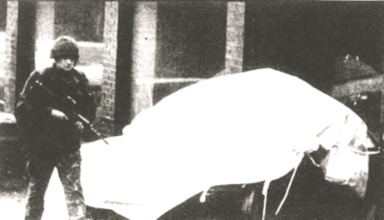
On December 12, 1993, a unit of the Provisional Irish Republican Army‘s (IRA) East Tyrone Brigade ambushes a two-men unmarked mobile patrol of the Royal Ulster Constabulary (RUC) in Fivemiletown, County Tyrone. Two constables, Andrew Beacom and Ernest Smith, are shot and killed instantly. A military helicopter is also fired at by a second IRA unit in the aftermath of the incident, during a follow-up operation launched in the surroundings of the town by both the British Army and the RUC. A number of suspects are questioned, but the perpetrators make good their escape. The action occurs just three days before the Downing Street Declaration.

Fivemiletown lays in the western edge of the Clogher Valley, near the border between County Fermanagh and County Tyrone. No deaths directly related with paramilitary activity has occurred there during the Troubles prior to the 1993 IRA shootings, though there are a number of incidents in the region in the previous months.

On May 7, 1992, members of the IRA South Fermanagh Brigade detonate a 1,000-pound bomb delivered by a tractor after crossing through a hedge outside the local RUC part-time barracks. The huge explosion leaves ten civilians wounded and causes widespread damage to the surrounding property. The security base itself is heavily damaged and the blast is heard 30 miles away. According to a later IRA statement, the destruction of the security base compels the British forces to organise their patrols from the nearby RUC barracks at Clogher, allowing the East Tyrone Brigade to study their pattern and carry out the 1993 ambush at Fivemiletown’s main street.

A secondary incident occurs some hours later, on May 9, when a British soldier kills his company’s sergeant major in a blue-on-blue shooting at the same place while taking part in a security detail around the wrecked facilities.

On January 20, 1993, the RUC base in Clogher is hit and severely damaged by a Mark-15 “barrack buster” mortar bomb launched by the IRA’s East Tyrone Brigade. A number of constables receive minor injuries.

Constable Andrew Beacom and Reserve Constable Ernest Smith are patrolling Fivemiletown’s Main Street in a civilian-type, unmarked Renault 21 on the early hours of December 12, 1993. Both men are part of the RUC Operational Support Unit, which surveils the border along with the British Army. The constables are based at Clogher RUC barracks.

The IRA reports that two active service units from the East Tyrone Brigade had taken up positions in the centre of Fivemiletown and identified the RUC unmarked vehicle before the ambush.

At 1:30 a.m., up to the junction of Main Street and Coneen Street, at least two IRA volunteers open fire from both sides of the road with automatic weapons, hitting the vehicle with more than 20 rounds. Beacom and Smith die on the spot. Constable Beacom lives in Fivemiletown, just a hundred metres from the site of the ambush, where his wife owns a restaurant. She is one of the first persons to arrive to the scene of the shooting. Smith resides with his family at Augher.

According to a colleague in the Operational Support Unit, himself a reserve constable deployed at Lisnaskea and a former Ulster Defence Regiment (UDR) soldier, their deaths “hit the unit very hard.” The men are appreciated for their in-depth knowledge of the area.

A “major” follow-up security operation is mounted between Fivemiletown and the border with the Republic of Ireland, supported by airborne troops and RUC reinforcements, in an attempt to block the attacker’s escape.

Approximately an hour after the ambush, an Army Air Corps (AAC) Westland Lynx helicopter comes upon a number of IRA volunteers in the searching area, just a few miles from the site of the shooting, but the aircraft becomes the target of automatic rifle fire and is forced to disengage. Though the helicopter is not hit, the assailants break contact successfully. The IRA East Tyrone Brigade report claims that the attack on the Westland Lynx is carried out by a second active service unit, which set up a firing position on the predicted path of the British helicopters carrying reinforcements into Fivemiletown after the initial shooting. A number of people are arrested and questioned about the killings, but the perpetrators manage to slip away.

The shootings are widely condemned. RUC Chief Constable Sir Hugh Annesley says that “At a time when the whole community is looking toward peace, the Provisional IRA has yet again shown they have absolutely nothing to offer but deaths and suffering.”

Presbyterian Moderator Rev. Andrew Rodgers calls on the governments to break any contact with Sinn Féin and other “men of blood in both sections of the community.”

A former IRA member cites instead the answer of an IRA volunteer in the area when questioned by him about the futility of the actions at Fivemiletown. He replies that “The war must go on.”

On December 15, 1993, just three days after the attack, the ambush and killing of the two constables at Fivemiletown is mentioned by Member of Parliament Ken Maginnis and Prime Minister John Major during the latter’s speech to the House of Commons right after the joint Downing Street Declaration with Albert Reynolds, the Irish Taoiseach, that sets the basis of the Northern Ireland peace process.

(Pictured: A photograph showing a British Army sentry guarding the scene of the IRA ambush on a Royal Ulster Constabulary mobile patrol, December 12, 1993)

Leave a comment

Death of Patrick Mayhew, British Barrister, Politician & Northern Ireland Secretary

Patrick Barnabas Burke Mayhew, Baron Mayhew of Twysden, PC, QC, DL, British barrister, politician and Secretary of State for Northern Ireland, who serves during a critical period in the Northern Ireland peace process, dies at his home in Kent, England, on June 25, 2016. He is a key figure in the December 1993 Downing Street Declaration which leads to the Provisional Irish Republican Army (IRA) ceasefire on August 31, 1994

Mayhew is born on September 11, 1929. His father, George Mayhew, is a decorated army officer turned oil executive. His mother, Sheila Roche, descendant of members of the Anglo-Irish Protestant ascendancy, is a relative of James Roche, 3rd Baron Fermoy, an Irish National Federation MP for East Kerry. Through his father, Mayhew is descended from the Victorian social commentator Henry Mayhew. He is educated at Tonbridge School, an all boys public school in Tonbridge, Kent.

Mayhew then serves as an officer in the 4th/7th Royal Dragoon Guards, studies law at Balliol College, Oxford, and is president of the Oxford University Conservative Association (OUCA) and of the Oxford Union. He is called to the Bar by the Middle Temple in 1955.

In 1963, Mayhew marries The Rev. Jean Gurney, and they have four sons.

Mayhew contests Dulwich at the 1970 United Kingdom general election, but the incumbent Labour Party member, Samuel Silkin, beats him by 895 votes. He is Member of Parliament (MP) for Tunbridge Wells from its creation at the February 1974 United Kingdom general election, standing down at the 1997 United Kingdom general election.

Mayhew is Under Secretary of Employment from 1979 to 1981, then Minister of State at the Home Office from 1981 to 1983. After this, he serves as Solicitor General for England and Wales from 1983 to 1987, and then Attorney General for England and Wales and simultaneously Attorney General for Northern Ireland from 1987 to 1992.

Mayhew is Secretary of State for Northern Ireland from 1992 to 1997, the longest anyone has served in this office.

Mayhew is one of only five Ministers (Tony Newton, Kenneth Clarke, Malcolm Rifkind and Lynda Chalker are the others) to serve throughout the whole 18 years of the premiership of Margaret Thatcher and John Major. This represents the longest uninterrupted Ministerial service in Britain since Henry John Temple, 3rd Viscount Palmerston, in the early 19th century.

Mayhew is knighted in 1983. On June 1997, he is given a life peerage as Baron Mayhew of Twysden, of Kilndown in the County of Kent. He retires from the House of Lords on June 1, 2015.

Mayhew suffers from cancer and Parkinson’s disease in his later years. He dies at the age of 86 on June 25, 2016, in his home in Kent.

Mayhew’s son, The Honourable Henry Mayhew, appears in the fourth episode of the series The Secret History Of Our Streets, discussing life in the Portland Road, Notting Hill, London. Another son, Tristram, co-founds the outdoor adventure company Go Ape. His son Jerome is the Conservative Party MP for the constituency of Broadland in Norfolk since December 2019.


Leave a comment

The Provisional Irish Republican Army Ceasefire Announcement

The Provisional Irish Republican Army (IRA) announces a ceasefire on August 31, 1994, after a quarter century of what it calls its “armed struggle” to get the British out of Northern Ireland. The statement comes just after 11:00 a.m. BST and says there will be a “complete cessation of military operations” from midnight and that the organisation is willing to enter into inclusive talks on the political future of the Province.

The statement raises hopes for peace and an end to 25 years of bombing and shooting that led to the deaths of more than 3,000 people. There is scepticism from the loyalist community and celebration in the Catholic areas of Belfast and Derry.

The Irish Minister for Foreign Affairs, Dick Spring, says the statement is historic and meets his government’s demand for an unconditional end to IRA violence. The Irish Taoiseach (Prime Minister), Albert Reynolds, calls on loyalist paramilitaries to follow suit.

But loyalists are suspicious of the declaration and fear it may lead to a sell-out in which Northern Ireland’s position within the United Kingdom is under threat. The Ulster Unionist Party (UUP) MP James Molyneaux says no moves towards talks should begin until the IRA has added the word “permanent” to the ceasefire declaration.

The announcement comes 18 months after secret talks began between the British Government and Irish republicans. It leads to the Anglo-Irish Downing Street Declaration in December 1993 which states that any change in the partition of Ireland can only come with the consent of those living north of the border. It also challenges republicans to renounce violence.

Social Democratic and Labour Party (SDLP) leader John Hume MP, who has been negotiating with Sinn Féin leader Gerry Adams, is “very pleased.” However, British Prime Minister John Major is cautious in his reaction to the IRA announcement. “We are beyond the beginning,” he says, “but we are not yet in sight of the end.”

Ian Paisley, leader of the hardline Democratic Unionist Party (DUP), rejects the wording of the declaration and says it is an “insult to the people [the IRA] has slaughtered because there was no expression of regret.”

Seven weeks later, on October 13, the loyalist terrorist groups announce their own ceasefire. On December 9, British officials meet Sinn Féin representatives for their first formal talks in 22 years.

The IRA ceasefire ends on February 9, 1996, when it plants a huge bomb in the London Docklands. It kills two, injures more than 100 and causes more than £85m of damage.

A new ceasefire is finally announced in July 1997.

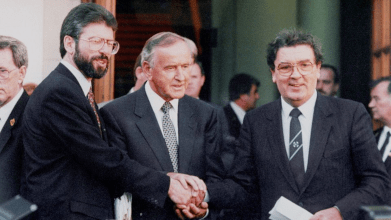
(Pictured: (L to R) Sinn Féin President Gerry Adams, Taoiseach Albert Reynolds and Social Democratic and Labour Party leader John Hume)


Leave a comment

The Downing Street Declaration

major-and-reynoldsTaoiseach of the Republic of Ireland, Albert Reynolds, and Prime Minister of the United Kingdom, John Major, sign the Downing Street Declaration (DSD) on December 15, 1993, at the British Prime Minister’s office in 10 Downing Street. The joint declaration stipulates that, if the Irish Republican Army (IRA) stops its campaign for three months, Sinn Féin will be allowed to join all-party talks.

The declaration affirms both the right of the people of Ireland to self-determination, and that Northern Ireland will be transferred to the Republic of Ireland from the United Kingdom only if a majority of its population is in favour of such a move. It also includes, as part of the prospective of the so-called “Irish dimension,” the principle of consent that the people of the island of Ireland, have the exclusive right to solve the issues between North and South by mutual consent.

The latter statement, which later becomes one of the points of the Good Friday Agreement, is key to produce a positive change of attitude by the republicans towards a negotiated settlement. The joint declaration also pledges the governments to seek a peaceful constitutional settlement, and promises that parties linked with paramilitaries, such as Sinn Féin, can take part in the talks, so long as they abandon violence.

The declaration, after a meeting between Sinn Féin President Gerry Adams and American congressman Bruce Morrison, which is followed by a joint statement issued by Adams and John Hume, is considered sufficient by the Provisional Irish Republican Army to announce a ceasefire on August 31, 1994 which is then followed on October 13 by an announcement of a ceasefire from the Combined Loyalist Military Command.

(Pictured: (L to R) John Major, Prime Minister of the United Kingdom, and Albert Reynolds, Taoiseach of the Republic of Ireland)