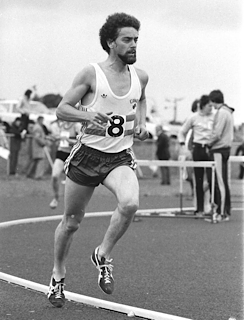
Cusack achieves his most famous victory on April 15, 1974, by winning the Boston Marathon, becoming the first and only Irishman to do so. His time of 2:13:39 is the third-fastest in Boston Marathon history at that point. His Boston win is a source of immense pride for the Irish community, especially in Boston. He recalls receiving $10 and $20 bills from Irish Americans in the mail with notes like “Have a beer on us, we’re proud of you!” His victory helps soothe the disappointment of local Irish fans who had seen fellow Irish runner Pat McMahon come close in previous years.
In 2024, on the 50th anniversary of his Boston win, Cusack returns to serve as the official race starter for the professional men’s division of the Boston Marathon.
Now in his 70s, Cusack remains a celebrated figure in Irish athletics and marathon history.
At Villanova, Carroll runs a sub-four-minute mile and in 1964, is the anchor for the team which breaks the 4 x 880-yard relay World Record. In the same year, he also sets the European Indoor record for the 880-yards and competes in the 1964 Summer Olympics in Tokyo, Japan, in the Men’s 800 metres finishing just outside of the qualifying places in heat 5 of the first round with a time of 1:51.1. When running against Bill Crothers in 1964, Sports Illustrated describes him as “one of the best middle-distance runners in the world.”
Carroll represents Ireland in the 400 metres (time: 46.8) and the 800 metres (time: 1:49) in the 1968 Summer Olympics in Mexico City, and continues to win national championships, fourteen in total. He wins a bronze medal in the 800m at the 1969 European Indoor Games in Belgrade.
In 1972, Carroll becomes the spokesman for the Dublin Corporation, now known as Dublin City Council, a post he holds until 1996, when he joins the Dublin Chamber of Commerce as its chief executive.
In 1980, Carroll leads a group which approaches the Business Houses Athletic Association and the Dublin Corporation with the idea for the Dublin Marathon. He is also among the 2,100 people who compete in the race that year. The winner of the Marathon receives the Noel Carroll Memorial Trophy presented each year by one of Carroll’s children.
Carroll dies on October 23, 1998, after suffering a heart attack while training at University College Dublin (UCD). In 2008, his four children take part in the Dublin Marathon to raise money for the Noel Carroll Building, the headquarters of a project in Kolkata, India, run by GOAL, a charity for which Carroll had served as the chairman.
Carroll’s grandson is the Irish rugby international player, Jordi Murphy.
Treacy is known as a tenacious runner who does not have an especially sharp final kick in track races. In the 1978 European Athletics Championships in Prague, he places 11th in the fast 10,000-metre race and fourth in the slow and tactical 5,000-metre race, losing to Italy‘s Venanzio Ortis by just three tenths of a second. In the 5,000-metre final, he lingers behind Great Britain‘s Nick Rose on the final back straight just after Rose drops from the lead group.
In the 1980 Summer Olympics in Moscow, Treacy collapses in his 10,000-metre heat with only 200 metres left, a victim of heat paralysis and dehydration. Because he was running in fourth place when he collapses and because only the top four runners qualify directly for the final from the three heats, his collapse allows Finnish four-time Olympic champion Lasse Virén, who had been trailing him, to qualify directly for the final. Having recovered from his heat-induced collapse, Treacy places seventh in the 5,000-metre final of those Olympics.
In the 1984 Summer Olympics in Los Angeles, California, Treacy places ninth in the 10,000-metre final before crowning his athletics career with a silver medal in the men’s marathon. Winner Carlos Lopes of Portugal is largely unchallenged for much of the race, with Treacy down the field until entering the top six around the 20-kilometre mark. He continues to work his way up the rankings until entering Los Angeles Memorial Coliseum just behind second-place English athlete Charlie Spedding. He overtakes Spedding with 150m to go, during which the Irish television commentary of Jimmy Magee lists the previous Irish Olympic medal winners up to that time, before culminating, “And for the 13th time, an Olympic medal goes to John Treacy from Villierstown in Waterford, the little man with the big heart.” His silver medal places Ireland 33rd on the medals table.
After the Los Angeles Olympics, Treacy runs competitively until 1995, retiring following a road race held in his honour in Waterford, attended by the other two medalists from the 1984 Olympic marathon, Carlos Lopes and Charlie Spedding. While he does not win any more major international championships medals, he does win the 1992 Los Angeles Marathon. At the 1986 European Athletics Championships in Stuttgart, he places sixth in the 10,000-metre race. In the 1987 World Championships in Athletics in Rome, he places twenty-sixth in the 10,000-metre race and thirteenth in the 5,000-metre final. He fails to finish the marathon at the 1988 Summer Olympics in Seoul and places 51st in his final Olympic games, the 1992 Summer Olympics in Barcelona in 1992. He wins the 1993 Dublin Marathon.
Treacy is currently chief executive of Sport Ireland, a statutory authority that oversees, and partly funds, the development of sport within Ireland . He is married to Fionnuala and they have four children: Caoimhe, Deirdre, Sean, and Conor.
A record 20,000 people take part in the Dublin Marathon on October 29, 2017, making it the fifth largest marathon in Europe. The first Dublin Marathon takes place in 1980 with just over 2,000 runners participating.
The Dublin Marathon is an annual 26.2 mile (42.2 km) roadmarathon in Dublin held on the last Sunday in October. Prior to 2016, the race takes place on the last Monday in October, which is a public holiday in Ireland. In October 2015, it is announced that from 2016 the marathon will be held on Sunday rather than the October Bank Holiday Monday to attract more overseas runners. Held each year since 1980, the marathon has a record 22,500 registrants for the 2019 race, including over 5,000 entrants from outside Ireland.
The race is founded in 1980 by a group led by Noel Carroll, who persuades the Business Houses Athletic Association (BHAA) to take up the idea. In the first year, 2,100 take part, of whom 1,420 finish. Dick Hooper of Raheny club Raheny Shamrock Athletic Club claims first place, in a time of 2:16:14. The women’s winner is Carey May who finishes in 2:42:11. That year’s runner-up is Neil Cusack, who returns in 1981 to post a winning time of 2:13:59.
Jerry Kiernan‘s 1982 time of 2:13:45 is a long-standing men’s course record. This is finally improved upon by Lezan Kipkosgei Kimutai over twenty years later in 2004, but Russian runner Aleksey Sokolov twice breaks the record with consecutive wins in 2006 and 2007, running 2:11:39 and 2:09:07 respectively. Moses Kangogo Kibet becomes the first man under 2:09 in Dublin with his win in 2:08:58. The current men’s record is 2:08:06 set by Othmane El Goumri in 2019.
Moira O’Neill is the first woman under two hours and forty minutes with her win of 2:37:06 in 1988 and home athlete Christine Kennedy improves this with a run of 2:35:56 three years later. KenyanRuth Kutol‘s win in 2:27:22 in 2003 is the first sub-2:30 time and Russian Tatyana Aryasova breaks this record in 2010 with her current women’s record of 2:26:13.
The participation level of the race has followed an upward trend: by 1988 the number of participants increases to 8,700 – up from 4,000 the previous year. It is not until 2000 that the 1988 participation record is finally broken when 8,900 take part. An increasing number of people take part every year in the late 2000s, with 11,000 at the 2007 edition. Entry levels have since increased significantly year-on-year with 19,500 completing the 2016 event.
In 2001 the marathon becomes part of the Dublin Race Series, which includes pre-marathon events of 5 miles, 10 kilometres, 10 miles and half marathon distance over the preceding months, run in the Phoenix Park and Swords, Dublin.
The 2020 and 2021 editions of the race are canceled due to the coronavirus pandemic, with all entries made valid for the following year and all registrants given the option of obtaining a full refund.

 seamus dubhghaill