seamus dubhghaill

Promoting Irish Culture and History from Little Rock, Arkansas, USA


Leave a comment

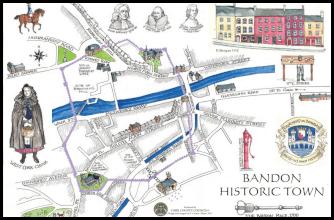
The Capture of Bandon

The Capture of Bandon begins on February 23, 1689, when the town of Bandon, County Cork, is forcibly seized from its rebellious Protestant inhabitants by force of Irish Army troops under Justin McCarthy. The skirmishing at the town takes place during the early stages of the Williamite War in Ireland. The Jacobite success at Bandon helps suppress any chance of a general Munster uprising against the rule of James II similar to that which occurs in Ulster the same year. The slogan “No Surrender!” is believed to have been first used at Bandon and subsequently taken up, more famously, by the defenders at the Siege of Derry later in the year.

In 1685, the Catholic James II comes to the throne. This leads to a sharp reversal of government policy in Ireland, which had previously favoured the Protestant inhabitants. This is quickly changed by James’ representative Richard Talbot, 1st Earl of Tyrconnell. Under Talbot’s administration, the army and civil government are mostly purged of Protestants, who are replaced by Catholics. In Bandon, the previous town burgesses are replaced by Catholic nominees.

Talbot’s actions lead to a growing hostility amongst the Protestant inhabitants across the island toward the King and his Irish government. Bandon is a historic centre of Protestants, dating back to the Plantation of Munster in the Elizabethan era and is a natural focus of dissent against James’s rule. In 1688, a similar opposition in England leads to the Glorious Revolution, in which William III successfully invades with a Dutch Army. Many Protestants now believe William to be their rightful King while Catholics, and some Protestants, remain loyal to James. During the growing turmoil, many rural County Cork Protestants come to shelter in Bandon.

Fearing a potential outbreak of rebellion in Bandon will occur, the government sends a detachment of the Irish Army under Captain Daniel O’Neill to take the town. They reportedly enter on a Sunday morning while the inhabitants are attending church services. The following day, February 24, sometimes referred to as “Black Monday,” the townspeople rise and attack the soldiers. Various sources say between three and eight of the redcoats are killed and the remainder are driven out of the town. Using their captured weapons, the Protestants then make an effort to prepare Bandon to withstand an assault.

Having received word about the growing rebellion in the county, Talbot in Dublin has already dispatched six companies of infantry under Justin McCarthy, an experienced Irish Catholic soldier. Instead of immediately assaulting Bandon, McCarthy first seizes nearby Cork, another major centre of Protestants in the south of the country and clamps down on other potential dissidents. He then proceeds to Bandon with his troops, plus some cavalry and artillery. Although they had previously hung out a banner proclaiming “No Surrender,” the defenders negotiate a surrender in exchange for generous conditions. Despite the usual punishment for rebellion being death, the town corporation is fined £1,000 and the walls are ordered to be demolished.

The comparatively light terms imposed on the town are part of a wider attempt by King James to convince Protestants of his goodwill toward them. It angers more hardline Catholics, including McCarthy’s nephew, Donough MacCarthy, 4th Earl of Clancarty, who wants a harsher punishment for the rebels.

The fighting at Bandon is part of a succession of defeats of locally raised Protestant troops both across Munster (at Castlemartyr) and Ireland as a whole, with the Ulster-raised Army of the North suffering heavy defeats at the Break of Dromore and the Battle of Cladyford. The advance of the mainly Catholic Jacobite Army is halted by the successful Protestant defence of Enniskillen and Derry. The arrival of large-scale reinforcements under Frederick Schomberg and King William reverse the tide, and Dublin is captured following the Battle of the Boyne in 1690. The same year, Bandon is re-taken by Protestant forces following John Churchill, 1st Duke of Marlborough‘s successful Siege of Cork. The walls are not rebuilt, as they are becoming increasingly militarily obsolete.

Leave a comment

Birth of Standish James O’Grady, Author, Journalist & Historian

Standish James O’Grady (Irish: Anéislis Séamus Ó Grádaigh), Irish author, journalist, and historian, is born in Castletownbere, County Cork, on September 18, 1846. He is inspired by Sylvester O’Halloran and plays a formative role in the Celtic Revival, publishing the tales of Irish mythology, as the History of Ireland: Heroic Period (1878), arguing that the Gaelic tradition has rival only from the tales of Homeric Greece.

O’Grady’s father is the Reverend Thomas O’Grady, the scholarly Church of Ireland minister of Castletown Berehaven, County Cork, and his mother Susanna Doe (or Dowe). The Glebe, his childhood home, lies a mile west of Castletownbere near a famine mass grave and ruined Roman Catholic chapel. He is a cousin of Standish Hayes O’Grady, another noted figure in Celtic literature, and of Standish O’Grady, 1st Viscount Guillamore. After a rather severe education at Tipperary Grammar School, he follows his father to Trinity College, Dublin, where he wins several prize medals and distinguishes himself in several sports.

O’Grady is a paradox for his times, proud of his Gaelic heritage, he is also a member of the Church of Ireland, a champion of aristocratic virtues (particularly decrying bourgeois values and the uprooting cosmopolitanism of modernity) and at one point advocates a revitalised Irish people taking over the British Empire and renaming it the Anglo-Irish Empire.

O’Grady proves too unconventional of mind to settle into a career in the church, and takes a job as a schoolmaster at Midleton College, then in a period of expansion. He also qualifies as a barrister, while earning much of his living by writing for the Irish newspapers. Reading Sylvester O’Halloran’s A general history of Ireland (1778) sparks an interest in early Irish history. After an initial lukewarm response to his writing on the legendary past in History of Ireland: The Heroic Period (1878) and Early Bardic Literature of Ireland (1879), he realises that the public wants romance, and so follows the example of James Macpherson in recasting Irish legends in literary form, producing historical novels including Finn and his Companions (1891), The Coming of Cuculain (1894), The Chain of Gold (1895), Ulrick the Ready (1896) and The Flight of the Eagle (1897), and The Departure of Dermot (1913).

O’Grady also studies Irish history of the Elizabethan period, presenting in his edition of Sir Thomas Stafford‘s Pacata Hibernia (1896) the view that the Irish people had made the Tudors into kings of Ireland to overthrow their unpopular landlords, the Irish chieftains. His The Story of Ireland (1894) is not well received, as it sheds too positive a light on the rule of Oliver Cromwell for the taste of many Irish readers. He is also active in social and political campaigns in connection with such issues as unemployment and taxation.

Until 1898, O’Grady works as a journalist for the Daily Express of Dublin, but in that year, finding Dublin journalism in decline, he moves to Kilkenny to become editor of the Kilkenny Moderator, which is printed at 28 High Street. It is here he becomes involved with Ellen Cuffe, Countess of Desart, and Captain Otway Cuffe. He engages in the revival of the local woolen and woodworking industries. In 1900 he founds the All-Ireland Review and returns to Dublin to manage it until it ceases publication in 1908. He also contributes to James LarkinsThe Irish Worker paper.

O’Grady’s influence crosses the divide of the Anglo-Irish and Irish-Ireland traditions in literature. His influence is explicitly stated by the Abbey Theatre set with Lady Gregory, W. B. Yeats and George William Russell attributing their interest in the Fenian Cycle of Gaelic tradition in part to him. This leads to him being known as the “Father of the Celtic Revival.” Some of the figures associated with the political party Sinn Féin, including its founder Arthur Griffith, have positive things to say about his efforts in helping to retrieve from the past the Gaelic heroic outlook.

O’Grady marries Margaret Allen Fisher, daughter of William Allen Fisher, and they have three sons. Advised to move away from Ireland for the sake of his health, they leave Ireland in 1918. After living in the north of France and Northamptonshire, they move to the Isle of Wight. He is working on a final exposition of his ideas when he dies suddenly on May 18, 1928.

O’Grady’s eldest son, Hugh Art O’Grady, is for a time editor of the Cork Free Press before he enlists in World War I in early 1915. He becomes better known as Dr. Hugh O’Grady, later Professor of the Transvaal University College, Pretoria (later the University of Pretoria), who writes the biography of his father in 1929.


3 Comments

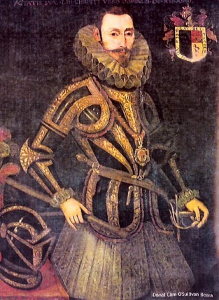
The Retreat of Donal Cam O’Sullivan Beare

donall-cam-osullivan-beare

Donal Cam O’Sullivan Beare and his clan begin their epic march to Ulster on December 31, 1602. O’Sullivan has supported Hugh O’Neill, Earl of Tyrone, in his fight against Elizabethan England‘s attempts to destroy Gaelic Ireland once and for all. The cause O’Neill and O’Sullivan fight for is probably doomed after O’Neill’s defeat in the Battle of Kinsale in 1601, but the fight goes on, nonetheless.

O’Sullivan Beare conceals 300 of the women, children and aged of his community in a stronghold on Dursey Island, but this position is attacked, and the defenders hanged. In what is later termed the Dursey Massacre, Philip O’Sullivan Beare, nephew of O’Sullivan Beare, writes that the women and children of the Dursey stronghold are massacred by the English, who tie them back-to-back, throw them from the cliffs, and shoot at them with muskets.

After the fall of Dursey and Dunboy, O’Sullivan Beare, Lord of Beara and Bantry, gathers his remaining followers and sets off northwards on December 31, 1602, on a 500-kilometre march with 1,000 of his remaining people. He hopes to meet Hugh O’Neill on the shores of Lough Neagh.

O’Sullivan Beare fights a long rearguard action northwards through Ireland, through Munster, Connacht and Ulster, during which the much larger English force and their Irish allies fight him all the way. The march is marked by the suffering of the fleeing and starving O’Sullivans as they seek food from an already decimated Irish countryside in winter. They face equally desperate people in this, often resulting in hostility, such as from the Mac Egans at Redwood Castle in County Tipperary and at Donohill in O’Dwyer’s country, where they raid the Earl of Ormonde‘s foodstore.

O’Sullivan Beare marches through Aughrim, where he raids villages for food and meets local resistance. He is barred entrance to Glinsk Castle and leads his refugees further north. On their arrival at Brian Oge O’Rourke‘s castle in Leitrim on January 4, 1603, after a fortnight’s hard marching and fighting, only 35 of the original 1,000 remain. Many had died in battles or from exposure and hunger, and others had taken shelter or fled along the route. O’Sullivan Beare had marched over 500 kilometres, crossed the River Shannon in the dark of a midwinter night, having taken just two days to make a boat of skin and hazel rods to carry 28 at a time the half-kilometre across the river, fought battles and constant skirmishes, and lost almost all of his people during the hardships of the journey.

In Leitrim, O’Sullivan Beare seeks to join with other northern chiefs to fight the English, and organises a force to this end, but resistance ends when Hugh O’Neill, 2nd Earl of Tyrone signs the Treaty of Mellifont. O’Sullivan Beare, like other members of the Gaelic nobility of Ireland who flees and seeks exile, making his escape to Spain by ship. O’Sullivan Beare settles in Spain and continues to plead with the Spanish government to send another invasion force to Ireland. King Phillip III gives him a knighthood, pension, and the title Earl of Bearhaven, but never that which he desires most, another chance to free his homeland.

Many generations of O’Sullivan Beare’s family later achieve prominence in Spain. In 1618, Donal Cam O’Sullivan Beare is killed in Madrid by John Bathe, an Anglo-Irishman, but the legend of “O’Sullivan’s March” lives on.

The Beara-Breifne Way long-distance walking trail follows closely the line of the historical march.