
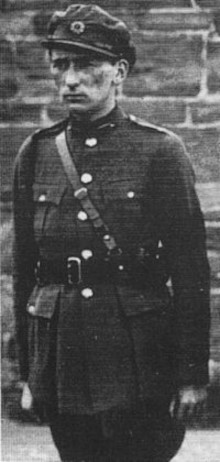
Liam Tobin, officer in the Irish Army and the instigator of the Irish Army Mutiny in March 1924, is born William Joseph Tobin at 13 Great Georges Street in Cork, County Cork, on November 15, 1895. During the Irish War of Independence, he serves as an Irish Republican Army (IRA) intelligence officer for Michael Collins‘ Squad.
Tobin is the eldest son of Mary Agnes (nee Butler) and David Tobin, a hardware clerk. He has two younger siblings, Katherine and Nicholas Augustine Tobin, also born in Cork. His family moves to John Street in Kilkenny and then to Dublin. He goes to school in Kilkenny and is an apprentice in a hardware shop at the time of the 1916 Easter Rising. As a participant in the Rising, he fights in the Four Courts garrison under Edward Daly. He is arrested, court martialed, and sentenced to death but his sentence is commuted to life imprisonment. He is a prisoner in Kilmainham, Mountjoy, Lewes, Dartmoor, Broadmoor and Pentonville prisons. He is released in June 1917.
In early 1919 Tobin becomes Collins’ chief executive in the Intelligence Directorate handling the many spies in Dublin Castle, including double agent David Neligan. Nancy O’Brien works for Under-Secretary for Ireland James Macmahon, decoding messages sent from London. Each day between 2:30 and 3:30 she passes any information acquired to either Tobin, Joseph McGrath, or Desmond FitzGerald. Tobin is involved in planning the assassinations of British soldiers, informants, members of the Royal Irish Constabulary, the Dublin Metropolitan Police, and operatives of MI5. He constructs detailed profiles of everyone remotely connected to the British government, often using Who’s Who, The Morning Post, and The Times, a newspaper that describes him as “one of the most formidable of [the] Twelve Apostles.”
In October 1921, Tobin travels with the Irish Treaty Delegation as part of Collins’ personal staff.
Tim Pat Coogan and James Mackay have examined Tobin’s involvement in the assassination of British Field Marshal Sir Henry Wilson. Wilson’s public tirades about Collins is evidence of mutual personal dislike between the two men. In May 1922 Collins tells Tobin “We’ll kill a member of that bunch” to the news of “bloody pogroms” in Belfast. Wilson is intimately involved with the Ulster loyalist cause, including the Curragh Mutiny and the establishment of the Ulster Special Constabulary. Just before the shooting, Coogan places Tobin in London. He meets courier Peig Ni Braonain at Euston Station collecting a document that has been sent from Dublin. Returning to Dublin before the incident, he is jubilant when he tells defence minister Richard Mulcahy about Wilson’s death. Mulcahy is appalled and threatens to resign.
Following the Anglo-Irish Treaty, Tobin is appointed deputy director of intelligence in the new state and assigned to the Criminal Investigation Department based at Oriel House. However Collins soon replaces him with Joseph McGrath. Tobin is placed on the Army Council and is Director of Intelligence from September 1922 until his appointment as Senior Aide-de-Camp to the new Governor–General of the Irish Free State, Tim Healy, in November 1922. The position provides an apartment in Viceregal Lodge.
In October 1922, Tobin’s brother Nicholas, a Free State captain, is accidentally shot dead by his own troops during the raid and capture of a bomb making factory at number 8 Gardiner’s Place, Dublin.
Tobin believes in the steppingstone doctrine which sees the Treaty as a stage towards full independence. With the outbreak of the Irish Civil War he remains loyal to Collins and takes the Pro-Treaty side. He leads in the fight against the Anti-Treaty IRA in the south. Disillusioned with the continuing hostilities and in the aftermath of the death of Collins, he forms an association called the IRA Organisation (IRAO) or “Old Irish Republican Army” to distinguish themselves from the anti-treaty insurgents.
Richard Mulcahy, the new Irish defence minister, proposes to reduce the army from 55,000 to 18,000 men in the immediate post- Civil-War period. Tobin knows his own position is to be affected and shares the perception that the Irish Army treats former British officers better than former IRA officers. On March 7, 1924, Tobin, together with Colonel Charlie Dalton, sends an ultimatum to President of the Executive Council of the Irish Free State W. T. Cosgrave demanding an end to the army demobilisation. The immediate response is an order for the arrest of the two men on a charge of mutiny. The cabinet, already wary of the Irish Army, orders an inquiry and appoints Garda Commissioner Eoin O’Duffy to the army command.
On March 18, the mutineers assemble with hostile intent at a Dublin pub. An order is made to arrest the mutineers and the cabinet demands the resignation of the army council. The generals resign, affirming the subservience of the military to the civilian government of the new state.
In later years, Tobin rebuilds relations with his Civil War foes and joins Éamon de Valera‘s Anti-Treaty Fianna Fáil party. He joins up with Joseph McGrath to form the Irish Hospitals’ Sweepstake in the 1930s. Many other former army comrades find work in this lottery. He leaves the Sweep in 1938. After World War II, he becomes Superintendent of the Oireachtas for the Irish Dáil.
On October 14, 1929, Tobin marries Monica “Mona” Higgins at the Church of the Holy Family, Aughrim Street, Dublin. They have two daughters, Máire and Anne Tobin. Following the death of his father, David, in 1956, Tobin’s health declines, resulting in his death in Dublin on April 30, 1963.
Tobin is portrayed by actor Brendan Gleeson in Neil Jordan‘s biopic Michael Collins.

 seamus dubhghaill