seamus dubhghaill

Promoting Irish Culture and History from Little Rock, Arkansas, USA


Leave a comment

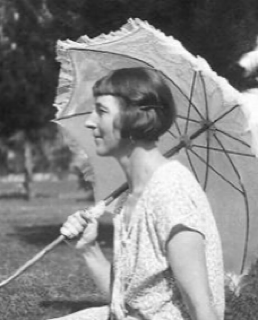
Death of Dorothy Kay, Irish-born South African Artist

Dorothy Moss Kay (née Elvery), an Irish-born South African artist, dies in Port Elizabeth, South Africa, on May 13, 1964.

Elvery is born on December 3, 1886, in GreystonesCounty Wicklow. Her father is William Elvery, whose family owns Elverys Sports store in Dublin. Her sister, Beatrice Elvery, also known as Beatrice, Lady Glenavy, is a painter, stained glass artist and sculptor. Elvery trains at Dublin Metropolitan School of Art in 1900 and at the Royal Hibernian Academy school, but promotes the notion that she was “self-taught.”

In 1910, Elvery moves to South Africa to marry Hobart Kay, FRCS. By 1916 they have settled in Port Elizabeth.

Kay is a founder member of the Eastern Province Society of Arts and Crafts. In 1924 she is elected a member of the Royal British Colonial Society of Artists. She paints and makes etchings, and in 1926 her etching Romance is bought by Mary of Teck, Queen of the United Kingdom, at the Dominion Artists’ Exhibition in London. She travels widely in South Africa and sketches as she goes, and is also commissioned to make many portraits of mayors of Port Elizabeth, many of them lost when the City Hall burns down in 1977. During World War II she is commissioned by the government to record the war on the home front, and some of her work is held in the South African National Museum of Military History. From 1927 to 1945 she produces two to four illustrations each week for The Outspan.

Kay’s largest painting is the 1937 work Surgery, showing a patient undergoing abdominal surgery (a cholecystectomy). She portrays herself as the scrub nurse and her husband Hobart as the surgeon. In preparation for this painting she visits three hospitals and observes at least two operations, making 27 pages of preliminary sketches of people and equipment used in surgery. During World War II she paints further medical paintings: Operation in a Base Hospital and Blood to Save Lives.

Kay holds one-woman exhibitions from 1922 to 1955, and retrospective exhibitions of her work are held at the Iziko South African National Gallery in 1965 and 1982.

In her early days at Port Elizabeth, Kay is a keen sailor and is described as “for a time the fastest spinnaker-hand in South Africa.”

Kay has three daughters and one son. Her daughter Joan Wright (1911-91) teaches painting at the Port Elizabeth Technical College School of Art and Design, and her daughter Marjorie Reynolds writes and publishes a biography of her mother in 1989, and a further book about the Elvery family in 1991, and also donates her mother’s collection of works and archives to the Iziko South African National Gallery as “The Kay Bequest” in 1992.

Kay dies at Port Elizabeth on May 13, 1964.


Leave a comment

Birth of Kevin Izod O’Doherty, Politician & Young Irelander

Kevin Izod O’Doherty, an Irish Australian politician who, as a Young Irelander, is transported to Tasmania in 1849, is born in Dublin on September 7, 1823, although other sources including the Dictionary of Australasian Biography indicate he is born in June 1824. He is first elected to the Legislative Assembly of Queensland in 1867. In 1885, he returns to Europe briefly serving as an Irish Home Rule MP at Westminster before returning in 1886 as a private citizen to Brisbane.

O’Doherty receives a good education and studies medicine, but before he is qualified, joins the Young Ireland party and in June 1848, together with Thomas Antisell and Richard D’Alton Williams, establish The Irish Tribune. Only five editions are issued, the first being on June 10, 1848. On July 10, 1848, when the fifth edition is issued, O’Doherty is arrested and charged with treason felony. At the first and second trials the juries disagree, but at the third trial, he is found guilty and sentenced to transportation for ten years.

O’Doherty arrives in Tasmania in November 1849, is at once released on parole to reside at Oatlands, and his professional services are utilised at St. Mary’s Hospital, Hobart. The other Irish prisoners nickname him “St. Kevin.”  In 1854 he receives a pardon with the condition that he must not reside in Great Britain or Ireland. He goes to Paris and carries on his medical studies, making one secret visit to Ireland to marry Mary Eva Kelly, to whom he is affianced before leaving Ireland. He receives an unconditional pardon in 1856, and completes his studies in Dublin, graduating FRCS in 1857. He practises in Dublin successfully, and in 1862 goes to Brisbane, Australia, and becomes well known as one of its leading physicians.

O’Doherty is elected a member of the Legislative Assembly of Queensland in 1867, in 1872 is responsible for a health act being passed, and is also one of the early opponents of the trafficking of Kanakas. In 1885, he resigns as he intends to settle in Europe.

In Ireland, O’Doherty is cordially welcomed, and is returned unopposed as Irish Parliamentary Party (IPP) MP for North Meath to the House of Commons of the United Kingdom in the November 1885 United Kingdom general election. However, finding the climate does not suit him, he does not seek re-election in 1886 and returns to Brisbane in that year. He attempts to take up his medical practice again but is not successful. He dies in poor circumstances in Brisbane on July 15, 1905.

O’Doherty’s wife and a daughter survive him. A fund is raised by public subscription to provide for his widow, a poet, who in her early days is well known as the author of Irish patriotic verse in The Nation under the soubriqet “Eva.” In Australia, she occasionally contributes to Queensland journals, and one of her poems is included in A Book of Queensland Verse. She dies at Brisbane on May 21, 1910.