seamus dubhghaill

Promoting Irish Culture and History from Little Rock, Arkansas, USA


Leave a comment

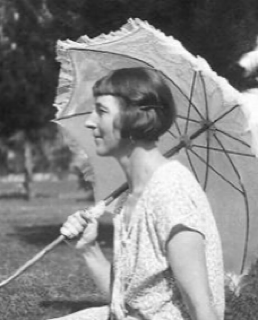
Death of Dorothy Kay, Irish-born South African Artist

Dorothy Moss Kay (née Elvery), an Irish-born South African artist, dies in Port Elizabeth, South Africa, on May 13, 1964.

Elvery is born on December 3, 1886, in GreystonesCounty Wicklow. Her father is William Elvery, whose family owns Elverys Sports store in Dublin. Her sister, Beatrice Elvery, also known as Beatrice, Lady Glenavy, is a painter, stained glass artist and sculptor. Elvery trains at Dublin Metropolitan School of Art in 1900 and at the Royal Hibernian Academy school, but promotes the notion that she was “self-taught.”

In 1910, Elvery moves to South Africa to marry Hobart Kay, FRCS. By 1916 they have settled in Port Elizabeth.

Kay is a founder member of the Eastern Province Society of Arts and Crafts. In 1924 she is elected a member of the Royal British Colonial Society of Artists. She paints and makes etchings, and in 1926 her etching Romance is bought by Mary of Teck, Queen of the United Kingdom, at the Dominion Artists’ Exhibition in London. She travels widely in South Africa and sketches as she goes, and is also commissioned to make many portraits of mayors of Port Elizabeth, many of them lost when the City Hall burns down in 1977. During World War II she is commissioned by the government to record the war on the home front, and some of her work is held in the South African National Museum of Military History. From 1927 to 1945 she produces two to four illustrations each week for The Outspan.

Kay’s largest painting is the 1937 work Surgery, showing a patient undergoing abdominal surgery (a cholecystectomy). She portrays herself as the scrub nurse and her husband Hobart as the surgeon. In preparation for this painting she visits three hospitals and observes at least two operations, making 27 pages of preliminary sketches of people and equipment used in surgery. During World War II she paints further medical paintings: Operation in a Base Hospital and Blood to Save Lives.

Kay holds one-woman exhibitions from 1922 to 1955, and retrospective exhibitions of her work are held at the Iziko South African National Gallery in 1965 and 1982.

In her early days at Port Elizabeth, Kay is a keen sailor and is described as “for a time the fastest spinnaker-hand in South Africa.”

Kay has three daughters and one son. Her daughter Joan Wright (1911-91) teaches painting at the Port Elizabeth Technical College School of Art and Design, and her daughter Marjorie Reynolds writes and publishes a biography of her mother in 1989, and a further book about the Elvery family in 1991, and also donates her mother’s collection of works and archives to the Iziko South African National Gallery as “The Kay Bequest” in 1992.

Kay dies at Port Elizabeth on May 13, 1964.


Leave a comment

Birth of Mildred Anne Butler, Animal & Genre Painter

Mildred Anne Butler, Irish artist who works in watercolour and oil of landscape, genre and animal subjects, is born on January 11, 1858, in Kilmurry, a Georgian house near Thomastown, County Kilkenny.

The youngest daughter of Captain Henry Butler, a grandson of the Edmund Butler, 11th Viscount Mountgarret, and Clara Butler (née Taylor) of the Newarke, Leicester, England. Her father is himself an enthusiastic painter, known for his publication South African sketches: illustrative of the wildlife of a hunter on the frontier of Cape Colony (1841). Her early artistic efforts are mainly copies of romantic subjects, but the influence of the London artist Paul Jacob Naftel, with whom she begins corresponding in the early 1880s, proves to be crucial to her artistic development. Studies with William Frank Calderon, an expert in animal painting, are also significant. She subsequently spends the summers of 1894 and 1895 in Newlyn, Cornwall, England, with the Irish artist Norman Garstin, who introduces her to contemporary French painting.

In 1885, Butler makes her first visit to the continent, traveling through France, Switzerland, and Italy. From 1905 to 1914 she travels regularly to Europe, most particularly Aix-les-Bains and Wiesbaden, during which time she produces genre views of French and German villages. After 1914 her life at the family home is interrupted only by visits to London exhibitions. She is best known for her paintings of Kilmurry and its environs, many of which display an interest in botany. Much of her work is dominated by detailed representations of animals and birds, often drawn from photographs and stuffed specimens.

Butler’s career as an exhibitor begins in 1882 with the Irish Fine Arts Society, later known as the Water Colour Society of Ireland (WCSI), with which she has a long association. She exhibits regularly with the society from 1892 onward and is a member of its committee for many years. She is also closely associated with the Dudley Museum and Art Gallery in London. Her work is first shown there in 1888, and on this evidence, she is elected to their society. The purchase by the Chantrey bequest for the Tate Gallery of The Morning Bath for £50 in 1896 is a high point in her career. The first painting by a woman to be selected by the council, its purchase is followed by almost consistently good press reviews for her work. The Athenaeum of May 5, 1897, writes: “The young lady knows how to look at her subjects with the eyes of a well-trained artist.”

Butler also comes to the attention of the American artistic press. She contributes to the portfolio of drawings given by the Society of Lady Artists to Princess May on her marriage to the Duke of York in 1893, while in 1922 her work is included in the portfolio presented to Princess Mary on her marriage. Her patrons include Queen Alexandra, and the grand duke of Hesse, who purchases two of her paintings after she is invited to exhibit in Hesse Darmstadt in 1911. In 1914 she is made a member of the Union Internationale des Beaux Arts, and in 1921 her paintings are shown in Japan. She regularly exhibits with the Belfast Ramblers, the Royal Ulster Academy, the Royal Academy of Arts (RA), the Royal Hibernian Academy (RHA), the Society of Lady Artists, and the Royal Watercolour Society, of which she is made an associate member in 1896, and a full member in 1937.

In her later years, severe rheumatism prevents Butler from painting. She has a keen interest in music. She survives all five of her siblings, and inherits Kilmurry, where she dies on October 11, 1941. She is buried at Thomastown, County Kilkenny. Her paintings are represented in the collections of the National Gallery of Ireland, Dublin City Gallery the Hugh Lane, the Ulster Museum, and the Tate, London.

(From: “Butler, Mildred Anne” by Frances Clarke, Dictionary of Irish Biography, http://www.dib.ie, October 2009)