
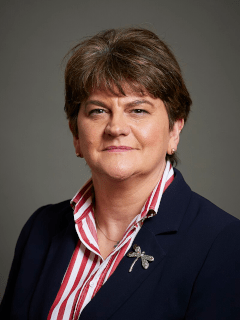
Arlene Isobel Foster (née Kelly), Baroness Foster of Aghadrumsee, DBE, PC, British broadcaster and politician from Northern Ireland, is born in Enniskillen, County Fermanagh, Northern Ireland, on July 17, 1970. She serves as First Minister of Northern Ireland from 2016 to 2017 and 2020 to 2021 and leader of the Democratic Unionist Party (DUP) from 2015 to 2021, the first woman to hold either position. She is a Member of the House of Lords, having previously been a Member of the Legislative Assembly (MLA) for Fermanagh and South Tyrone from 2003 to 2021.
Foster is raised in the townland of Dernawilt, on the outskirts of Aghadrumsee. When she is nine, her family moves to the Castlebalfour Estate, a housing estate in nearby Lisnaskea, following a nighttime attempt by the Provisional Irish Republican Army (IRA) to kill her father, a Royal Ulster Constabulary (RUC) reservist, who is shot and severely injured at their family farm.
As a teenager, Foster is on a school bus that is bombed by the IRA, the vehicle targeted because its driver is a soldier in the Ulster Defence Regiment (UDR). A girl sitting near her is seriously injured. She is a pupil at Enniskillen Collegiate Grammar School in Enniskillen from 1982 to 1989, and attends Queen’s University Belfast (QUB), where she graduates with an LLB degree. Her political career begins at QUB when she joins the Queen’s Unionist Association, part of the Ulster Unionist Party (UUP). She serves as the association’s chair from 1992 to 1993.
After leaving QUB Foster remains active in the UUP, chairing its youth wing, the UYUC, in 1995. In 1996, she becomes an Honorary Secretary of the UUP’s ruling body, the Ulster Unionist Council, a position which she holds until her resignation from the UUP on December 18, 2003. She is a councillor on Fermanagh District Council representing Enniskillen from 2005 to 2010.
Foster serves in the Northern Ireland Executive as Minister of the Environment from 2007 to 2008, Minister for Enterprise and Investment from 2008 to 2015 and Minister for Finance and Personnel from 2015 to 2016. In December 2015, she is elected unopposed to succeed Peter Robinson as leader of the DUP. In January 2016, she becomes First Minister of Northern Ireland and shares power with Martin McGuinness.
McGuinness resigns as deputy First Minister in January 2017 amid the Renewable Heat Incentive scandal, which involves a green energy scheme that Foster set up during her time as Minister for Enterprise and Investment. The scheme is set to cost the taxpayer £490 million and there are allegations of corruption surrounding her role in implementing the scheme. McGuinness asks her to step aside as First Minister while her involvement in the scheme is investigated, but she refuses to step aside or resign and says that the voices calling for her resignation are those of “misogynists and male chauvinists.” Under the terms of the Northern Ireland power-sharing agreement, the First and deputy First Ministers are equal and, therefore, she cannot remain in her post as First Minister and is subsequently removed from office. McGuinness’s resignation causes a 2017 snap assembly election to be held, in which the DUP loses ten seats. After no party receives an outright majority in the 2017 United Kingdom general election, the DUP enters into an agreement with the Conservative Party to support Prime Minister Theresa May‘s government. In January 2020, she becomes First Minister of Northern Ireland again after the Executive is reinstated under the terms of the New Decade, New Approach agreement.
On April 28, 2021, after more than twenty DUP MLAs and four DUP MPs sign a letter “…voicing no confidence in her leadership,” Foster announces that she will resign as party leader and as First Minister. She is succeeded by Edwin Poots as DUP leader on May 28, 2021. She leaves office as First Minister on June 14, 2021, and is succeeded by Paul Givan as First Minister on June 17, 2021. She resigns from the Northern Ireland Assembly in October 2021 and becomes a presenter on GB News.
In May 2024, it is confirmed that Foster will be appointed chairperson of Intertrade UK, a new body to promote trade within the UK which is announced as part of the UK government package to restore devolution.
Foster and her husband, Brian, have three children. They live on the outskirts of Brookeborough, a village in the east of County Fermanagh. In 2008, she is recognised as Assembly member of the year at the Women in Public Life Awards.
(Pictured: Official portrait of Baroness Foster of Aghadrumsee, January 30, 2024)

 seamus dubhghaill