seamus dubhghaill

Promoting Irish Culture and History from Little Rock, Arkansas, USA


Leave a comment

The 1990 Lough Nenagh Ambush

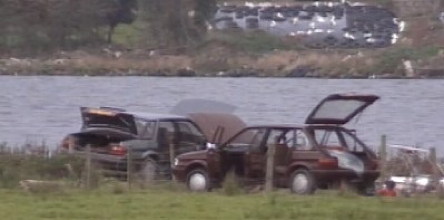
The 1990 Lough Neagh ambush is a gun attack carried out by the Provisional Irish Republican Army (IRA) on November 10, 1990, at Castor Bay, near Morrows Point, Lough Neagh, County Armagh, Northern Ireland targeting members of the security forces involved in a waterfowl hunting trip with other two men at the time. An active service unit (ASU) of the IRA’s North Armagh Brigade shoots dead a Royal Ulster Constabulary (RUC) Inspector, an RUC Reservist, a former Ulster Defence Regiment (UDR) soldier and one civilian. Some members of the wildfowling party struggle with their attackers, and one of the constables returns fire before being killed.

On September 7, 1990, UDR soldier Colin McCullough is shot dead by the IRA while in the company of his girlfriend at Oxford Island on the shore of Lough Neagh in the same area as the November 10 ambush. On October 6, in a revenge attack, the “Protestant Action Force” (a cover name for the Ulster Volunteer Force) shoots dead Catholic man Denis Carville at the same location, also while sitting in his car with his girlfriend.

At 7:30 a.m. on November 10, 1990, the four men leave home for Castor Bay on the shore of Lough Neagh for a wildfowling trip. Their early morning hunting excursions to the Department of the Environment-managed waterworks compound are routine and all of the men live in the Lurgan and Waringstown areas. It is believed the IRA team are waiting for the group inside the compound and ambush them shortly following their arrival.

The victims were David Murphy, an RUC Special Branch Inspector; Thomas Taylor, a part-time RUC Reservist; Norman Kendall, an electrician and former UDR soldier; and Keith Dowey, an employee with the Department of the Environment water service and father of two young children.

According to a 2000 report, the goal of the IRA unit, apparently members of the North Armagh Brigade led by the late Patsy Haughian, is only to abduct and interrogate Murphy about collusion between the RUC and loyalist militants, but things go wrong when Kendall and Dowey arrive at the scene in a car. Dowey, the driver, is shot and killed instantly, but there is evidence that Kendall puts up some resistance before being slain. Taylor produces his personal weapon and shoots at the assailants, but is cut down by a hail of fire. Murphy struggles and manages to avoid being bundled into the vehicle, but is eventually killed by Haughian. After the hunting party fails to appear at lunch time the alarm is raised. It is initially feared they have been kidnapped but four bodies are accounted for. The gunmen escape in one of the victim’s cars which is later found partially burned out at Brownlow Terrace, Lurgan. The IRA unit then hides in a house on the shores of the lake before returning to Lurgan the following morning.

The attack is widely condemned by politicians in Northern Ireland and the Republic of Ireland. Unionist politicians call for tougher security measures. Local Ulster Unionist Party (UUP) MP David Trimble criticises Secretary of State Peter Brooke for ruling out the introduction of internment without trial in response to the incident and other killings in the preceding weeks and links the attack to a landmark speech given by Brooke the previous day signaling to the Provisional IRA and Sinn Féin that Britain has no “selfish strategic or economic interest” in Northern Ireland. RUC Chief Constable Hugh Annesley visits the scene of the shootings and describes the attack as “repulsive, futile and cowardly murder” and says, “it is important to say yet again that the terrorists have no mandate from either Protestant or Catholic, north or south of the Irish border for such atrocities.”

Social Democratic and Labour Party (SDLP) representative Bríd Rodgers categorises the killings as part of an ongoing cycle of so-called “tit for tat” murders and urges anyone with information to contact the police. A message is read at Mass in Lurgan following the attack from the Bishop of Dromore and local priests warning Catholics to take precautions for their safety because of the risk of revenge attacks by Loyalists.

The alleged leader of the IRA squad, Patsy Haughian, dies of cancer at age 38 in October 2000. He is never formally accused of the killings.

Leave a comment

Birth of Arlene Foster, Northern Ireland Politician & Broadcaster

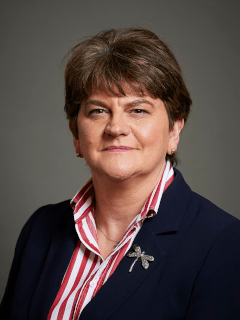
Arlene Isobel Foster (née Kelly), Baroness Foster of Aghadrumsee, DBE, PC, British broadcaster and politician from Northern Ireland, is born in Enniskillen, County Fermanagh, Northern Ireland, on July 17, 1970. She serves as First Minister of Northern Ireland from 2016 to 2017 and 2020 to 2021 and leader of the Democratic Unionist Party (DUP) from 2015 to 2021, the first woman to hold either position. She is a Member of the House of Lords, having previously been a Member of the Legislative Assembly (MLA) for Fermanagh and South Tyrone from 2003 to 2021.

Foster is raised in the townland of Dernawilt, on the outskirts of Aghadrumsee. When she is nine, her family moves to the Castlebalfour Estate, a housing estate in nearby Lisnaskea, following a nighttime attempt by the Provisional Irish Republican Army (IRA) to kill her father, a Royal Ulster Constabulary (RUC) reservist, who is shot and severely injured at their family farm.

As a teenager, Foster is on a school bus that is bombed by the IRA, the vehicle targeted because its driver is a soldier in the Ulster Defence Regiment (UDR). A girl sitting near her is seriously injured. She is a pupil at Enniskillen Collegiate Grammar School in Enniskillen from 1982 to 1989, and attends Queen’s University Belfast (QUB), where she graduates with an LLB degree. Her political career begins at QUB when she joins the Queen’s Unionist Association, part of the Ulster Unionist Party (UUP). She serves as the association’s chair from 1992 to 1993.

After leaving QUB Foster remains active in the UUP, chairing its youth wing, the UYUC, in 1995. In 1996, she becomes an Honorary Secretary of the UUP’s ruling body, the Ulster Unionist Council, a position which she holds until her resignation from the UUP on December 18, 2003. She is a councillor on Fermanagh District Council representing Enniskillen from 2005 to 2010.

Foster serves in the Northern Ireland Executive as Minister of the Environment from 2007 to 2008, Minister for Enterprise and Investment from 2008 to 2015 and Minister for Finance and Personnel from 2015 to 2016. In December 2015, she is elected unopposed to succeed Peter Robinson as leader of the DUP. In January 2016, she becomes First Minister of Northern Ireland and shares power with Martin McGuinness.

McGuinness resigns as deputy First Minister in January 2017 amid the Renewable Heat Incentive scandal, which involves a green energy scheme that Foster set up during her time as Minister for Enterprise and Investment. The scheme is set to cost the taxpayer £490 million and there are allegations of corruption surrounding her role in implementing the scheme. McGuinness asks her to step aside as First Minister while her involvement in the scheme is investigated, but she refuses to step aside or resign and says that the voices calling for her resignation are those of “misogynists and male chauvinists.” Under the terms of the Northern Ireland power-sharing agreement, the First and deputy First Ministers are equal and, therefore, she cannot remain in her post as First Minister and is subsequently removed from office. McGuinness’s resignation causes a 2017 snap assembly election to be held, in which the DUP loses ten seats. After no party receives an outright majority in the 2017 United Kingdom general election, the DUP enters into an agreement with the Conservative Party to support Prime Minister Theresa May‘s government. In January 2020, she becomes First Minister of Northern Ireland again after the Executive is reinstated under the terms of the New Decade, New Approach agreement.

On April 28, 2021, after more than twenty DUP MLAs and four DUP MPs sign a letter “…voicing no confidence in her leadership,” Foster announces that she will resign as party leader and as First Minister. She is succeeded by Edwin Poots as DUP leader on May 28, 2021. She leaves office as First Minister on June 14, 2021, and is succeeded by Paul Givan as First Minister on June 17, 2021. She resigns from the Northern Ireland Assembly in October 2021 and becomes a presenter on GB News.

In May 2024, it is confirmed that Foster will be appointed chairperson of Intertrade UK, a new body to promote trade within the UK which is announced as part of the UK government package to restore devolution.

Foster and her husband, Brian, have three children. They live on the outskirts of Brookeborough, a village in the east of County Fermanagh. In 2008, she is recognised as Assembly member of the year at the Women in Public Life Awards.

(Pictured: Official portrait of Baroness Foster of Aghadrumsee, January 30, 2024)


Leave a comment

Birth of Sir Kenneth Percy Bloomfield in Belfast

Sir Kenneth Percy Bloomfield, former head of the Northern Ireland Civil Service who is later a member of the Independent Commission for the Location of Victims’ Remains and for a time Northern Ireland Victims Commissioner, is born in Belfast on April 15, 1931. He has also held a variety of public sector posts in Northern Ireland and elsewhere.

Bloomfield is born to English parents and grows up close to Neill’s Hill railway station. Between the years of 1943 and 1949, he attends the Royal Belfast Academical Institution and later goes on to read Modern History at St. Peter’s College, Oxford. On September 12, 1988, he and his wife are the targets of an Irish Republican Army (IRA) attack on their home in Crawfordsburn, County Down. Neither Bloomfield nor his wife are injured in the blast.

Having joined the Civil Service in 1952, Bloomfield is appointed Permanent Secretary to the power sharing executive in 1974. After the collapse of the executive, he goes on to become Permanent Secretary for the Department of the Environment and the Department of Economic Development, and finally Head of the Northern Ireland Civil Service on December 1, 1984. In that capacity he is the most senior advisor to successive Secretaries of State for Northern Ireland and other Ministers on a wide range of issues. He retires from the post in April 1991.

Since retiring from the Civil Service, Bloomfield has embarked on a life of involvement in a diverse range of organisations. He has taken up roles such as Chairman for the Northern Ireland Legal Services Commission and his alma mater, the Royal Belfast Academical Institution. He has also been involved in the political reform of the States of Jersey and spearheaded the Association for Quality Education, which is fighting to retain academic selection in the Northern Ireland education system. In December 1997 he is asked by the Secretary of State for Northern Ireland, Mo Mowlam, to become the Northern Ireland Victims Commissioner for a fixed term. His role is to produce a report on the way forward for Victims issues in Northern Ireland. His report entitled We Will Remember Them is published in April 1998. From 1991 to 1999 he serves as the BBC‘s National Governor for Northern Ireland.

Bloomfield receives a Knighthood in the 1987 Queen’s Birthday Honours and honorary doctorates from Queen’s University, Belfast, the Open University and the Ulster University. He is also a Member of the Royal Irish Academy.