seamus dubhghaill

Promoting Irish Culture and History from Little Rock, Arkansas, USA


Leave a comment

Birth of Pat Quinlan, Irish Army Officer

Patrick Quinlan, Irish Army officer who commands the Irish UN force that fights at the Siege of Jadotville in Katanga in 1961, is born in Reeneragh, Caherdaniel, County Kerry, on December 30, 1919.

Quinlan goes to school in nearby Loher. He and his wife Carmel have a son, Leo, who is sixteen when his father serves in the Congo, and later becomes a commandant, the same rank his father held when in Katanga, although the father retires with the higher rank of colonel.

The Siege of Jadotville (modern Likasi) takes place in September 1961, during the United Nations intervention in the Katanga conflict in Congo-Léopoldville, in Central Africa.

“A” Company, 35th Battalion (UN service) of the Irish Army United Nations Operation in the Congo (ONUC) contingent, commanded by Quinlan, is attacked by Katangese Gendarmerie troops loyal to President Moïse Tshombe and the State of Katanga. Quinlan’s lightly armed company is besieged in Jadotville, and resists Katangese assaults for six days. A relief force of Irish, Indian and Swedish troops is unsuccessful in their attempts to reach Quinlan’s position.

Quinlan’s company suffers five wounded in action during the six-day siege. On the other hand, up to 300 Katangese troops are killed, including thirty mercenaries, and an indeterminate number are wounded, with figures ranging from 300 to 1,000. Quinlan, however, has no access to resupply and reinforcements and, with his transport destroyed by Katanga’s Fouga Magister jet, a breakout is virtually impossible. In the end, with his position untenable, without any clear orders or promise of assistance, having run out of ammunition and food and low on water, he accepts a second offer to surrender to the Katangese.

Although suffering no loss of life, Quinlan’s company are held as prisoners of war and hostages for approximately one month. The Katangese barter the Irish soldiers for prisoners in the custody of the Congolese government. After being released, “A” Company are returned to their base in Elisabethville (now Lubumbashi). Some weeks later, Quinlan finds himself involved in active combat again, this time with his company in support of Swedish UN troops. Eventually they are reinforced with fresh troops from Ireland. After weeks of fighting and their six-month tour of duty now complete, “A” Company is rotated home to Ireland that December.

In its immediate aftermath, the Irish state does not give much recognition to the Battle of Jadotville, and no Irish soldier receives any decoration for actions at Jadotville. This may have been because of a perceived shame that “A” Company had surrendered and an unwillingness to highlight political or strategic errors at higher levels by the UN mission. Quinlan, however, recommends a number of his men for the Military Medal for Gallantry (MMG), Ireland’s highest award for military valour, for their actions during the battle.

Quinlan never serves overseas again and retires as a full colonel after forty years with the Irish Army.

Quinlan dies on August 27, 1997, unaware that his reputation will be restored nine years after his death. His wife does not live to see his official rehabilitation either, dying two years after her husband.

The veterans of Jadotville are dissatisfied with the Irish Defence Forces‘ refusal to acknowledge the battle and the implied black mark on the reputation of their commander. Following a long campaign for recognition, in 2004 the then Minister for Defence, Willie O’Dea, agrees to hold a review of the battle. An inquiry by the Defence Forces clears Quinlan and “A” Company of allegations of soldierly misconduct. A commemorative stone recognising the soldiers of “A” Company is erected on the grounds of Custume Barracks in Athlone in 2005. A commissioned portrait of Quinlan is installed in the Congo Room of the Irish Defence Forces’ UN School.

In 2016, the Irish government awards a Presidential Unit Citation to “A” Company, the first in the State’s history. In October 2017, a plaque commemorating Quinlan is unveiled by former Taoiseach Enda Kenny at Coomakista Pass, County Kerry.

In November 2020, an Independent Review Group commissioned by Irish Defence Minister Simon Coveney recommends that Quinlan receive the Distinguished Service Medal (DSM).

Quinlan’s tactics at Jadotville influence subsequent training programmes, and are, according to RTÉ, “cited in military textbooks worldwide as the best example of the use of the so-called perimeter defence.”

Quinlan is played by Jamie Dornan in the film The Siege of Jadotville (2016), which is adapted from Declan Power‘s book, The Siege at Jadotville: The Irish Army’s Forgotten Battle (2005). His wife Carmel is played by Fiona Glascott. Colonel Quinlan’s son, Commandant Leo Quinlan, says that Dornan bears an uncanny resemblance to his father, and gets everything about him right except his County Kerry accent, which is so strong that “if he had done my father’s accent, you’d need subtitles.” Quinlan’s grandson Conor is a member of the film’s cast.
Leave a comment

The Siege of Jadotville

As part of the larger Congo Crisis (1960–1964), the siege of Jadotville begins on September 13, 1961, lasting for five days. While serving under the United Nations Operation in the Congo (Opération des Nations Unies au Congo, ONUC), a small contingent of the Irish Army‘s 35th Battalion, designated “A” Company, are besieged at the UN base near the mining town of Jadotville (modern-day Likasi) by Katangese forces loyal to the secessionist State of Katanga. The siege takes place during the seven-day escalation of hostilities between ONUC and Katangese forces during Operation Morthor. Although the contingent of 156 Irish soldiers repels attacks by a 3,000-strong Katangese force, they are eventually forced to surrender after running out of ammunition and water. “A” Company is subsequently held as prisoners of war for approximately one month, before being released on October 15 as part of a prisoner exchange. The Irish forces inflict approximately 1,300 casualties (including up to 300 killed) on the Katangan force, with no deaths amongst “A” Company.

On the morning of Wednesday, September 13, 1961, the soldiers stationed at Jadotville are informed of Operation Morthor by UN Headquarters at Elisabethville. At 07:40 twenty Katangese troops attack while many of the UN Irish troops of A Company are attending an open-air Mass. Expecting to take the men off-guard, the first attackers move in rapidly. However, they are spotted by an Irish sentry, and a warning shot by Private Billy Ready alerts the company to the threat. Ready is wounded in a later exchange of fire.

The paramilitary Katangese Gendarmerie, which is a combined force of mercenaries, Belgian settlers and local tribesmen, attack the Irish company. The attackers have a strength of 3,000–5,000 men – consisting of mostly Katangese and settlers, but with many Belgian, French and Rhodesian mercenaries armed with a mix of weapons. Additionally, these forces have limited air support from a Fouga CM.170 Magister trainer-light ground attack jet fitted with a pair of underwing bombs and twin 7.5 mm machine guns, which repeatedly attacks the UN position. The Irish soldiers are armed with personal weapons, several water-cooled Vickers machine guns, 60 mm mortars and two Irish-built Ford Mark VI armoured cars under the command of Lieutenant Kevin Knightly.

The Katangese attack in waves of 600 or so, preceded by bombardment from 81 mm mortars and a French 75mm field gun. The Irish Support Platoon of “A” Company knocks out most of the Katangese mortar and artillery positions, including the 75mm gun, with counter-battery fire from 60mm mortars. The fire from the UN Irish positions proves accurate and effective. Mercenary officers are reportedly observed shooting native gendarmes to stem the rout caused in Katangese lines.

The 500 Irish and Swedish UN troops based in Kamina, and Indian army Gurkhas make several attempts to relieve the besieged Irish soldiers. The supporting force of mercenaries beat back these efforts. They have been brought in by Moïse Tshombe, Katanga’s premier, whose secessionist government has been supported by Belgium.

Attempting to reach the besieged “A” Company, the relief column, named “Force Kane” after its commander Commandant John Kane, is stymied in a series of battles at a pinch point called the Lufira Bridge. It carries the Jadotville-to-Elisabethville Highway across the Lufira River. The Katangese forces dig in here and bring heavy and sustained ground and air fire onto the relief column, killing three Indian UN troops, injuring a number of Irish UN troops and ultimately forcing the column off the bridge. Additionally, during the effort to reach the trapped company, the Katanga forces set off charges on the railway bridge to impede potential relief efforts.

On September 14, the Katangan Fouga jet flies passes over the battlefield, dropping bombs that rendered the Company’s vehicles inert and cause injuries to Privates Tahaney and Gormley.

During the siege, the Irish radio to their headquarters: “We will hold out until our last bullet is spent. Could do with some whiskey.”

On September 16, a second attempt to reach the Irish Company is made but fails with another three Indian troops being killed and a further eight soldiers suffering injuries. The Katangese ask Commandant Pat Quinlan for a ceasefire, as their own forces have been seriously diminished. By this time their effective strength may have been reduced to 2,000 men. Later that same day, a ceasefire agreement is reached between Commandant Quinlan and the Burgomaster of the Katangan forces, enabling the Irish troops to re-supply with water. The Gendarmerie retreat from their positions surrounding the UN.

Quinlan lacks any clear direction or communication from his superiors, and the Katangese gradually infringe on the ceasefire agreement to undermine “A” Company’s position. With his position untenable, without any clear orders or promise of assistance, having run out of ammunition and food and being low on water, Quinlan accepts their second offer to surrender. On September 17, Quinlan meets with Katanga Minister Munongo, in which a formal written ceasefire and surrender agreement is made, which contains the proviso that the Irish Company will keep their weapons and be unharmed.

“A” Company, 35th Battalion, suffers five wounded in action during the siege. The Katangese suffered up to 300 killed, including 30 mercenaries and an indeterminate number of wounded, with figures ranging from 300 to 1,000.

The Irish soldiers are held as hostages for approximately one month, in an effort to extort terms of ceasefire that are embarrassing to the United Nations.

After being released, the troops are returned to their base in Elisabethville. Some weeks later, however, “A” Company finds itself in active combat again, this time with the support of Swedish UN troops. Eventually, they are reinforced with fresh troops from Ireland, their replacement being the 36th Battalion. After weeks of fighting and their six-month tour of duty now complete, “A” Company is rotated out of the battle zone and are home in Ireland that December.

In 2016, the Irish government awards a Presidential Unit Citation to “A” Company, the first in the State’s history. In October 2017, a plaque commemorating Quinlan is unveiled in his native County Kerry, by former Taoiseach Enda Kenny. The decision of the State to honour individually the soldiers of Jadotville or their next of kin is one of the last decisions taken by Kenny before he retires as Taoiseach in June 2017. They are presented with newly designed Siege of Jadotville Medals in Athlone on December 2, 2017.

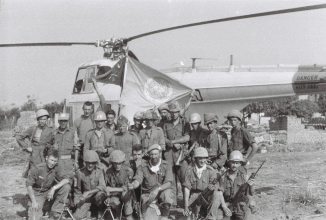
(Pictured: No.3 Platoon, A Company, 35th Battalion, pose in front of a UN relief helicopter, September 17, 1961)


Leave a comment

The Crash of Aer Lingus Flight 712

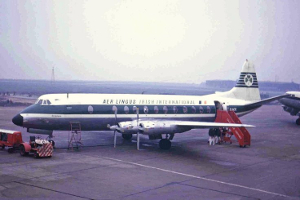
Aer Lingus Flight 712 crashes enroute from Cork to London on March 24, 1968 killing all 61 passengers and crew. The aircraft, a Vickers Viscount 803 named “St. Phelim,” crashes into the sea off Tuskar Rock, County Wexford. Although the investigation into the crash lasts two years, a cause is never determined. There has long been popular speculation that the aircraft was shot down by a British experimental missile. Aberporth in west Wales is at the time the most advanced British missile testing station.

The flight leaves Cork Airport at 10:32 AM for London. The flight proceeds normally until a call is heard with the probable contents “twelve thousand feet descending spinning rapidly.” There is no further communications with the aircraft and London ATC informs Shannon ATC that they have no radio contact with EI-AOM. London ATC requests Aer Lingus Flight EI 362, flying a Dublin to Bristol route, to search west of Strumble. This search at 500 feet in good visibility turns up nothing. At 11:25 AM a full alert is declared. By 12:36 PM there is a report of wreckage sighted at position 51°57′N, 06°10′W. Searching aircraft, however, find nothing and the report is cancelled. Aircraft and ships from the UK resume the search the following day and wreckage is sighted and bodies are recovered 6 nautical miles northeast of Tuskar Rock with more wreckage scattered an additional 6 nautical miles to the northwest.

Thirteen bodies are recovered over the next few days. Another body is recovered later. The main wreckage is located on the sea bed by trawling 1.72 nautical miles from Tuskar Rock at 39 fathoms.

In the years since the crash several witnesses have come forward with evidence to support the missile theory, including a crew member of the British ship HMS Penelope. He alleges that part of the wreckage was recovered by Penelope and removed to the UK.

An investigation report is produced in 1970, a review is undertaken between 1998 and 2000, and an independent study is commissioned in 2000.

However, in 2002 a review process conducted by the Air Accident Investigation Unit (AAIU) discloses that Aer Lingus paperwork relating to a routine maintenance inspection carried out on the aircraft in December 1967 is found to be missing in 1968. Moreover, a large body of research is done by the investigators after the accident, regarding the maintenance operating plan used for EI-AOM and defects on the aircraft found during analysis of the maintenance records. This research is not referred to in the 1970 report. A new board of investigation is set up by the Irish Government and finds that the crash is the consequence of a chain of events starting with a failure to the left tail-plane caused by metal fatigue, corrosion, flutter, or a bird strike, with the most likely cause being a flutter-induced fatigue failure of the elevator trim tab operating mechanism.

In March 2007 retired RAF Squadron Leader Eric Evers, who is previously chief flying instructor with the British military in RAF Little Rissington, makes a claim that the accident is in fact caused by a mid-air collision between the Aer Lingus Vickers Viscount and a French-built  Fouga Magister military aircraft which is training with the Irish Air Corps. Evers maintains that both the French and Irish authorities colluded in a subsequent cover-up, and the Magister wreckage may still be on the seabed. Evers claims have been largely disputed.

Aer Lingus still uses this flight number for a daily flight from Cork to London’s Heathrow Airport, contrary to airline convention of discontinuing a flight number following a crash. The route is operated with an aircraft from the Airbus A320 family.