seamus dubhghaill

Promoting Irish Culture and History from Little Rock, Arkansas, USA


Leave a comment

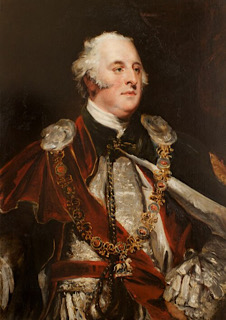
Birth of John Pratt, 1st Marquess Camden

John Jeffreys Pratt, 1st Marquess Camden, a British politician, is born at Lincoln’s Inn FieldsLondon, on February 11, 1759. He is styled Viscount Bayham from 1786 to 1794 and known as the 2nd Earl Camden from 1794 to 1812. He serves as Lord Lieutenant of Ireland in the revolutionary years 1795 to 1798 and as Secretary of State for War and the Colonies between 1804 and 1805.

Pratt is born the only son of the barrister Charles Pratt, 1st Earl Camden, and Elizabeth, daughter of Nicholas Jeffreys, of The Priory, Brecknockshire, Wales. He is baptised on the day Halley’s Comet appears. In 1765, his father is created Baron Camden, at which point he becomes The Hon. John Pratt. He is educated at the University of Cambridge (Trinity College).

In 1780, Pratt is elected Member of Parliament for Bath and obtains the position of Teller of the Exchequer the same year, a lucrative office which he keeps until his death, although after 1812 he refuses to receive the large income arising from it. He serves under William Perry, 2nd Earl of Shelburne, as Lord of the Admiralty between 1782 and 1783 and in the same post under William Pitt the Younger between 1783 and 1789, as well as a Lord of the Treasury between 1789 and 1792.

In 1786, Pratt’s father is created Earl Camden, at which point he becomes known by one of his father’s subsidiary titles as Viscount Bayham.

In 1793, Pratt is sworn of the Privy Council. In 1794 he succeeds his father as 2nd Earl Camden, and the following year he is appointed Lord Lieutenant of Ireland by Pitt.

As an opponent of parliamentary reform and of Catholic emancipation, Pratt’s term of office is one of turbulence, culminating in the Irish Rebellion of 1798. His refusal in 1797 to reprieve the United Irishman William Orr, convicted of treason on the word of one witness of dubious credit (and for which his own sister, Frances Stewart, Marchioness of Londonderry, petitions him), arouses great public indignation. To break the United Irish conspiracy, he suspends habeas corpus and unleashes a ruthless martial law campaign to disarm and break up the republican organization.

Pratt resigns from office in June 1798, to be replaced with Charles Cornwallis, 1st Marquess Cornwallis, who oversees the military defeat of the rebellion. In 1804, Pratt becomes Secretary of State for War and the Colonies under Pitt, and in 1805 Lord President of the Council, an office he retains until 1806. He is again Lord President from 1807 to 1812, after which date he remains for some time in the cabinet without office. In 1812 he is created Earl of Brecknock and Marquess Camden.

The enforced resignation from the Cabinet of Robert Stewart, Viscount Castlereagh, the stepson of his sister Frances (Lady Londonderry), to whom he has always been personally close, in September 1809, leads to a series of bitter family quarrels, when it becomes clear that Pratt has known for months of the plan to dismiss Stewart, but has given him no warning. Stewart himself regards Pratt as “a weak friend,” not an enemy, and they are eventually reconciled. Other members of the Stewart family, however, never forgive Pratt for what they regard as his disloyalty.

Pratt is also Lord Lieutenant of Kent between 1808 and 1840 and appoints himself Colonel of the Cranbrook and Woodsgate Regiment of Local Militia in 1809. He is Chancellor of the University of Cambridge between 1834 and 1840. He is made a Knight of the Garter in 1799 and elected a Fellow of the Society of Antiquaries of London in 1802.

Pratt marries Frances, daughter of William Molesworth, in 1785. She dies at Bayham AbbeySussex, in July 1829. He survives her by eleven years and dies at SealKent, on October 8, 1840, aged 81. He is succeeded by his only son, George.

The family owns and lives in a house located at 22 Arlington Street in St. James’s, a district of the City of Westminster in central London, which adjoins The Ritz Hotel. In the year of his death, he sells the house to Henry Somerset, 7th Duke of Beaufort.


2 Comments

Execution of William Orr, Member of the United Irishmen

William Orr, a member of the United Irishmen, is executed by the British on October 14, 1797, in what is widely believed at the time to be “judicial murder” and whose memory leads to the rallying cry “Remember Orr” during the Irish Rebellion of 1798. He is regarded as the first United Irish martyr.

Little is known of Orr’s early life. He is born in 1766 to a Presbyterian farming family and bleach-green proprietor, at Ferranshane outside Antrim town. The family is in comfortable circumstances and, as a result, he receives a good education. His appearance and manner are at the time considered noteworthy as he stands 6′ 2″ in height and is always carefully and respectably dressed, a familiar feature in his apparel being a green necktie, which he wears “even in his last confinement.” His popularity amongst his countrymen is also noted, particularly among the Northern Presbyterian patriots. He becomes active in the Irish Volunteers and then joins the United Irishmen. Sometime in the mid-1790s, he contributes several articles to their newspaper, the Northern Star.

Orr is charged at Carrickfergus Town Hall with administering the United Irishmen oath to a soldier named Hugh Wheatly, an offence which had recently been deemed a capital charge under the 1796 Insurrection Act. The offence is aggravated from a legal point of view because of the allegation that it is a serving soldier whom he is alleged to have administered the oath to. The prosecution makes the most of this “proof” of the “treasonable” aim of the United Irishmen to “seduce from their allegiance” the “men who are the Kingdom’s only safeguard against the foreign foe.”

The United Irishmen know from the evidence of some of their own number that Orr had not administered the oath on the occasion alleged. They also have the evidence of another eyewitness, James “Jemmy” Hope. The soldier witness Wheatly perjures himself and it is proved he is of bad character. The person who did tender the oath is a well-known member of the Society, William McKeever, who subsequently escapes to the United States. It is widely believed at the time that the authorities wish to make an example of Orr to act as a deterrent to potential United Irishmen recruits.

The actual case, which does not appear in the course of the proceedings but everyone, according to T. A. Jackson, is “in the know” and fully aware that the United Irishmen’s oath had been administered to a soldier “whether it was Orr or another who administered the oath was merely incidental.”

Orr is represented by John Philpot Curran, and the trial leads to a speech, which, according to T. A. Jackson, “is among the most remarkable of his many remarkable speeches.” It is a charge of libel against the Press newspaper, the journal founded by Arthur O’Connor to replace the Northern Star. The Press had published an open letter to the Viceroy, remarking scornfully on his refusal to show clemency to Orr. Curran’s defence is a counter-attack — an indictment of the Government, root and branch.

The only evidence used against Orr is the unsupported evidence of the soldier Wheatly and after hearing Curran’s defence of the prisoner, “there could be no possible doubt of his innocence.” Even the presiding judge, Barry Yelverton, 1st Viscount Avonmore, is said to have shed tears at the passing of the death sentence, although Orr’s friend, the poet and United Irishman William Drennan expresses his disgust at this display with the words “I hate those Yelvertonian tears.”

The sentence was hardly passed on Orr when regret is to seize on those who had aided in securing that verdict. The witness Wheatly, who subsequently goes insane and is believed to have died by his own hand, makes an affidavit before a magistrate admitting that he had sworn wrongly against Orr. Two members of the jury make depositions stating that they had been “induced to join in the verdict of guilty while under the influence of drink,” while two others swear that they had “been terrified into the same course by threats of violence.”

These particulars are placed before the Viceroy, but Lord Camden, the Lord Lieutenant of Ireland, is “deaf to all appeals” (including from his sister Lady Londonderry). “Well might Orr exclaim within his dungeon” he said “that the Government had laid down a system having for its object murder and devastation.”

Though his execution is postponed three times, Orr is hanged in the town of Carrickfergus on October 14, 1797, surrounded by an extra strong military guard. It is said that the population of the town, to express their sympathy with the “patriot” being “murdered by law,” and to mark their repugnance of the conduct of the Government towards him, quit the town on the day of his execution.

Orr’s fate “excited the deepest indignation throughout the country” and it is commented on “in words of fire” by the national writers of the period, and for many years after the rallying cry of the United Irishmen is “Remember Orr.” The journalist Peter Finnerty, who publishes an attack on Yelverton and Camden for their conduct in the matter, is later convicted of seditious libel, despite an eloquent defence by Curran.

(Pictured: William Orr from a sketch by E. A. Morrow)