seamus dubhghaill

Promoting Irish Culture and History from Little Rock, Arkansas, USA


Leave a comment

Death of Charles Donnelly, Poet & Republican Political Activist

Charles Patrick Donnelly, Irish poet, republican and left-wing political activist, is killed on February 27, 1937, fighting on the republican side during the Spanish Civil War.

Donnelly is born in Killybrackey, near Dungannon, County Tyrone, on July 10, 1914, into a family of cattle breeders. His father, Joseph Donnelly, sells his farm in 1917 and the family moves to Dundalk and opens a greengrocer‘s shop. Joseph Donnelly becomes quite prosperous, running his shop, dealing cattle and buying and selling property in the Dundalk area. In addition to Charles, the Donnellys have five other sons and two daughters. His mother, Rose, dies in 1927, when he is 13 years old.

Donnelly receives his early education in the Christian Brothers school in Dundalk. When he is fourteen in 1928, the family moves again, this time to Dublin, where his father purchases a house on Mountjoy Square in the north inner city. He enrolls in O’Connell School on North Frederick Street but is expelled after only a few weeks. He spends the next few months wandering the streets of Dublin during school time before his father discovers what had happened. Also at this time, he meets and is befriended by radical political activists from the Irish Republican Army (IRA), the Communist Party of Ireland and the left-Republican group Saor Éire.

Donnelly’s father and aunts get him an apprenticeship with a carpenter, but he gives this up after a year to enroll in University College Dublin (UCD) in 1931, where he studies Logic, English, History and the Irish language. In university he begins writing poetry and prose for student publications but fails his first-year examinations. At this time, he also becomes deeply involved in radical left-wing and republican politics. He drops out of university in 1934, having failed his first-year exams three times and joins the radical group, the Republican Congress. There he befriends veteran republicans Frank Ryan and George Gilmore. He also becomes involved in a romantic relationship with another republican activist, Cora Hughes, Éamon de Valera‘s goddaughter and later partner of George Gilmore. In July 1934, he is arrested and imprisoned for two weeks for his role in picketing a Dublin bakery with other Congress members. After this, his father expells him from the family home and he spends a period sleeping in parks around Dublin.

The Republican Congress splits at its first annual meeting in September 1934, but the 20-year-old Donnelly is elected to the National Executive of the truncated organisation. Thereafter, he writes for the Congress newspaper on political and social questions. In January 1935, he is again arrested for assaulting a Garda at a Congress demonstration and is imprisoned for a month. In February 1935, he leaves Ireland for London. In the British capital he forms the first Republican Congress branch in London and becomes its first chairman. He finds employment variously as a dishwasher in pubs and cafes and as a reporter with an international news agency. While in London he remains a regular contributor to the Republican Congress newspaper and various left-wing publications. Together with two other poets, Leslie Daiken and Ewart Milne, he is one of the founders of a duplicated publication called Irish Front, the London journal of the Republican Congress. Daiken admits that many of the Irish Front editions are written almost entirely by Donnelly.

Eoin McNamee recalls Donnelly as “a frail looking Dublin man with a Tyrone background…he was something of an intellectual and clearly the theorist of the Irish Republican Congress in London at that time. He was well versed in Marxism, wrote for the Congress and Communist press, and frequently appeared on left-wing public platforms.”

In July 1936, on the outbreak of the Spanish Civil War, Donnelly urges the Republican Congress to send fighters to the International Brigades. He himself returns to Dublin with the intention of organising such a force. By the end of 1936, he has gone again to London and joins the Brigades. He reaches Spain on January 7, 1937, and at Albacete, meets up with an Irish contingent, led by Frank Ryan, known as the Connolly Column, who had come to Spain to fight on the Republican side. He and his comrades are attached to the American Lincoln Battalion. On February 15, after receiving only rudimentary military training, the Lincoln Battalion is thrown into the Battle of Jarama, near Madrid. Donnelly reaches the front on February 23, where he is promoted to the rank of field commander. On February 27, his unit is sent on a frontal assault on the Nationalist positions on a hill named Pingarrón. The object of the attack is to take the enemy trenches and ultimately to drive them across the Jarama River. He and his unit are pinned down by machine gun fire all day. In the evening, the Nationalists launch a counterattack.

A Canadian veteran recalls, “We ran for cover, Charlie Donnelly, the commander of an Irish company is crouched behind an olive tree. He has picked up a bunch of olives from the ground and is squeezing them. I hear him say something quietly between a lull in machine gun fire: Even the olives are bleeding.” The line later becomes famous.

A few minutes later, as his unit retreats, Donnelly is caught in a burst of gunfire. He is struck three times, in the right arm, the right side and the head. He collapses and dies instantly. His body lay on the battlefield until it is recovered by fellow Irish Brigadier Peter O’Connor on March 10. He is buried at Jarama in an unmarked grave with several of his comrades.

Written by Donnelly’s brother Joseph, a collection of his work, Charlie Donnelly: the Life and Poems, is published in 1987 by Dedalus Press. On the eve of the 71st anniversary of his death, February 26, 2008, he is commemorated with the unveiling of a plaque at his alma mater, UCD, attended by 150 people. The commemoration, organised jointly by a group of UCD students and the Donnelly family, is hosted by the School of English and also includes a lecture by Gerald Dawe on Donnelly’s life and poetry. In April 2008, the UCD branch of the Labour Party is renamed the Charlie Donnelly Branch in his honour.

Donnelly’s friend Blanaid Salkeld commemorates him in her poem “Casualties,” writing “That Charlie Donnelly small and frail/ And flushed with youth was rendered pale/ But not with fear, in what queer squalor/ Was smashed up his so-ordered valour.” A 1976 documentary about the Civil War by Cathal O’Shannon is entitled Even the Olives are Bleeding.

Donnelly is survived by a brother, Joseph, who manages to get many of his poems published in 1987; only five or six are published during his lifetime. Discussing his work, Colm Tóibín says it “mixed an Audenesque exactitude with a youthful romanticism… his poem “The Tolerance of Crows” belongs in any anthology of modern poetry.” In 1992, Donnelly has work included in Dedalus Irish Poets: An Anthology from Dedalus Press.

In 1992 New Island Books publishes Even the Olives Are Bleeding: The Life and Times of Charles Donnelly by Joseph O’Connor. The book is launched by future Irish President Michael D. Higgins.

Donnelly is commemorated in the Christy Moore song Viva La Quinta Brigada.


Leave a comment

Death of Irish Poet Ewart Milne

Ewart Milne, Irish poet, dies in Bedford, Bedfordshire, England, of a heart attack on January 14, 1987. He describes himself on various book jackets as “a sailor before the mast, ambulance driver and courier during the Spanish Civil War, a land worker and estate manager in England during and after World War II” and also “an enthusiast for lost causes – national, political, social and merely human.”

Milne is born in Dublin on May 25, 1903, to English and Welsh Irish parents and is educated at Christchurch Cathedral Grammar School. In 1920 he signs on as a seaman and works on boats, off and on, until 1935. During the 1930s he begins writing and has his first poems published in 1935.

The background to the Spanish Civil War contributes to Milne’s political awakening and he comes to England to work as a voluntary administrator for the Spanish Medical Aid Committee in London, for whom he often acts as a medical courier. He also was once unwillingly involved in an arms deal while visiting Spain on their behalf.

After Spanish Medical Aid Committee is wound up, Milne returns to Ireland but remains politically active in support of the campaign for the release of Frank Ryan, the leader of the Connolly Column of Irish volunteers on the Republican side, who had been captured and imprisoned in Spain. At one point he takes part in a delegation to Westminster seeking Labour Party support for this. In August 1938 he is reported in The Worker’s Republic as being one of the twelve-member committee of the James Connolly Irish club in London.

During his time in England and Spain, Milne gets to know the left-leaning poets who support the Republican cause, including W. H. Auden, Stephen Spender and Cecil Day-Lewis. In 1938 his first collection of poems, Forty North Fifty West, is published in Dublin, followed by two others in 1940 and 1941. Having taken a pro-British line in neutral Ireland, he is informed by Karl Petersen, the German press attaché in Dublin, that he is on the Nazi death list. This convinces him to help in the British war effort and he returns to England with the help of John Betjeman, then working at the British embassy in Ireland.

Between 1942–1962 Milne is resident in England and an active presence on the English literary scene. In particular he becomes associated with the poets grouped around the magazine Nine, edited by Peter Russell and Ian Fletcher. He and his wife Thelma also back the young Irish poet Patrick Galvin when he launches his own magazine, Chanticleer. This generous encouragement of younger writers is later extended to several others, including John F. Deane, Gerald Dawe and Maurice Scully.

Milne regards his return to Dublin in 1962 as a disaster, as his four-year stay is overshadowed by quarrels with the establishment, the discovery of betrayal by a friend and the death of his wife from lung cancer. The misery of those events is recorded in Time Stopped (1967). The artistic frustration of the time also results in the poems included in Cantata Under Orion (1976). Returning to England in 1966, he settles in Bedford. Politically he remains involved and speaks alongside Auberon Waugh at the rally on behalf of Biafra in 1968, but his views move further to the right in later years. He writes to The Irish Times on April 13, 1976, saying that he has been “taken in by Stalin and that Leninism is Satanism.” He also sides with the Loyalist position in the Ulster conflict. He dies in Bedford of a heart attack on January 14, 1987.

Milne is twice married, first to Kathleen Ida Bradner in 1927, by whom he has two sons; then in 1948 to Thelma Dobson, by whom he has two more sons.

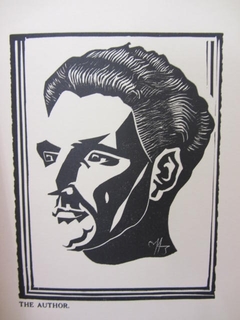
(Pictured: A portrait of Ewart Milne by Cecil F. Salkkeld, as it appears in Milne’s book Forty North Fifty West)


Leave a comment

Birth of Ewart Milne, Irish Poet

ewart-milne

Ewart Milne, Irish poet, is born in Dublin on May 25, 1903, He describes himself on various book jackets as “a sailor before the mast, ambulance driver and courier during the Spanish Civil War, a land worker and estate manager in England during and after World War II” and also “an enthusiast for lost causes – national, political, social and merely human.”

Milne is born of English and Welsh Irish parents and is educated at Christchurch Cathedral Grammar School. In 1920 he signs on as a seaman and works on boats, off and on, until 1935. During the 1930s he begins writing and has his first poems published in 1935.

The background to the Spanish Civil War contributes to Milne’s political awakening and he comes to England to work as a voluntary administrator for the Spanish Medical Aid Committee in London, for whom he often acts as a medical courier. He also was once unwillingly involved in an arms deal while visiting Spain on their behalf.

After Spanish Medical Aid Committee is wound up, Milne returns to Ireland but remains politically active in support of the campaign for the release of Frank Ryan, the leader of the Connolly Column of Irish volunteers on the Republican side, who had been captured and imprisoned in Spain. At one point he takes part in a delegation to Westminster seeking Labour Party support for this. In August 1938 he is reported in The Worker’s Republic as being one of the twelve-member committee of the James Connolly Irish club in London.

During his time in England and Spain, Milne gets to know the left-leaning poets who support the Republican cause, including W. H. Auden, Stephen Spender and Cecil Day-Lewis. In 1938 his first collection of poems, Forty North Fifty West, is published in Dublin, followed by two others in 1940 and 1941. Having taken a pro-British line in neutral Ireland, he is informed by Karl Petersen, the German press attaché in Dublin, that he is on the Nazi death list. This convinces him to help in the British war effort and he returns to England with the help of John Betjeman, then working at the British embassy in Ireland.

Between 1942–1962 Milne is resident in England and an active presence on the English literary scene. In particular he becomes associated with the poets grouped around the magazine Nine, edited by Peter Russell and Ian Fletcher. He and his wife Thelma also back the young Irish poet Patrick Galvin when he launches his own magazine, Chanticleer. This generous encouragement of younger writers is later extended to several others, including John F. Deane, Gerald Dawe and Maurice Scully.

Milne regards his return to Dublin in 1962 as a disaster, as his four-year stay is overshadowed by quarrels with the establishment, the discovery of betrayal by a friend and the death of his wife from lung cancer. The misery of those events is recorded in Time Stopped (1967). The artistic frustration of the time also results in the poems included in Cantata Under Orion (1976). Returning to England in 1966, he settles in Bedford. Politically he remains involved and speaks alongside Auberon Waugh at the rally on behalf of Biafra in 1968, but his views move further to the right in later years. He writes to The Irish Times on April 13, 1976, saying that he has been “taken in by Stalin and that Leninism is Satanism.” He also sides with the Loyalist position in the Ulster conflict. He dies in Bedford of a heart attack on January 14, 1987.

Milne is twice married, first to Kathleen Ida Bradner in 1927, by whom he has two sons; then in 1948 to Thelma Dobson, by whom he has two more sons.

(Pictured: A portrait of Ewart Milne by Cecil F. Salkkeld, as it appears in Milne’s book Forty North Fifty West)


Leave a comment

Brian Keenan Released by Islamic Jihad

brian-keenan

Brian Keenan, Northern Irish writer, is released by the Islamic Jihad Organization on August 24, 1990 after having spent 52 months as a hostage in Beirut, Lebanon. His works include the book An Evil Cradling, an account of the four and a half years he spends as a hostage.

Keenan is born into a working-class family in East Belfast on September 28, 1950. He leaves Orangefield High School early and begins work as a heating engineer. However, he continues an interest in literature by attending night classes and in 1970 gains a place at the University of Ulster in Coleraine. Other writers there at the time included Gerald Dawe and Brendan Hamill. In the mid 1980s he returns to the Magee College campus of the university for postgraduate study. Afterwards he accepts a teaching position at the American University of Beirut, where he works for about four months.

On the morning of April 11, 1986 Keenan is kidnapped by the Islamic Jihad Organization. After spending two months in isolation, he is moved to a cell shared with the British journalist John McCarthy. He is kept blindfolded throughout most of his ordeal, and is chained by hand and foot when he is taken out of solitary.

The British and American governments at the time have a policy that they will not negotiate with terrorists and Keenan is considered by some to have been ignored. Because he is travelling on both Irish and British passports, the Irish government makes numerous diplomatic representations for his release, working closely with the Iranian government. Throughout the kidnap they also provide support to his two sisters, Elaine Spence and Brenda Gillham, who are spearheading the campaign for his release. He is released from captivity to Syrian military forces on August 24, 1990 and is driven to Damascus. There he is handed over by the Syrian Foreign Ministry to the care of Irish Ambassador, Declan Connolly. His sisters are flown by Irish Government executive jet to Damascus to meet him and bring him home to Northern Ireland.

An Evil Cradling is an autobiographical book by Keenan about his four years as a hostage in Beirut. The book revolves heavily around the great friendship he experiences with fellow hostage John McCarthy, and the brutality that is inflicted upon them by their captors. It is the 1991 winner of The Irish Times Literature Prize for Non-fiction and the Christopher Ewart-Biggs Memorial Prize.

Keenan returns to Beirut in 2007 for the first time since his release 17 years earlier, and describes “falling in love” with the city.

Brian Keenan now lives in Dublin.


Leave a comment

Kidnapping of Writer Brian Keenan

Irish writer Brian Keenan is taken hostage in BeirutLebanon, on April 11, 1986.

Keenan is born into a working-class family in East Belfast on September 28, 1950. He leaves Orangefield High Schoolearly and begins work as a heating engineer. However, he continues an interest in literature by attending night classes and in 1970 gains a place at the University of Ulster in Coleraine. Other writers there at the time include Gerald Dawe and Brendan Hamill. In the mid-1980s Keenan returns to the Magee College campus of the university for postgraduate study. Afterwards he accepts a teaching position at the American University of Beirut, where he works for about four months.

On the morning of April 11, 1986 Keenan is kidnapped by Islamic Jihad. After spending two months in isolation, he is moved to a cell shared with the British journalist John McCarthy. He is kept blindfolded throughout most of his ordeal, and is chained by his hands and feet when taken out of solitary.

The British and American governments at the time have a policy that they will not negotiate with terrorists and Keenan is considered by some to have been ignored. Because he is travelling on both British and Irish passports, the Irish government makes numerous diplomatic representations for his release, working closely with the Iranian government. Throughout the kidnap the government also provides support to Keenan’s two sisters, Elaine Spence and Brenda Gillham, who are spearheading the campaign for his release.

Keenan is released from captivity to Syrian military forces on August 24, 1990 and is driven to Damascus. There he is handed over by the Syrian Foreign Ministry to the care of Irish Ambassador, Declan Connolly. His sisters are flown by Irish Government executive jet to Damascus to meet him and bring him home to Northern Ireland.

An Evil Cradling is an autobiographical book by Keenan about his four years as a hostage in Beirut. The book revolves heavily around the great friendship he experiences with fellow hostage John McCarthy, and the brutality that is inflicted upon them by their captors. It is the 1991 winner of The Irish Times Literature Prize for Non-fiction and the Christopher Ewart-Biggs Memorial Prize.

Keenan returns to Beirut in 2007 for the first time since being released 17 years earlier, and describes “falling in love” with the city. He now lives in Dublin.

(Pictured: Brian Keenan arrives at Dublin Airport after his release from captivity in Beirut in August 1990)