By mid-1922, the Irish Civil War begins after the Anglo-Irish Treaty splits the IRA into pro- and anti-Treaty factions. The 4th Northern Division, based in counties Armagh, Down, and Louth, is one of the most formidable Anti-Treaty units in the region. Frank Aiken, a veteran IRA commander, has rebuilt this division during the Truce period, using it for guerrilla operations and border raids.
The Free State Army, under the National Army, is consolidating control in southern and midland counties, while Anti-Treaty forces focus on border counties to prevent Free State expansion and to maintain resistance.
The August 16 assault on Dundalk is a border raid aimed at disrupting Free State supply lines and communications, isolating and weakening Free State positions in the Louth area and demonstrating Anti-Treaty strength to other IRA units and the wider population. They use two mines to breach the walls of the barracks and temporarily take over the town.
Seven Free State soldiers are killed and fifteen are wounded. Two republicans are killed, accidentally by one of their own mines, and thirty are wounded. About 240 republican prisoners are freed from the prison and 400 rifles are taken. Aiken, however, does not try to hold the town and, while in possession of it, calls for a truce in a meeting in the town square.
While the attack is significant in symbolic terms, it does not achieve a decisive strategic breakthrough. Free State forces are able to regroup and counterattack, and the operation highlights the challenges Anti-Treaty units face in sustaining large-scale offensives against a better-equipped and more mobile National Army.
The raid exemplifies the “war along the border” strategy, where Anti-Treaty forces target Free State-held border towns and infrastructure. Aiken’s leadership as commander of the 4th Northern Division underscores his reputation as a skilled guerrilla leader. The attack reflects the early Civil War pattern of small-scale, mobile raids by Anti-Treaty forces against Free State-held towns and garrisons.
In summary, the August 16, 1922, Dundalk attack is a notable Anti-Treaty IRA operation that showcases the 4th Northern Division’s capabilities but also the limitations of their conventional-style assaults against the Free State’s growing military presence.
(Pictured: Frank Aiken and the 4th Northern Division of the Irish Republican Army)
By mid-July 1922, the Free State has re-taken counties Limerick and Waterford, but the IRA still controls counties Cork and Kerry, as well as much of the west under Liam Lynch’s command. A purely land-based advance into these areas risks long, attritional battles. Dalton’s plan is to create a second front by landing troops along the County Kerry and County Cork coasts, isolating republican strongholds like Tralee.
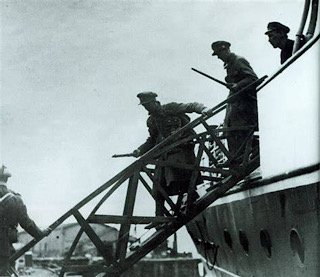
The SS Lady Wicklow carries 450 soldiers of the Dublin Guardbrigade under Paddy Daly, along with a field gun and an armoured car nicknamed the Ex-Mutineer. The Dublin Guards are considered the most disciplined and politically reliable unit in the Army, and Daly is one of Michael Collins’ trusted lieutenants. The landing is intended to secure Fenit as a base for an amphibious assault on Tralee, a key republican stronghold.
The surprise attack catches the IRA forces off guard, taking their left flank in the rear. The Free State quickly advances, and by the following days, much of County Kerry is freed from republican control. The operation is part of a broader offensive that culminates in the capture of Tralee on August 2, one of the bloodiest single days of combat for the National Army.
While the initial landings are successful, the IRA mounts counterattacks over August and September, regaining some ground. However, the Free State’s superior resources, better equipment, and lack of popular support for the republicans allows them to consolidate control in County Kerry over time. The Fenit landing is a turning point, shifting the momentum in favour of the Free State and contributing to the eventual republican defeat in the Irish Civil War.
In summary, the August 2, 1922, naval landing at Fenit is a bold, surprise amphibious operation that disrupts republican defenses, opens County Kerry to Free State advance, and alters the course of the Irish Civil War.
(Pictured: Free State troops landing at Fenit, County Kerry, on August 2, 1922)
Donnelly is born in Killybrackey, near Dungannon, County Tyrone, on July 10, 1914, into a family of cattle breeders. His father, Joseph Donnelly, sells his farm in 1917 and the family moves to Dundalk and opens a greengrocer‘s shop. Joseph Donnelly becomes quite prosperous, running his shop, dealing cattle and buying and selling property in the Dundalk area. In addition to Charles, the Donnellys have five other sons and two daughters. His mother, Rose, dies in 1927, when he is 13 years old.
Donnelly receives his early education in the Christian Brothers school in Dundalk. When he is fourteen in 1928, the family moves again, this time to Dublin, where his father purchases a house on Mountjoy Square in the north inner city. He enrolls in O’Connell School on North Frederick Street but is expelled after only a few weeks. He spends the next few months wandering the streets of Dublin during school time before his father discovers what had happened. Also at this time, he meets and is befriended by radical political activists from the Irish Republican Army (IRA), the Communist Party of Ireland and the left-Republican group Saor Éire.
Donnelly’s father and aunts get him an apprenticeship with a carpenter, but he gives this up after a year to enroll in University College Dublin (UCD) in 1931, where he studies Logic, English, History and the Irish language. In university he begins writing poetry and prose for student publications but fails his first-year examinations. At this time, he also becomes deeply involved in radical left-wing and republican politics. He drops out of university in 1934, having failed his first-year exams three times and joins the radical group, the Republican Congress. There he befriends veteran republicans Frank Ryan and George Gilmore. He also becomes involved in a romantic relationship with another republican activist, Cora Hughes, Éamon de Valera‘s goddaughter and later partner of George Gilmore. In July 1934, he is arrested and imprisoned for two weeks for his role in picketing a Dublin bakery with other Congress members. After this, his father expells him from the family home and he spends a period sleeping in parks around Dublin.
The Republican Congress splits at its first annual meeting in September 1934, but the 20-year-old Donnelly is elected to the National Executive of the truncated organisation. Thereafter, he writes for the Congress newspaper on political and social questions. In January 1935, he is again arrested for assaulting a Garda at a Congress demonstration and is imprisoned for a month. In February 1935, he leaves Ireland for London. In the British capital he forms the first Republican Congress branch in London and becomes its first chairman. He finds employment variously as a dishwasher in pubs and cafes and as a reporter with an international news agency. While in London he remains a regular contributor to the Republican Congress newspaper and various left-wing publications. Together with two other poets, Leslie Daiken and Ewart Milne, he is one of the founders of a duplicated publication called Irish Front, the London journal of the Republican Congress. Daiken admits that many of the Irish Front editions are written almost entirely by Donnelly.
Eoin McNamee recalls Donnelly as “a frail looking Dublin man with a Tyrone background…he was something of an intellectual and clearly the theorist of the Irish Republican Congress in London at that time. He was well versed in Marxism, wrote for the Congress and Communist press, and frequently appeared on left-wing public platforms.”
In July 1936, on the outbreak of the Spanish Civil War, Donnelly urges the Republican Congress to send fighters to the International Brigades. He himself returns to Dublin with the intention of organising such a force. By the end of 1936, he has gone again to London and joins the Brigades. He reaches Spain on January 7, 1937, and at Albacete, meets up with an Irish contingent, led by Frank Ryan, known as the Connolly Column, who had come to Spain to fight on the Republican side. He and his comrades are attached to the American Lincoln Battalion. On February 15, after receiving only rudimentary military training, the Lincoln Battalion is thrown into the Battle of Jarama, near Madrid. Donnelly reaches the front on February 23, where he is promoted to the rank of field commander. On February 27, his unit is sent on a frontal assault on the Nationalist positions on a hill named Pingarrón. The object of the attack is to take the enemy trenches and ultimately to drive them across the Jarama River. He and his unit are pinned down by machine gun fire all day. In the evening, the Nationalists launch a counterattack.
A Canadian veteran recalls, “We ran for cover, Charlie Donnelly, the commander of an Irish company is crouched behind an olive tree. He has picked up a bunch of olives from the ground and is squeezing them. I hear him say something quietly between a lull in machine gun fire: Even the olives are bleeding.” The line later becomes famous.
A few minutes later, as his unit retreats, Donnelly is caught in a burst of gunfire. He is struck three times, in the right arm, the right side and the head. He collapses and dies instantly. His body lay on the battlefield until it is recovered by fellow Irish Brigadier Peter O’Connor on March 10. He is buried at Jarama in an unmarked grave with several of his comrades.
Written by Donnelly’s brother Joseph, a collection of his work, Charlie Donnelly: the Life and Poems, is published in 1987 by Dedalus Press. On the eve of the 71st anniversary of his death, February 26, 2008, he is commemorated with the unveiling of a plaque at his alma mater, UCD, attended by 150 people. The commemoration, organised jointly by a group of UCD students and the Donnelly family, is hosted by the School of English and also includes a lecture by Gerald Dawe on Donnelly’s life and poetry. In April 2008, the UCD branch of the Labour Party is renamed the Charlie Donnelly Branch in his honour.
Donnelly’s friend Blanaid Salkeld commemorates him in her poem “Casualties,” writing “That Charlie Donnelly small and frail/ And flushed with youth was rendered pale/ But not with fear, in what queer squalor/ Was smashed up his so-ordered valour.” A 1976 documentary about the Civil War by Cathal O’Shannon is entitled Even the Olives are Bleeding.
Donnelly is survived by a brother, Joseph, who manages to get many of his poems published in 1987; only five or six are published during his lifetime. Discussing his work, Colm Tóibín says it “mixed an Audenesque exactitude with a youthful romanticism… his poem “The Tolerance of Crows” belongs in any anthology of modern poetry.” In 1992, Donnelly has work included in Dedalus Irish Poets: An Anthology from Dedalus Press.
As a child, Murphy is a loner with mood swings and an explosive temper. He grows up in Texas, around Farmersville, Greenville, and Celeste, where he attends elementary school. His father drifts in and out of the family’s life and eventually deserts them. He drops out of school in fifth grade and gets a job picking cotton for a dollar a day to help support his family. After his mother dies of endocarditis and pneumonia in 1941, he works at a radio repair shop and at a combination general store, garage and gas station in Greenville.
After the attack on Pearl Harbor, Murphy’s older sister helps him to falsify documentation about his birthdate in order to meet the minimum-age requirement for enlisting in the military. Turned down by the Navy and the Marine Corps, he enlists in the Army. He first sees action in the 1943 Allied invasion of Sicily. Then, in 1944, he participates in the Battle of Anzio, the liberation of Rome, and Operation Dragoon, the invasion of Southern France. He fights at Montélimar and leads his men on a successful assault at the L’Omet quarry near Cleurie in northeastern France in October.
Murphy receives every military combat award for valor available from the U.S. Army, as well as French and Belgian awards for heroism. He receives the Medal of Honor for valor that he demonstrates at the age of 19 for single-handedly holding off an entire company of German soldiers for an hour at the Colmar Pocket in France in January 1945, then leading a successful counterattack while wounded and out of ammunition.
After the war, Murphy embarks on a 21-year acting career. He plays himself in the 1955 autobiographical film To Hell and Back, based on his 1949 memoirs of the same name, but most of his roles are in westerns. He makes guest appearances on celebrity television shows and stars in the series Whispering Smith. He is a fairly accomplished songwriter. He breeds American Quarter Horses in California and Arizona and becomes a regular participant in horse racing.
Suffering from what would today be described as posttraumatic stress disorder (PTSD), Murphy sleeps with a loaded handgun under his pillow. He looks for solace in addictive sleeping pills. In his last few years, he is plagued by money problems but refuses offers to appear in alcohol and cigarette commercials because he does not want to set a bad example.