seamus dubhghaill

Promoting Irish Culture and History from Little Rock, Arkansas, USA


Leave a comment

Birth of Irish Sculptor Albert Power

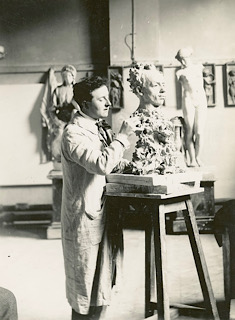
Albert George Power, Irish sculptor in the academic realist style, is born at 8 Barrack Street (now Benburb Street) in Dublin on November 16, 1881. He is particularly known for his iconic statue of the Irish writer Pádraic Ó Conaire.

Power is born to Henry Power, a watchmaker, and Mary (née Atkins), an embroideress. He has one older brother, and one younger sister. He attends a Christian Brothers national school in North Brunswick Street. As a child he plays in local clay brickyards and sculpts busts of his friends. After finishing his primary school education, he trains with a firm of sculptors run by Edward Smyth. In 1884, he enrolls as an evening pupil at the Dublin Metropolitan School of Art (DMSA), later attending as a full-time student from 1906 to 1911. During his time at the DMSA he is taught and strongly influenced by John HughesOliver Sheppard and William Orpen. He wins a number of prizes during his time at the DMSA, including medals, three scholarships, book prizes, and the national gold medal for the best modeling of a nude figure, in Ireland, Scotland, and the Channel Islands in 1911.

Power marries Agnes Kelly in 1903. The couple has ten children, four daughters and six sons, including May and James who also become sculptors.

Power establishes his own stone-carving business in 1912 from his new home at 18 Geraldine Street, Phibsborough, Dublin. As the firm grows, it moves to premises nearby at 15 Berkeley Street from 1930. He executes a wide range of works, including monuments and architectural features in bronze, marble, and stone. Among his notable works are the figure of “Science” designed by Sheppard from the façade of the new Royal College of Science for Ireland (later Government Buildings) on Merrion Street, Dublin, carved motifs and sphinxes for the Gresham Hotel, O’Connell Street, and four statues on the dome of Christ the King church, Carndonagh, County Donegal.

Power is considered the leading Irish sculptor of the 1920s and 1930s. He is a nationalist and promotes the use of Irish materials such as limestone from Durrow and Connemara marble. He is noted for his academic realist style. He exhibits regularly with the Royal Hibernian Academy from 1906, becoming an associate member in 1911, and a full member in 1919. Among those he models sculptures for are James Stephens (1913), W. B. Yeats (1918), and Lord Dunsany (1920). Among his patrons are Oliver St. John Gogarty, and through Gogarty he is commissioned to model a number of prominent Irish nationalists. Gogarty asks him to carve a portrait of Terence MacSwiney in 1920, while MacSwiney is on hunger strike in HM Prison Brixton, London. Smuggled into the prison to do a thumbnail sketch, Power then carves a portrait in the form of a life mask.

On Gogarty’s recommendation, Power is commissioned by the Irish Free State government to create portraits of a number of leading politicians including Arthur Griffith (1922), Michael Collins (1936), and Austin Stack (1939). He is also privately commissioned to execute a portrait of Éamon de Valera in 1944. Among his monumental works are sculptures of Tom Kettle (1919) at St. Stephen’s Green, Dublin, Christ the King in Gort, County Galway, (1933), Pádraic Ó Conaire (1935) at Eyre Square, Galway, and W. B. Yeats (1939) at Sandymount Green, Dublin. He is one of the artists invited to submit designs for the new coinage of the Irish Free State in 1928.

Power dies in Dublin on July 10, 1945, following complications from a double hernia. His is buried in Glasnevin Cemetery, Dublin.

Leave a comment

Birth of Evie Hone, Painter & Stained Glass Artist

Eva Sydney Hone RHA, Irish painter and stained glass artist usually known as Evie, is born at Roebuck Grove, County Dublin, on April 22, 1894. She is considered to be an early pioneer of cubism, although her best known works are stained glass. Her most notable pieces are the East Window in the Chapel at Eton College, which depicts the Crucifixion, and My Four Green Fields, which is now in the Government Buildings in Dublin.

Hone is the youngest daughter of Joseph Hone, of the Hone family, and Eva Eleanor (née Robinson), daughter of Sir Henry Robinson and granddaughter of Arthur Annesley, 10th Viscount Valentia. Her mother dies two days after her birth. She is related to artists Nathaniel Hone and Nathaniel Hone the Younger.

Shortly before her twelfth birthday, Hone suffers from polio (infant paralysis), suffering a fall while helping to decorate the Taney parish church for Easter. Her resulting ill health leads to her seeking treatment in Harley Street, Marylebone, Central London. She is educated by a governess, continuing her education in Switzerland, and goes on tours to Spain and Italy before moving to London in 1913. Her three sisters all marry British Army officers, and all are widowed in World War I.

Hone studies at the Byam Shaw School of Art in London and then under Bernard Meninsky at the Central School of Arts and Crafts. She meets Mainie Jellett when both are studying under Walter Sickert at the Westminster Technical Institute. She works under André Lhote and Albert Gleizes in Paris before returning to become influential in the modern movement in Ireland and becoming one of the founders of the Irish Exhibition of Living Art. She is considered an early pioneer of Cubism but in the 1930s turns to stained glass, which she studies with Wilhelmina Geddes.

Hone is extremely devout. She spends time in an Anglican Convent in 1925 at Truro in Cornwall and converts to Catholicism in 1937. This possibly influences her decision to begin working in stained glass. Initially, she works as a member of the An Túr Gloine stained glass co-operative before setting up a studio of her own in Rathfarnham.

Hone’s most important works are probably the East Window, depicting the Crucifixion, for the Chapel at Eton College, Windsor (1949–1952) and My Four Green Fields, now located in Government Buildings, Dublin. This latter work, commissioned for the Irish Government’s Pavilion, wins first prize for stained glass in the 1939 New York World’s Fair. It graces CIÉ‘s Head Office in O’Connell Street from 1960 to about 1983. The East Window of Eton College is commissioned following the destruction of the building after a bomb is dropped in 1940 on the school during World War II. She is commissioned to design the East Window in 1949, and the new window is inserted in 1952. This work is featured on an Irish postage stamp in 1969. From December 2005 to June 2006, an exhibition of her work is on display at the National Gallery of Ireland. Saint Mary’s church in Clonsilla also features her stained glass windows.

Despite ill health, Hone continues to produce a huge number of small stained glass panels as well as oils, watercolours, and gouache landscapes. In 1953, she is represented at the Contemporary Irish Art exhibition at Aberystwyth, Wales, and at the Tate gallery in London, receiving as well an honorary LLD from Trinity College Dublin (TCD). In 1954, she is elected an honorary member of the Royal Hibernian Academy (RHA).

Unmarried, Hone dies on March 13, 1955, while entering her parish church at Rathfarnham. She is survived by two of her sisters. Over 20,000 people visit a memorial exhibition of her work at University College Dublin (UCD), Earlsfort Terrace, Dublin, in 1958.

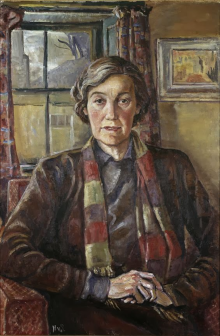
(Pictured: Portrait of Evie Hone by Hilda van Stockum)


Leave a comment

Death of Evie Hone, Painter & Stained Glass Artist

Eva Sydney Hone RHA, Irish painter and stained glass artist usually known as Evie, dies on March 13, 1955, in Rathfarnham, County Dublin. She is considered to be an early pioneer of cubism, although her best known works are stained glass. Her most notable pieces are the East Window in the Chapel at Eton College, which depicts the Crucifixion, and My Four Green Fields, which is now in the Government Buildings in Dublin.

Hone is born at Roebuck Grove, County Dublin, on April 22, 1894. She is the youngest daughter of Joseph Hone, of the Hone family, and Eva Eleanor, née Robinson, daughter of Sir Henry Robinson and granddaughter of Arthur Annesley, 10th Viscount Valentia. She is related to Nathaniel Hone and Nathaniel Hone the Younger. Shortly before her twelfth birthday she suffers from polio. She is educated by a governess, continuing her education in Switzerland, and goes on tours to Spain and Italy before moving to London in 1913. Her three sisters all marry British Army officers, and all are widowed in World War I.

Hone studies at the Byam Shaw School of Art in London and then under Bernard Meninsky at the Central School of Arts and Crafts. She meets Mainie Jellett when both are studying under Walter Sickert at the Westminster Technical Institute. She works under André Lhote and Albert Gleizes in Paris before returning to become influential in the modern movement in Ireland and become one of the founders of the Irish Exhibition of Living Art. She is considered an early pioneer of Cubism but in the 1930s turns to stained glass, which she studies with Wilhelmina Geddes.

Hone’s most important works are probably the East Window, depicting the Crucifixion, for the Chapel at Eton College, Windsor (1949–1952) and My Four Green Fields, now located in Government Buildings, Dublin. This latter work, commissioned for the Irish Government’s Pavilion, wins first prize for stained glass in the 1939 New York World’s Fair. It graces CIÉ‘s Head Office in O’Connell Street from 1960 to about 1983. The window is then taken into storage by Abbey Glass in Kilmainham, Dublin at the request of the Office of Public Works.

The East Window of Eton College is commissioned following the destruction of the building after a bomb is dropped on the school in 1940 during World War II. She is commissioned to design the East Window in 1949, and the new window is inserted in 1952. This work is featured on an Irish postage stamp in 1969. From December 2005 to June 2006, an exhibition of her work is on display at the National Gallery of Ireland. Saint Mary’s church in Clonsilla also features her stained glass windows.

Hone is extremely devout. She spends time in an Anglican Convent in 1925 at Truro in Cornwall and converts to Catholicism in 1937. This may have influenced her decision to begin working in stained glass. Initially she works as a member of the An Túr Gloine stained glass co-operative before setting up a studio of her own in Rathfarnham.

Hone is elected an honorary member of the Royal Hibernian Academy (RHA) in 1954.

Unmarried, Hone dies on March 13, 1955, while entering her parish church at Rathfarnham. She is survived by two of her sisters. Over 20,000 people visit a memorial exhibition of her work at University College Dublin (UCD), Earlsfort Terrace, Dublin, in 1958.

(Pictured: “My Four Green Fields” by Evie Hone, which depicts the four provinces of Ireland)


Leave a comment

U.S. Vice President Joe Biden Arrives in Ireland

joe-biden-michael-higgins

Vice President of the United States Joe Biden arrives in Ireland on Tuesday, June 21, 2016, for a six-day visit. He arrives with his brother and sister, his daughter and five grandchildren and is welcomed to Ireland by Minister for Foreign Affairs and Trade Charles Flanagan.

Biden then travels to Government Buildings where he is formally welcomed by Taoiseach Enda Kenny. Kenny says he hopes Biden enjoyed his visit and Biden says that he himself has visited Ireland several times privately, but never as vice president. He adds that he had promised his late son Beau that he would make a family trip to Ireland, “Unfortunately Beau didn’t make it, but we decided that we would bring the whole family.”

Biden, an Irish American, speaks of his great-grandfather who emigrated from Ireland, and he also speaks of the pride his family feels in their Irish heritage.

Kenny presents Biden with a hurley and a sliotar, to which the Vice President responds, “I have witnessed one game and I have one regret, that they don’t have this in the United States. I played American football and American baseball in high school and college, but this would have been … this is a dangerous game.”

Biden holds a bilateral meeting with Kenny in the evening and meets with the President of Ireland, Michael D. Higgins, the following day at his official residence, Áras an Uachtaráin in Dublin‘s Phoenix Park. As he signs the visitors’ book, he paraphrases another famous Irish American, former U.S. President John F. Kennedy, who had visited the Republic of Ireland 53 years earlier. His written entry makes reference to a speech made to Dáil Éireann in June 1963, when Kennedy said, “our two nations, divided by distance, have been united by history.”

During his visit Biden visits County Mayo and County Louth, where his ancestors originated, in addition to several engagements in Dublin and a stop at Newgrange. He also arranges to fit in a round of golf with Kenny.

Biden speaks at an event at Trinity College, Dublin on the morning of Friday, June 24 and delivers a keynote address to an American Ireland Fund event in Dublin Castle in the evening. He addresses the Irish American experience, the shared heritage of the two nations, and the values of tolerance, diversity and inclusiveness.

On Saturday, June 25, Biden visits various locations in County Louth including the Kilwirra Cemetery and Newgrange in County Meath.

Biden returns to the United States following a lunch with Kenny on Sunday, June 26.

(Pictured: U.S. Vice President Joe Biden signing the visitor’s book as Irish President Michael D. Higgins look on at his official residence, Áras an Uachtaráin)