seamus dubhghaill

Promoting Irish Culture and History from Little Rock, Arkansas, USA


Leave a comment

Irish Regiments Fight at the Battle of Saragossa

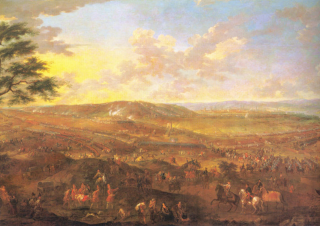
Irish regiments in service of Spain fight at the Battle of Saragossa, also known as the Battle of Zaragoza, on August 20, 1710, during the War of the Spanish Succession.

A Spanish Bourbon army loyal to Philip V of Spain and commanded by Alexandre Maître, Marquis de Bay, is defeated by a Grand Alliance force under Guido Starhemberg. Despite this victory, which allows Philip’s rival Archduke Charles to enter the Spanish capital of Madrid, the allies are unable to consolidate their gains. Forced to retreat, they suffer successive defeats at Brihuega in November and Villaviciosa in December, which effectively end their chances of installing Archduke Charles on the Spanish throne.

The 1710 Spanish campaign opens on May 15 when the Spanish Bourbon army commanded by Philip V in person and Francisco Castillo Fajardo, Marquis of Villadarias, advance on the town of Balaguer. Guido Starhemberg, commander of the Allied forces in Catalonia, halts this attempt by preventing the Spanish from fording the Segre River, a success in which the officers of the British contingent have a leading role.

Having received reinforcements, in June Philip makes another attempt upon Balaguer with 20,000 infantry and 6,000 cavalry but is defeated at Almenar on July 27. The allied troops take up a strong defensive position and repel the Spanish attacks until the British commander, James Stanhope, leading their vanguard, breaks the Spanish lines. Philip is forced to withdraw to Zaragoza, capital of Aragon, while Villadarias is replaced by the French general Alexandre Maître, Marquis de Bay.

On August 9, the Spanish army reaches Zaragoza and de Bay positions his troops with the river Ebro on his left and the Torrero heights to the right. On August 15, an Allied cavalry attack is repulsed, followed by five days of minor skirmishes before the Allies cross the Ebro in force on August 19 and are allowed to deploy during the night.

The two forces are roughly equal in strength, the allies having thirty-seven battalions of infantry and forty-three squadrons opposed to the Spanish-Bourbon army of thirty-eight battalions and fifty-four squadrons. The Allied left, composed of Catalonian and Dutch troops, is led by Pedro Manuel de Ataíde, 5th Count of Atalaia, the right by Stanhope, made up of British, Portuguese and Austrian cavalry, with Starhemberg in charge of the centre, mainly German, Austrian and Spanish infantry.

On August 20 at 8:00 a.m., an artillery-duel starts which lasts four hours before Stanhope charges the Bourbon-Spanish left. At first the Spanish and Walloon troops of the Bourbon army seem to gain the advantage, having defeated a body of eight Portuguese squadrons, which they chased from the field. This opens a gap in the Bourbon lines, which opens a gap for Stanhope who scatters the disorganized Spanish soldiers, while at the centre and the right their attacks are repulsed.

The battle follows the same pattern as at Almenar, with the allies repulsing fierce Bourbon cavalry charges before counter-attacked with their infantry and pushing the Spanish back. In less than three hours, the Allies army wins a comprehensive victory, capturing the Bourbon artillery along with 73 standards. Between 5,000 and 6,000 Spanish soldiers are killed or wounded, and another 7,000 captured, with Allied losses estimated as 1,500 men dead or wounded.

Archduke Charles enters Zaragoza the next day. The defeat of the army of Philip V of Spain is severe, the way to Madrid is open. Philip V abandons Madrid on September 9 and goes to Valladolid. Archduke Charles enters a very hostile and almost empty Madrid on September 28. Charles comments, “This city is a desert!” In the winter of 1710, Archduke Charles and the allied troops have to abandon Madrid, due to the great opposition of the people of Madrid and the dangerous strategic situation. After this, the British army suffers a defeat at the Battle of Brihuega, and the rest of the allied army is defeated at the Battle of Villaviciosa.

Leave a comment

The Irish Brigade of France Fight in the Battle of Marsaglia

Units of the Irish Brigade of France fight in Italy at the Battle of Marsaglia, a battle in the Nine Years’ War, on October 4, 1693. The battle involves the French army of Marshal Nicolas Catinat against the army of the Grand Alliance, allies of William of Orange, under the Duke of Savoy, Victor Amadeus II of Sardinia.

Catinat, advancing from Fenestrelle and Susa to the relief Pinerolo, defended by René de Froulay, Comte de Tessé, and which the Duke of Savoy is besieging, takes up a position in formal order of battle north of the village of Marsaglia, near Orbassano. Here, on October 4, the Duke of Savoy attacks him with his entire army, front to front, but the greatly superior regimental efficiency of the French, and Catinat’s minute attention to details in arraying them, gives the new marshal a victory that is a worthy pendant to Neerwinden.

During the battle, Irish dragoons are reported to have “overthrown squadrons, sword in hand,” but elsewhere on the battlefield, Prince Eugene of Savoy overruns a French line and advances to the second line, held by Irish regiments. There Eugene’s advance is broken, and his troops are soon put to rout. The impetuous Irish then pursue without orders. Seeing this development, the French commander orders a general advance and the allied army breaks and runs. Official French reports speak of the “extreme valor” of the Irish that day.

The Piedmontese and their allies lose approximately 12,000 killed, wounded and prisoners, as against Catinat’s 1,800. Among the Irish killed in this great victory are Brigadier Francis O’Carroll of the dragoons and Colonel Daniel O’Brien, 4th Viscount Clare. One very young officer of the Irish Brigade who survives the fight is Lieutenant Peter Lacy.

Marsaglia is, if not the first, at any rate, one of the first, instances of a bayonet charge by a long deployed line of infantry. Hussars figure here for the first time in Western Europe. A regiment of them had been raised in 1692 from deserters from the Austrian service. It is also notable as one of the first major battles to see the new Irish Brigade in action for the French army.

(Pictured: Marshal Nicholas Catinat at the Battle of Marsaglia, October 4, 1693, painting by Eugène Devéria, 1837, Museum of the History of France)


Leave a comment

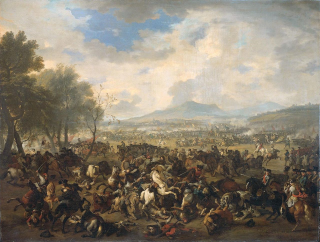
The Battle of Ramillies

The Irish Brigade of France fights at the Battle of Ramillies in the War of the Spanish Succession on May 23, 1706. For one hundred years Irishmen are smuggled from Ireland to France, where their rights are stripped by foreign invaders to fill the ranks of the famous Irish Brigade. During those one hundred years they fight all over Europe, in North America, the Caribbean, and even India. They shed their blood freely on several hundred fields “from Dunkirk to Belgrade,” in the words of Thomas Davis.

For the Grand AllianceAustria, England, and the Dutch Republic – the Battle of Ramillies follows an indecisive campaign against the Bourbon armies of King Louis XIV of France in 1705. Although the Allies capture Barcelona that year, they are forced to abandon their campaign on the Moselle, stall in the Spanish Netherlands and suffer defeat in northern Italy. Yet despite his opponents’ setbacks Louis XIV wants peace, but on reasonable terms. Because of this, as well as to maintain their momentum, the French and their allies take the offensive in 1706.

The campaign begins well for Louis XIV’s generals. In Italy, Marshal of France Louis Joseph, Duke of Vendôme, defeats the Austrians at the Battle of Calcinato in April, while in Alsace Marshal Claude Louis Hector de Villars forces Louis William, Margrave of Baden-Baden, back across the Rhine. Encouraged by these early gains Louis XIV urges Marshal François de Neufville, Duke of Villeroy, to go over to the offensive in the Spanish Netherlands and, with victory, gain a ‘fair’ peace. Accordingly, the French Marshal sets off from Leuven at the head of 60,000 men and marches toward Tienen, as if to threaten Zoutleeuw. Also determined to fight a major engagement, John Churchill, 1st Duke of Marlborough, commander-in-chief of Anglo-Dutch forces, assembles his army of some 62,000 men near Maastricht, and marches past Zoutleeuw. With both sides seeking battle, they soon encounter each other on the dry ground between the rivers Mehaigne and Gete, close to the small village of Ramillies, Belgium.

In less than four hours Marlborough’s Dutch, English, and Danish forces overwhelm Villeroi’s and Maximilian II Emanuel‘s Franco-Spanish-Bavarian army. The Duke’s subtle moves and changes in emphasis during the battle, something his opponents fail to realise until it is too late, catches the French in a tactical vice. With their foe broken and routed, the Allies are able to fully exploit their victory. Town after town falls, including Brussels, Bruges and Antwerp. By the end of the campaign Villeroi’s army has been driven from most of the Spanish Netherlands. With Prince Eugene of Savoy‘s subsequent success at the Siege of Turin in northern Italy, the Allies impose the greatest loss of territory and resources that Louis XIV would suffer during the war. Thus, the year 1706 proves, for the Allies, to be an annus mirabilis.

(Pictured: “The Battle of Ramillies between the French and the English, 23 May 1706” by Jan van Huchtenburgh, oil on canvas painted between 1706 and 1710)


Leave a comment

The Battle of Blenheim

battle-of-blenheim

The Irish Brigade of France fights at the Battle of Blenheim, a major battle of the War of the Spanish Succession, on August 13, 1704. The overwhelming Allied victory ensures the safety of Vienna from the Franco-Bavarian army, thus preventing the collapse of the Grand Alliance.

Louis XIV of France seeks to knock Leopold I, Holy Roman Emperor, out of the war by seizing Vienna, the Habsburg capital, and gain a favourable peace settlement. The dangers to Vienna are considerable as Maximilian II Emanuel, Elector of Bavaria and Marshal of France Ferdinand de Marsin‘s forces in Bavaria threaten from the west and Marshal Louis Joseph, Duke of Vendôme‘s large army in northern Italy poses a serious danger with a potential offensive through the Brenner Pass. Vienna is also under pressure from Francis II Rákóczi‘s Hungarian revolt from its eastern approaches. Realising the danger, the John Churchill, 1st Duke of Marlborough resolves to alleviate the peril to Vienna by marching his forces south from Bedburg and help maintain Emperor Leopold within the Grand Alliance.

A combination of deception and skilled administration, designed to conceal his true destination from friend and foe alike, enables Marlborough to march 250 miles unhindered from the Low Countries to the River Danube in five weeks. After securing Donauwörth on the Danube, Marlborough seeks to engage the Elector’s and Marsin’s army before Marshal Camille d’Hostun, duc de Tallard can bring reinforcements through the Black Forest. However, with the Franco-Bavarian commanders reluctant to fight until their numbers are deemed sufficient, the duke enacts a policy of plundering in Bavaria designed to force the issue. The tactic proves unsuccessful, but when Tallard arrives to bolster the Elector’s army, and Prince Eugene of Savoy arrives with reinforcements for the Allies, the two armies finally meet on the banks of the Danube in and around the small village of Blindheim, from which the English “Blenheim” is derived.

Blenheim is one of the battles that alters the course of the war, which until then was leaning for Louis’ coalition, and ends French plans of knocking the emperor out of the war. France suffers as many as 38,000 casualties including the commander-in-chief, Marshal Tallard, who is taken captive to England. Before the 1704 campaign ends, the Allies have taken Landau, and the towns of Trier and Traben-Trarbach on the Moselle in preparation for the following year’s campaign into France itself. The offensive never materialises as the Grand Alliance’s army has to depart the Moselle to defend Liège from a French counteroffensive. The war would rage on for another decade.

(Pictured: The Duke of Marlborough Signing the Despatch at Blenheim. Oil by Robert Alexander Hillingford)