seamus dubhghaill

Promoting Irish Culture and History from Little Rock, Arkansas, USA


Leave a comment

The “German Plot”

On Friday, May 17, 1918, the British government orders the arrest and imprisonment of all leading members of Sinn Féin, claiming they were involved in a plan to import arms from Germany. The British cover for these arrests is a bogus “German Plot,” which has since been thoroughly discredited.

The “German Plot” is a spurious conspiracy that the Dublin Castle administration in Ireland claims to exist between the Sinn Féin movement and the German Empire in May 1918. Allegedly, the two factions conspire to start an armed insurrection in Ireland during World War I, which would divert the British war effort. The administration uses these claims to justify the internment of Sinn Féin leaders, who are actively opposing attempts to introduce conscription in Ireland and more Irishmen being used as cannon fodder in service to their oppressors.

The “plot” originates on April 12 when the British arrest Joseph Dowling after he is put ashore in County Clare by a German U-boat. Dowling is a member of the Irish Brigade, one of several schemes by Roger Casement to get German assistance for the 1916 Easter Rising. Dowling now claims that the Germans are planning a military expedition to Ireland. William Reginald Hall and Basil Thomson believe him and convince the authorities to intern all Sinn Féin leaders. One hundred fifty are arrested on the night of May 17–18 and taken to prisons in England, including Éamon de Valera, Arthur Griffith, Constance Markievicz and W. T. Cosgrave. The introduction of internment and conscription reflects a decision of the British cabinet to take a harder line on the Irish Question following the failure of the Irish Convention.

Historian Paul McMahon characterises the “Plot” as “a striking illustration of the apparent manipulation of intelligence in order to prod the Irish authorities into more forceful action.” Republicans are tipped off about the impending arrests, allowing some to escape capture while others choose to be taken in order to secure a propaganda victory. The internment is counterproductive for the British, imprisoning the more accommodating Sinn Féin leadership while failing to capture members of the Irish Republican Brotherhood who are more committed to physical force republicanism.

The British live to regret one man who slips through their fingers that spring. Michael Collins uses the months he might have spent in an English prison assembling and consolidating his control of an intelligence organisation and putting it on a more focused military footing that soon makes the Empire squeal.

Even at the time, the proposition that the Sinn Féin leadership are directly planning with the German authorities to open another military front in Ireland is largely seen as spurious. Irish nationalists generally view the “German Plot” not as an intelligence failure but as a black propaganda project to discredit the Sinn Féin movement, particularly to an uninformed public in the United States. McMahon comments that this belief is mistaken, and that the authorities acted honestly but on the basis of faulty intelligence. It is still a matter of study and conjecture what impact it had on U.S. foreign policy regarding the 1919 bid for international recognition of the Irish Republic.

(Pictured: Dublin Castle, Dame Street, Dublin)


Leave a comment

Roger Casement’s Efforts to Gain German Military Aid Ends

During World War I, Roger Casement makes efforts to gain German military aid for the 1916 Easter Rising. His journey on the German submarine SM U-19 comes to an end on April 21, 1916.

In April 1916, Germany offers the Irish 20,000 Mosin–Nagant 1891 rifles, ten machine guns and accompanying ammunition, but no German officers. It is a fraction of the quantity of the arms Casement had hoped for, with no military expertise on offer. The weapons leave Germany bound for Ireland on a German cargo vessel named the SS Libau, disguised as a Norwegian vessel, Aud-Norge.

Casement confides his personal papers to Dr. Charles Curry, with whom he has stayed at Riederau on the Ammersee, before leaving Germany. He departs with Robert Monteith and Sergeant Daniel Beverley (Bailey) of the Irish Brigade in a submarine, initially the SM U-20, which develops engine trouble, and then the SM U-19, shortly after the Aud sails. According to Monteith, Casement believes the Germans are toying with him from the start and providing inadequate aid that will doom a rising to failure. He wants to reach Ireland before the shipment of arms and to convince Eoin MacNeill, who he believes is still in control, to cancel the rising.

Casement sends John McGoey, a recently arrived Irish American, through Denmark to Dublin, ostensibly to advise what military aid is coming from Germany and when, but with Casement’s orders “to get the Heads in Ireland to call off the rising and merely try to land the arms and distribute them.” McGoey does not reach Dublin, nor does his message. His fate is unknown until recently. Evidently abandoning the Irish Nationalist cause, he joins the Royal Navy in 1916, survives the war, and later returns to the United States, where he dies in an accident on a building site in 1925.

About 2:00 a.m. on the morning of April 21, 1916, three days before the rising begins, Robert Monteith, Daniel Bailey (calling himself Beverly), and Casement climb into a small boat for the trip to shore at Banna Strand in Tralee Bay, County Kerry. Their boat, now in the Imperial War Museum in London, capsizes before they reach shore.

Monteith helps an exhausted Casement to safety on shore. Casement is convinced that the Rising cannot be successful without a large number of German troops, and the best he has been able to obtain is one boatload of arms. Suffering from a recurrence of the malaria that had plagued him since his days in the Congo, and too weak to travel, Monteith and Bailey leave Casement at the ruins of McKenna’s Fort, an ancient ring fort in Rahoneen, Ardfert, now renamed Casement’s Fort, and head for Tralee.

About 1:30 p.m., Casement is discovered by two Royal Irish Constabulary (RIC) officers. He nearly talks his way out of being arrested, but a 12-year-old boy at the scene points out a piece of paper Casement had tossed away as the police approach. On that paper is a German code list. He is arrested on charges of high treason, sabotage and espionage against the Crown. He manages to send word to Dublin about the inadequate German assistance.

The Kerry Brigade of the Irish Volunteers might have tried to rescue Casement over the next three days, but its leadership in Dublin holds that not a shot is to be fired in Ireland before the Easter Rising is in train and therefore orders the Brigade to “do nothing.” A subsequent internal inquiry attaches “no blame whatsoever” to the local Volunteers for failing to attempt a rescue. Casement is taken to Brixton Prison and placed under special observation for fear of an attempt of suicide as there is no staff at the Tower of London to guard suicidal cases.

Casement’s trial at bar opens at the Royal Courts of Justice on June 26, 1916, before the Lord Chief Justice (Viscount Reading), Justice Horace Avory, and Justice Thomas Horridge. Refusing to agree to a “guilty but insane” plea, he is subsequently found guilty and sentenced to be hanged. He unsuccessfully appeals against his conviction and death sentence.

On the day of his execution by hanging at Pentonville Prison, August 3, 1916, Casement is received into the Catholic Church at his request. He is attended by two Catholic priests, Dean Timothy Ring and Father James Carey, from the East London parish of SS Mary and Michael. The latter, also known as James McCarroll, says of Casement that he was “a saint … we should be praying to him [Casement] instead of for him.” At the time of his death he is 51 years old.

Casement’s body is buried in quicklime in the prison cemetery at the rear of Pentonville Prison, though his last wish was to be buried at Murlough Bay on the north coast of County Antrim, in present-day Northern Ireland. Finally, in 1965, his remains are repatriated to Ireland. His remains lay in state at the Garrison Church, Arbour Hill (now Arbour Hill Prison) in Dublin for five days, close to the graves of other leaders of the 1916 Easter Rising, although he would not be buried beside them. After a state funeral, the remains are buried with full military honours in the republican plot in Glasnevin Cemetery in Dublin, alongside other Irish republicans and nationalists. The President of Ireland, Éamon de Valera, who is then in his mid-eighties and the last surviving leader of the Easter Rising, attends the ceremony, along with an estimated 30,000 others.


Leave a comment

The Dromkeen Ambush

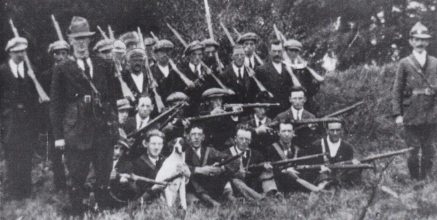
The Dromkeen ambush takes place on February 3, 1921, during the Irish War of Independence, at Dromkeen, County Limerick, when the Irish Republican Army (IRA) ambushes a Royal Irish Constabulary (RIC) patrol, killing eleven policemen.

In late January, Richard O’Connell, commander of the Mid Limerick Brigade flying column, along with Captains Sean Lynch and Morgan Portley, begin planning an ambush of an RIC convoy from the Pallas RIC headquarters. Observing their activities for several months, local Volunteer John Purcell, of Caherconlish, finds that the first Thursday of each month they send a convoy to Fedamore with the payroll for RIC constables there, about eleven miles away. They also seem to use the same route each time. Such predictability is often a fatal flaw in a guerrilla war. The ambush is set for February 3.

The ambush is carried out by the flying columns of the East Limerick and Mid Limerick Brigades of the IRA, some forty riflemen, under the command of Donnocha O’Hannigan, commander of East Limerick Brigade flying column, and Richard O’Connell, commander of the Mid Limerick Brigade flying column.

The ambush location is well selected. The lorries are to come from the west. There is a severe right-hand turn at Dromkeen House, where the road turns east for several hundred yards in a straight line, to an intersection that splits to the north and south. O’Hannigan puts D. Guerin, Sean Stapleton, and Maurice Meade, all of East Limerick Brigade, at the corner to be the lookouts for the convoy. There are low stonewalls along both sides of most of the road. About halfway down its length there is a cemetery and an old, ruined church on the south side.

O’Hannigan spreads his men along both sides of the road, behind the walls and in several homes along the road and sets up barricades on the forks on the eastern end of the ambush, set back so the driver will not see them until they get to the intersection. He takes up a command position in an old, ruined cottage at the intersection. In addition to O’Hannigan, John MacCarthy, David Clancy and a few other East Limerick Volunteers are in the ruined cottage.

At approximately 2:30 p.m. the lookouts near Dromkeen House let them know the lorries are approaching. The plan is to let the lead lorry reach the barricade before they open fire, expecting them to be widely spaced. They are closer together than expected, however, and the men lining the road and near Dromkeen House open fire first at the second lorry when it is near the ruins of the old church to prevent it being getting beyond them. Michael Hennessy, of the Kilfinane Company of the East Limerick Brigade, in a spot near one of the walls, later says he killed the driver of the second lorry, Constable Sidney Millin, on his first shot. Millin may have had his foot on the brake at that moment, as the lorry almost immediately stops in the middle of the road.

The sound of the firing causes the lead lorry to speed up. Turning to the left and seeing one barricade, the driver tries to turn to the right, but is going too fast. He runs into the wall and then slams into a donkey cart with a bog of flour in it, sending a cloud of flour into the air and coming to a halt.

The cloud of flour, along with the fact that they are the only RIC members in civilian clothes, apparently saves the lives of two RIC men, Constable Cox and District Inspector Sanson, who was in charge of the convoy, who are thrown clear of the cab. By the time the cloud of flour clears, two men in civilian clothes are seen running through the field. Given that Crown Forces have been known to have civilian hostages in their lorries, O’Hannigan had his men hold their fire for fear of killing a hostage, and the two escape. Many of the Volunteers later speak of Sanson with scorn for abandoning his men.

All the Volunteer participants say the firing only lasts about ten minutes, with the RIC and Black and Tans able to mount very little resistance before all eleven left in the two lorries are either dead or wounded. Of the three remaining in the first lorry, one is apparently killed very quickly by rifle fire and several grenades. The other two manage to get out and take cover but are quickly hit.

Two constables managed to get underneath the second lorry. They put up a short resistance before both are hit and killed by Volunteers Johnny Vaughan and Seán Carroll, who move into positions along the road. The only Volunteer casualty is Liam Hayes, who is later a general in the Free State Army. He has part of his left thumb and part of a finger shot off, probably by friendly fire. As the firing ends, the Volunteers come out from cover to collect the arms from the dead and wounded.

It has been claimed that three of the RIC dead were executed after they had surrendered. Particular suspicion for this alleged killing of prisoners has fallen on Maurice Meade, a former British soldier who was captured by the Germans in World War I and had joined Roger Casement‘s Irish Brigade. In reprisal, British forces burn ten homes and farms in the area.

In February 2009, up to 2,000 people turn out for the unveiling of a memorial to the ambush.

(From: “The Dromkeen Ambush: Down Into the Mire in County Limerick” by Joee Gannon, The Wild Geese, http://www.thewildgeese.irish, November 2017 | Pictured: The East Limerick Flying Column)