seamus dubhghaill

Promoting Irish Culture and History from Little Rock, Arkansas, USA


Leave a comment

The Lansdowne Road Football Riot

The Lansdowne Road football riot occurs during a friendly football match between the Republic of Ireland and England in Lansdowne Road Stadium in Dublin on February 15, 1995.

The last time England had played Ireland at Lansdowne Road was a UEFA Euro 1992 qualifying Group 7 match on November 14, 1990. After that match, there were clashes between some Irish and English fans and the Gardaí on O’Connell Street in Dublin. Before the 1995 friendly match, the Football Association of Ireland (FAI) holds talks with The Football Association (The FA) to review security arrangements to avoid a similar episode. The FA is offered 4,000 out of approximately 40,000 tickets, for English fans.

In pubs near Lansdowne Road stadium some English fans chant “No surrender to the IRA,” “Fuck the Pope” and “Clegg is innocent.” Irish fans are goaded, spat on and attacked. Pub staff find British National Party (BNP) literature left behind and, in some cases, pro-Loyalist graffiti in toilets.

The match begins at 6:15 p.m., and after 22 minutes, David Kelly scores a goal for Ireland. When a David Platt goal is disallowed for England in the 26th minute due to Platt being offside, some of the English fans begin throwing debris down into the lower stands, including parts of benches which they had ripped out earlier in the match. When this happens, the referee immediately stops the game, and brings the players off the pitch. When Jack Charlton, the Irish manager and former England player, walks off the pitch, the mobs “Judas, Judas.” The fans in the lower stands then spill out onto the pitch to escape the missiles from the English fans. Some Irish fans had mistakenly been put into the area where the English fans are when the FA returned a number of tickets to the FAI.

After the teams leave the pitch, the frequency of missiles intensifies, and after 12 minutes, the game is called off, and the fans are evacuated, with the exception of 4,500 English fans, who are kept in the stadium until the Garda Public Order Unit attempts to escort them out, at which time more violence breaks out. The Gardaí are slow to reach the area where the rioters are, and there is some confusion as to the exact location of the English fans between the Gardaí and the stewards. Twenty people are injured during the rioting, and forty are arrested.

The rioting is condemned on both sides of the Irish Sea. England manager Terry Venables says, “It was terrible. I have no words strong enough to describe how we feel about this. There could be repercussions.” Jack Charlton says, “I have seen a lot in football but nothing like this. It is a disaster for Irish football, but I didn’t want the game abandoned because what do you do with 2,000 English fans running around the town? The English fans were being bombarded by some of their own. And they brought out the worst in some of ours.” The rioting brings into question England’s hosting of UEFA Euro 1996, with Ireland’s Minister of State for Youth and Sport, Bernard Allen asking, “How can people from Ireland and from other countries go to England and expect to be safe watching matches in the presence of people like those who were here tonight?” The Garda handling of the match is criticised in the press when it is revealed that the Gardaí had been informed of the plans of some of the English fans to cause trouble by the British National Criminal Intelligence Service (NCIS). The decision to seat the English fans in an upper tier is also questioned in the press.

After questions are raised about the conduct of the Gardaí, former Chief Justice of Ireland, Thomas Finlay, is appointed to investigate the events. He finds that the rioting was entirely caused by the English fans without any provocation. The investigation finds that the head of the NCIS had offered help to the Gardaí in dealing with the hooligans, an offer which the Gardaí refused. Gardaí failed to act on a warning that 20 supporters of the England team who wore insignia of Combat 18 were travelling to the match. The segregation of the fans was also found to be insufficient, and this was found to be a contributory factor to the incident.

The next meeting between the two sides does not take place until Wednesday, May 29, 2013, a friendly at Wembley Stadium, and the next meeting in the Republic of Ireland is on Sunday, June 7, 2015, at Dublin’s Aviva Stadium. Both games pass without major disturbances.


Leave a comment

Birth of Michael McCarthy, Professional Football Player & Manager

Michael Joseph “Mick” McCarthy, professional football manager, pundit and former player, is born on February 7, 1959, in Barnsley, South Yorkshire, England. He is most recently the head coach of Blackpool.

McCarthy makes his league debut for then-Fourth Division Barnsley on August 20, 1977, in a 4–0 win over Rochdale. He spends two years in the basement league, before the club wins promotion. A strong central defender, he is a virtual ever-present for his hometown club, but departs in December 1983 for fellow Division 2 club Manchester City.

Manchester City wins promotion in McCarthy’s first full season, and he finally has the chance to play at the highest level. His first season in the topflight is steady enough as the club reaches mid-table, but relegation strikes the following year. However, he does not face the drop as he signs for Celtic in May 1987 in a surprise £500,000 move.

McCarthy is brought to Parkhead by David Hay but within days of the signing the Celtic boss is sacked. Fortunately for McCarthy, Hay’s replacement is the returning Parkhead legend Billy McNeill, who quickly recognises that McCarthy’s strength and aggression are qualities desperately required by a notoriously leaky Celtic defence. He picks up his first silverware with Celtic as they win the league and cup double in his first season. The following season he again wins a Scottish Cup winners medal, although the club has to settle for third place in the league.

If ever an example is needed to reflect McCarthy’s values, it cannot be bettered than that on the day of the 1998 Scottish Cup Final. Celtic wins 2-1, but to the disgust of many, the unpopular Conservative Prime Minister Margaret Thatcher is in attendance and to present the trophy to the winners. The players are under pressure from the Scottish Football Association (SFA) to meet her, but a few refuse. According to fellow Celtic player Andy Walker, McCarthy refuses point-blank, as he is from Barnsley and the son of a miner. Shaking hands with her is an impossibility for him.

In the summer of 1988, McCarthy joins fellow Celtic players Packie Bonner and Chris Morris in Germany as part of the Republic of Ireland European Championship squad and gives a fine account of himself particularly in the historic 1-0 win over England. He, like Bonner and Morris, also star in the Republic’s 1990 FIFA World Cup squad which makes it to the quarterfinals in Italy.

In terms of his Celtic career, McCarthy never repeats the achievements or level of performance of his debut season.

McCarthy signs for Lyon in the summer of 1989 for £350,000. Afflicted by injuries and mindful of his spot in Ireland’s World Cup team, he finishes that season on loan to Millwall. After a captain’s showing in Italy for the Ireland national side, Millwall signs him full-time and later he becomes manager at The Den in 1992. In February 1996, he follows Jack Charlton into the Ireland manager’s job and experiences various highs and lows over his nearly seven years in charge. He has since managed Sunderland and Wolverhampton Wanderers.

In later years McCarthy becomes a low-key candidate for the Celtic manager’s job after the departures of Martin O’Neill and Gordon Strachan but is never favoured by the board or the general support for the role. Ironically then in 2018, he takes over from Martin O’Neill following his second stint as the Ireland manager. Notably, Roy Keane is Martin O’Neill’s assistant and has to step down also. On April 4, 2020, amid the global coronavirus pandemic, he stands down as manager and is immediately replaced by Stephen Kenny.

McCarthy joins Cypriot First Division club APOEL as manager on November 2, 2020, signing a contract until 2022. He is sacked by the club on January 5, 2021, following a run of 2 wins, 1 draw and 5 defeats in his eight games in charge.

On January 22, 2021, McCarthy is appointed as manager of Cardiff City, following the sacking of Neil Harris. He signs a contract until the end of the season. After making an unbeaten start to his reign at the club, a run that includes a six-game winning streak, he signs a new two-year deal with the club on March 4, 2021. Cardiff finishes the season in 8th place. Despite losing one of their opening six matches at the start of the following season, a run of results follows which sees Cardiff drop as low as 21st in the table. On October 23, 2021, after suffering a club-record eighth successive loss of the season at the hands of Middlesbrough, McCarthy leaves the club by mutual consent.

On January 19, 2023, McCarthy is appointed head coach of the Championship’s second-bottom placed club Blackpool on a short-term contract until the end of the season. On April 8, 2023, he leaves Blackpool by mutual consent, following a 3–1 home defeat to Cardiff the previous day. He achieves two wins in his 14 games in charge, losing nine of them, which leaves the club in 23rd position. “With results on the pitch not improving in recent weeks, the decision has been agreed by both parties that a change is needed,” the club says in a statement.


Leave a comment

Birth of Frank Stapleton, Association Footballer & Manager

Francis Anthony Stapleton, Irish former professional association football player and manager, is born in Dublin on July 10, 1956. He is best remembered for his time at Arsenal, Manchester United and as a pivotal player for the Republic of Ireland national football team. He has also been manager at Bradford City and Major League Soccer (MLS) club New England Revolution.

Stapleton is a distinguished centre-forward, once touted as being among the best in the world in his position, and an exceptionally strong header of the ball. He starts his career with Arsenal, joining them in 1972 as an apprentice, after being turned down by Manchester United. He makes his first-team debut in March 1975, at home to Stoke City, and goes on to form a potent striking partnership with Malcolm Macdonald. The two score 46 goals between them in 1976–77. He is Arsenal’s top scorer for the three following seasons and helps the Gunners reach a trio of FA Cup finals. He scores one of the goals in Arsenal’s 1979 FA Cup Final 3–2 win over Manchester United, and scores 108 goals in 300 appearances in total for the Gunners.

Stapleton moves on to Manchester United in the summer of 1981 for £900,000 as new manager Ron Atkinson begins building a team capable of challenging for silverware after a disappointing 1980–81 season under Dave Sexton. He helps United win the 1983 and 1985 FA Cups. It is in the first of those finals, when he scores against Brighton & Hove Albion, in which he makes history by becoming the first man to score for two different clubs in FA Cup Finals. United finishes in the top four of the league in each of Stapleton’s first five seasons at Old Trafford, and comes close to winning a league title medal in the 1985–86 season after United wins their first ten league games of the season before their form slumps and they finished fourth. Atkinson is sacked and replaced by Alex Ferguson in November 1986, and Stapleton remains a regular member of the first team under the new manager, but he leaves at the end of the season to sign for Ajax. There, he makes just six appearances and scores one goal before quickly being moved to Belgian side Anderlecht at the end of 1987, followed by a three-month loan back to England with Derby County. He then plays for French club Le Havre for a season, before returning to England with Blackburn Rovers in 1989, followed by moves to Aldershot, Huddersfield Town (as player-coach) and Bradford City.

After three seasons as player-manager at Bradford, Stapleton is sacked following their narrow failure to qualify for the Division Two playoffs at the end of the 1993-94 season. He then has a brief spell at Brighton & Hove Albion in the 1994–95 season, playing two games before finally announcing his retirement as a player.

Stapleton also wins 71 caps for the Republic of Ireland national team, scoring a then record 20 goals. He makes his international debut under then player-manager Johnny Giles in a friendly against Turkey in Ankara in 1976 at 20 years of age. He scores after only three minutes of his debut when he heads home a Giles free-kick at the near post. That friendly international finishes 3–3 and marks the start of a magnificent international career for the quiet and reserved Stapleton.

Stapleton is committed to international football insisting that an “international release clause” be inserted to all of his contracts so that he can be released to play in international games for Ireland.

Stapleton plays a significant role in Ireland’s attempt to qualify for the 1982 FIFA World Cup in Spain in 1982. Goals against Cyprus, the Netherlands and France by him in the qualifying matches are not enough as Ireland is denied a place at the World Cup by a superior French goal difference. He is made captain of the national team for the qualifying campaign for the 1986 FIFA World Cup though Ireland fails to emulate their fine performance in the 1982 qualifiers.

Jack Charlton takes over as the Irish manager in 1986 and he keeps Stapleton as captain despite a sometimes uneasy relationship between the two men. Stapleton scores a magnificent diving header in the opening UEFA Euro 1988 qualifier against Belgium in the 2–2 draw at the Heysel Stadium, Brussels, that September. He also scores in the 2–1 defeat by Bulgaria in Sofia on April 1, 1987, with another goal against Luxembourg in the 2–1 victory at Lansdowne Road the following September.

Stapleton captains the Irish team to the 1988 Euro finals and plays in all of their matches during the competition including Ireland’s famous victory against England.

After the 1988 European Championships Stapleton remains on the fringe of the national team during qualification for 1990 FIFA World Cup in Italy making just two appearances late in the campaign. By then, his 20 goals for the Republic had made him the national side’s all-time leading goalscorer, a record which is broken ten years later by Niall Quinn, who is in the early stages of his own international career when Stapleton bows out of the international scene. He does, however, score an 87th-minute goal against Malta in a 3–0 friendly in Valletta just prior to those finals in Italy.

Stapleton moves to the United States to manage Major League Soccer side New England Revolution in 1996. In the 2003–04 season he briefly returns to English football as a specialist coach of Bolton Wanderers. The Bolton manager, Sam Allardyce, wants Stapleton to enhance the skills of the strikers at the club and sees the Irishman as an ideal candidate, given his successful playing career.

Stapleton is appointed assistant manager to former teammate Ray Wilkins with Jordan on September 3, 2014.


4 Comments

Republic of Ireland’s First World Cup Finals Match

The Republic of Ireland plays their first ever match in the finals of the World Cup, drawing 1-1 with England in Cagliari, Sardinia on June 11, 1990.

At Italia ’90 the Irish team is drawn in a very tough Group F that includes European champions the Netherlands, African footballing power Egypt, and England. This is something of a coincidence as the English and the Dutch were also in Ireland’s UEFA Euro 1988 group. The tournament organisers are fearful that this grouping might lead to crowd disorder particularly between the English and Dutch fans. The group is based on the Italian islands of Sicily and Sardinia and security is very tight with alcohol bans in place on match days.

Ireland’s first match at a World Cup finals competition is against their longtime foe England. The English are seeking revenge for their surprise defeat by the Irish in the opening group match at Euro ’88. Once again Bobby Robson‘s English team is expected to beat Ireland and his players underline that by taking an early lead through an eight-minute goal from Gary Lineker. Despite Ireland getting a greater foothold in the second half an equaliser is elusive until an error by Steve McMahon allows Kevin Sheedy to score in the 73rd minute.

Ireland’s next matches are against Egypt and the Netherlands, both played in Palermo and both ending in a draw. The Irish team finishes group play with 0 wins, 0 losses and 3 draws. England registers the only win in the group, beating Egypt. The three European teams progress into the next round.

In the knock-out round Ireland avoids drawing West Germany, the ultimate winner of the 1990 World Cup. They draw Romania as their first opponent and end regulation in yet another draw in Genoa. A penalty shoot-out follows and after the first eight penalties the teams are still tied at 4-4. Irish goalkeeper Packie Bonner blocks Romania’s fifth penalty kick. David O’Leary steps up confidently and sends his kick past the goalkeeper and into the net. Ireland has advanced to the quarterfinals at the first attempt.

Ireland bows out at the quarterfinals stage losing by a single goal to the hosts, Italy, at the Stadio Olimpico in Rome. It is a very strange campaign in that Ireland does not win any of their matches, scores only two goals, and plays in some really poor matches in terms of quality of play. Notwithstanding this the Irish over-achieves which is fully appreciated by the Irish supporters. The green army stays on in the Stadio Olimpico long after the final whistle to laud manager Jack Charlton and his gallant squad.

(From: “Ireland at 1990 World Cup Finals in Italy,” Soccer-Ireland.com, http://www.soccer-ireland.com | Photograph by Ray McManus / SPORTSFILE)


Leave a comment

Birth of Irish Footballer Liam Brady

William Brady, former Irish footballer who also serves as assistant manager of the Republic of Ireland national football team from 2008 to 2010, is born in Dublin on February 13, 1956.

Brady is raised in Dublin and attends St. Aidan’s C.B.S., leaving before his Intermediate Certificate. He alleges at the time that he had been expelled for missing a school Gaelic football match to play a schoolboy soccer international, however the school denies this.

Brady is a talented offensive midfielder renowned for his left foot and elegant technical skills such as his high-quality passing, vision, and close control, which makes him an excellent playmaker. He combines these abilities with significant tenacity, an eye for goal from midfield, and accurate penalty-taking. In addition to his footballing ability, he also stands out throughout his career for his professionalism.

Brady starts his career at Arsenal F.C., moving to London to join the side on schoolboy forms in 1971, at the age of 15. He turns professional on his 17th birthday in 1973, and makes his debut on October 6, 1973 against Birmingham City F.C. as a substitute for Jeff Blockley. Arsenal reaches three FA Cup finals in a row between 1978 and 1980. Arsenal wins only the 1979 final against Manchester United F.C., with Brady starting the move that ends in Alan Sunderland‘s famous last-minute winner.

Brady spends two seasons with Juventus F.C. in Italy, picking up two Italian Championship medals, in 1981 and 1982. He scores the only goal (a penalty) in the 1–0 win against Catanzaro that wins the 1982 title.

Brady makes his debut for the Republic of Ireland national football team on October 30, 1974, in a 3–0 win against the Soviet Union at Dalymount Park in a European Championship qualifier. Due to a suspension accrued before UEFA Euro 1988 he is not eligible to play within the tournament. During qualifications for the 1990 FIFA World Cup he retires from the international game. As Ireland advances to the World Cup he declares himself available to play once again. However, manager Jack Charlton goes on to declare that only those who played in the qualifiers will make the trip to Italy. Brady wins 72 international caps for the Republic of Ireland with 70 within the starting line-up, scoring 9 goals.

Brady goes on to manage two clubs – Celtic F.C. and then Brighton and Hove Albion F.C. – together with being the assistant manager of Ireland’s national football team. He also holds the post of Head of Youth Development at Arsenal F.C. from 1996 to 2013, and is a frequent television pundit with RTÉ Sport.

While at Arsenal F.C., and particularly early in his career, Brady is nicknamed “Chippy”, not for his ability to chip the ball but for his fondness for fish and chips. He also becomes involved in an anti-drugs campaign in the early 1990s, called “give drugs the boot”, encouraging young boys to play sport as a healthy pastime.


Leave a comment

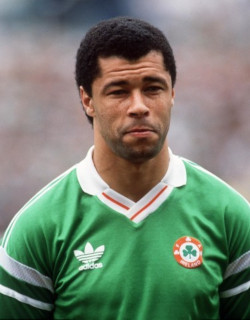
Birth of Professional Footballer Paul McGrath

Paul McGrath, former professional footballer for St. Patrick’s Athletic F.C., Manchester United F.C., Aston Villa F.C., Derby County F.C., and the Republic of Ireland national football team, is born in Greenford, Middlesex on December 4, 1959.

McGrath is born to an Irish mother and a Nigerian father. His father disappears soon after his conception. His mother, Betty McGrath, is terrified that her father will find out she had become pregnant outside marriage and in an interracial relationship. She travels in secret to London to have her child, who is considered illegitimate, and gives him up for fostering when he is four weeks old. When he is five years old, the family he had been fostered by comes to Betty saying they cannot control him. Betty places him into an orphanage.

McGrath begins as a schoolboy with Pearse Rovers and plays junior football for Dalkey United. While at the latter, he attracts the attention of Manchester United scout Billy Behan. Before becoming a full-time professional with League of Ireland club St. Patrick’s Athletic in 1981, he briefly works as an apprentice metal worker and a security guard in Dublin.

McGrath makes his debut in a League of Ireland Cup clash with the Shamrock Rovers F.C. in August at Richmond Park. He ultimately excels at St. Patrick’s, earning the nickname “The Black Pearl of Inchicore” and receiving the PFAI Players’ Player of the Year Award in his first and only season, scoring four goals in 31 total appearances.

In 1982, McGrath moves to Manchester United, then managed by Ron Atkinson. He misses out on a place in the FA Cup victory over Brighton & Hove Albion F.C. the following year. He is named man of the match for the 1985 FA Cup Final, which United wins 1–0 against Everton F.C. In his early years at Manchester United, he is frequently used as a midfielder, changing to defender while still at Old Trafford.

In 1985–86, it appears that McGrath is on course to pick up a league title medal after United wins their first 10 league games of the season, but injuries to key players including Bryan Robson soon take their toll on the side and they eventually finish fourth in the table, 12 points behind champions Liverpool F.C. Despite a dismal start to the 1986–87 season and a managerial change, McGrath remains a regular member of the first team. United finishes second behind Liverpool in the league a year later.

By the 1988–89 season, McGrath is struggling with knee injuries and is becoming a less regular member of the first team. His relationship with manager Alex Ferguson is becoming strained, as McGrath’s alcohol addiction and physical problems lead to United offering him a retirement package of £100,000. He refuses and Ferguson begins to inform clubs of his availability. Aston Villa’s offer is accepted and McGrath signs on August 3, 1989 for a fee of £400,000.

While at Aston Villa, McGrath plays some of the best football of his career, despite recurrent knee problems. Villa comes close to winning the title in his first season, finishing second to Liverpool. In the inaugural season of the Premier League (1992-93), Aston Villa again finishes as runners-up, behind Manchester United. As a sign of the regard he is now held in by his fellow professionals, McGrath wins the PFA Players’ Player of the Year award at the end of the season. He wins his first trophy with Villa, defeating Manchester United in the 1993–94 Football League Cup. In 1996 he wins a second League Cup for Villa. By the end of his Villa career he has chalked up 323 appearances for the club.

McGrath departs Aston Villa in the autumn of 1996, leaving a legacy as one of the greatest players in the club’s history. He is sold to Derby County for £200,000 and helps the newly promoted Rams finish 12th in its first Premier League season. He then drops down a division to sign for Sheffield United F.C. in the summer of 1997. He plays his final game as a professional for Sheffield United against Ipswich Town F.C. on November 9, 1997. He officially retires at the end of the season.

In McGrath’s international career he wins his first full cap against Italy in 1985, last playing 12 years later, against Wales. During that time, he is often regarded as the single most influential player Ireland has in the national team’s glory days.

In McGrath’s international career he is a major part of the breakthrough of Ireland’s national team of the late 1980s and early 1990s. During the early part of Jack Charlton‘s era, he plays as a defensive midfielder, due to the wealth of talent Ireland has in defence. In UEFA Euro 1988, as the national side first qualifies for an international tournament, he is present in the 1–0 group stage win against England.

In 1990, Ireland qualifies for its first FIFA World Cup, eventually reaching the quarter-finals, where they lose to Italy 1-0, with McGrath ever present in the lineups. He captains the team four times in 1992 after the retirement of Mick McCarthy, and ignores a painful shoulder virus to play in the 1994 FIFA World Cup.

In Ireland’s opening game of the 1994 World Cup, a 1–0 win against favourites Italy, in a perfect example of his commitment to the game, McGrath puts up an astonishing defensive performance in spite of excruciating knee problems. Even after his retirement from international football in 1997, he is still regarded today as one of the greatest players ever to put on Ireland’s green shirt.

Upon retiring, McGrath settles in Monageer, County Wexford. In 2004, one year after being taken to court, charged with a breach of the peace, he returns to the football world after five years, moving to Waterford F.C. in Ireland as director of football.

In 2011, McGrath launches a singing career with a cover version of the Gerry Goffin and Carole King song “Goin’ Back.” The recording is followed by the planning of an album of covers by the footballer, with a percentage of the album’s proceeds going to the Acquired Brain Injury Foundation and the Cystic Fibrosis Foundation of Ireland.