seamus dubhghaill

Promoting Irish Culture and History from Little Rock, Arkansas, USA


Leave a comment

Birth of “Jem” Finer, Founding Member of The Pogues

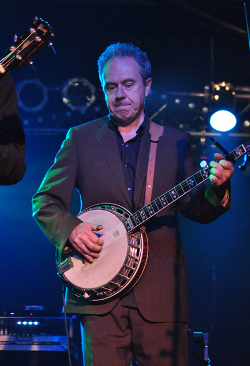
jem-finerJeremy Max “Jem” Finer, English musician, artist, composer, and one of the founding members of The Pogues, is born in Stoke-on-Trent, England on July 20, 1955.

After college at Keele University, Finer travels around Europe and spends some time working on a barge in France. He settles in London and becomes the bass player in a group called The Petals and lives in 32 Burton Street, a house which he sometimes shares with Spider Stacey and Shane MacGowan. Together with James Fearnley they found The Pogues. Primarily a banjoist, he also plays other instruments, including mandola, saxophone, hurdy-gurdy, and the guitar. Apart from Shane MacGowan, Finer is the most prolific composer for the band.

Finer appears on all the band’s albums until their breakup in 1996. He continues working as a musician and composer after leaving The Pogues.

On January 1, 2000, the Finer-composed Longplayer piece of music is started and is designed to last 1,000 years without ever repeating itself. It currently exists in both computer-generated and live versions. Longplayer represents a convergence of many of his concerns, particularly those relating to systems, long-durational processes, and extremes of scale in both time and space.

Finer serves as “Artist in Residence” at the Astrophysics Sub-department of the University of Oxford between October 2003 and June 2005. Finer and Hamburg-based swamp pop legend DM Bob begin recording and performing together in 2005, releasing their album Bum Steer in August of that year and co-producing the debut album by experimental pop band Marseille Figs. In July 2005, Finer wins the PRS Foundation New Music Award on the basis of his proposal to build a device that will automatically “compose” a song of indeterminate length by harnessing the creative force of the weather.

In March 2012, Mobile Sinfonia, a global composition for ringtones is launched, developed during a year Finer spends as a non-resident artist at the University of Bath. This piece concerns mutual invasion of soundscape via ringtones.

Finer is currently working on a number of new projects continuing his interest in long-term sustainability and the reconfiguring of older technologies, including Spiegelei, a spherical camera obscura featuring Finer’s innovative 360-degree projection system and the Supercomputer in Cambridge, a 5-bit mechanical sculpture which will compute minimal musical scores.


Leave a comment

Birth of The Pogues’ Guitarist Philip Chevron

philip-chevron

Philip Ryan, Irish singer-songwriter and guitarist professionally known as Philip Chevron and best known as a member of The Pogues, is born on June 17, 1957. He is regarded as one of the most influential figures in Irish punk music.

Chevron grows up in Santry, a suburb of Dublin. Beginning in the late 1970s, he is lead singer and co-founder of the punk rock group The Radiators from Space, receiving some critical acclaim but little widespread popularity or financial success. Following a temporary breakup of the band in 1981, he lives in London for a while where he meets and befriends Shane MacGowan through time spent working together at a record shop. Following the release of the Pogues’ 1984 debut album Red Roses For Me, Chevron is invited to join the band as a temporary replacement for banjo player Jem Finer while on paternity leave. He takes over as guitarist following MacGowan’s decision to concentrate on singing, thereby becoming a full-time member of the band in time for the recording of its second album, Rum, Sodomy and the Lash.

Chevron proves himself as a singer-songwriter, writing the songs Thousands Are Sailing and Lorelei among others. He leaves The Pogues in 1994 following problems with drugs and alcohol. In 2003, he reforms The Radiators (Plan 9) with ex-Pogues bassist Cait O’Riordan. They release the album Trouble Pilgrim in 2006.

In later years, he becomes The Pogues’ unofficial spokesperson and resident expert on the reclusive MacGowan, frequently visiting online fora and directly answering questions from fans. In 2004, he personally oversees the remastering and re-release of The Pogues’ entire back catalogue on CD. He tours regularly with The Pogues, who reunite after a successful reunion tour in 2001.

In June 2007, The Pogues’ website announces that Chevron has been diagnosed with oesophageal cancer. In early 2008, the website announces that Chevron has recovered, and to his surprise and joy, his hearing has returned to almost pre-treatment levels. He embarks on the March 2008 tour of the United States and manages to sing Thousands Are Sailing at each performance. By 2009, Chevron appears to have recovered from the cancer.

However, in May 2013, it is announced that the cancer has returned, and it is “lethal.” In June he stoically tells the Irish Daily Mail, “I am a gay, Irish, Catholic, alcoholic Pogue who is about to die from cancer – and don’t think I don’t know it.” Chevron dies on October 8, 2013, in Dublin at the age of 56. His last public appearance is at the Olympia Theatre in Dublin for a fundraiser in August of that same year.