seamus dubhghaill

Promoting Irish Culture and History from Little Rock, Arkansas, USA


2 Comments

Death of Brian Dillon, Republican Leader & IRB Member

Brian Dillon, Irish republican leader and a member of the Irish Republican Brotherhood (IRB), dies at his home in Cork, County Cork, on August 17, 1872. He is a central figure in the Cork Fenian movement.

Dillon is born in Glanmire, County Cork, in 1830. As a child, he is injured in a heavy fall which results in curvature of the spine and general ill health. His family moves to a house near the corner of Old Youghal Road and Ballyhooly Road. He attends the School of Art for several years and becomes quite talented with brush and pencil. He lives through the Great Famine and becomes an ardent nationalist.

Dillon is appointed a Fenian leader in Cork by James Stephens, the head of the Irish Republican Brotherhood. Under his supervision the Fenian recruits drill on the Fair Field and at Rathpeacon and are hoping for a rebellion in 1865 when the Fenians are at their strongest. He often associates with other Cork Fenians such as John J. Geary, James Mountaine and John Lynch. He chairs the Fenian meetings at Geary’s pub.

In September 1865, police arrest Fenian leaders James Stephens and Jeremiah O’Donovan Rossa in Dublin, and Dillon in Cork. The police search his home and find a pair of field glasses, some drawings and some incriminating letters sewn into the mattress of his bed. He is remanded in Cork City Gaol until his trial.

On December 18, Dillon and another Cork Fenian, John Lynch, are tried together in the dock in Cork Courthouse by Judge Keogh. The charges are primarily based on information provided by an informer named John Warner, an ex-military pensioner. Isaac Butt and Mr. Waters represent the defendants. The charges are “in one indictment with having conspired to depose the Queen, &c., and with illegally drilling and being drilled in furtherance of that design.” Both are found guilty, based primarily on the testimony of informants, although John Warner’s account is very weak and unsatisfactory under cross-examination. The defendants are sentenced to ten years’ penal servitude.

Dillon is brought under armed guard by train from Cork to Dublin and then thrown into Mountjoy Gaol. He spends nearly a month there and suffers from lack of sleep. In January 1866, he and John Sarsfield Casey are handcuffed together on the tough and rough sea crossing between Kingstown and Holyhead. On arrival at Holyhead, they are then taken by train to Pentonville Prison. This is a very cold prison, and he becomes seriously ill in May 1866. He is transferred to the hospital wing of Woking Convict Invalid Prison, and this is to be his home for the next four-and-a-half years. Here he becomes Convict Number 2658.

In 1870, after five years imprisonment, a commission is set up to investigate the Fenian prisoners, and on account of his bad health, this commission recommends that Dillon be allowed home to Cork. In January 1871 he is transferred to Millbank Prison London and is set free two weeks later on February 8. The following day he arrives in Dublin and after a few days’ rest, he returns to Cork by train. All along the route thousands of people wait on the platforms to greet him and read special addresses of welcome. The train reaches Cork at 8:00 p.m. and even though a carriage and pair are waiting, he is glad to seek refuge in the first covered car he can find, so dense is the crowd all around him wanting to shake his hand. The triumphal procession from the station to his home then begins and the hills all along the route are lighted with tar barrels.

Amid emotional scenes Dillon meets his family and afterwards appears at one of the windows of the house and thanks the people of Ireland for the great reception he has received everywhere on his journey home to Cork. He is now in very poor health and his mother begins the task of nursing him back to health. Everything that loving care and money could do is done, and from New York comes a cheque for £50 from the generous-hearted O’Donovan Rossa. Other friends also contribute, but all to no avail. On Saturday, August 17, 1872, he dies at his home surrounded by his sorrowing relatives.

Dillon’s funeral is one of the biggest ever seen in Cork. The cortege is headed by the Barrack Street Band, and at least ten other bands take part. All have their instruments dressed in sombre black. On Monday, August 18, his remains are privately borne to St. Joseph’s cemetery, to a temporary resting place, as it has been decided to build a vault in the family burial ground in Rathcooney which will not be ready for a few days. Later the funeral route travels from Turners Cross along Anglesea Street, South Mall, Grand Parade, Patrick Street, McCurtain Street and St. Luke’s. The funeral procession stops outside his home and prayers are recited for the repose of his soul. The procession then moves on toward Ballyvolane and up the steep hill toward the graveyard at Rathcooney. On arrival at the newly built tomb, so dense is the crowd milling around the hearse that considerable difficulty is experienced in getting the coffin to the grave. The priests then read the burial service, and, in a hushed silence, Canon Freeman asks the entire assembly to kneel and recite the Lord’s Prayer aloud. He blesses the grave, and the mortal remains of Brian Dillon are lowered to rest. The coffin is then covered, and after Colonel Ricard O’Sullivan Burke‘s oration, the crowd quietly disperses.

Today Dillon’s name is inscribed in the National Monument on the Grand Parade and in street names like Dillon’s Cross, Brian Dillon Park and Brian Dillon Crescent. The Brian Dillons GAA club in the same area of Cork city is also named after him.

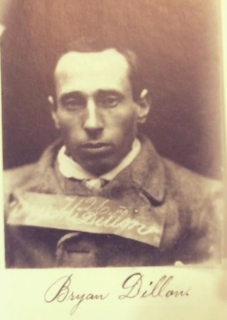
(Pictured: A mug shot of Brian Dillon)


Leave a comment

Birth of Charles Patrick Meehan, Priest & Historian

Charles Patrick Meehan, priest and historian, is born on July 12, 1812, at 141 Great Britain Street (now Parnell Street), Dublin.

Meehan’s father, a native of Manorhamilton, County Leitrim, is a prosperous farmer at Ballymahon, County Longford. He receives his early education in a hedge school and from a local curate at Ballymahon. In 1828 he enters the Pontifical Irish College in Rome, where he is a brilliant student, acquiring fluency in several languages. As a child he had loved to listen to stories of the Flight of the Earls and the Flight of the Wild Geese, and during his time in Rome he discovers the neglected graves of Hugh O’Neill and Hugh O’Donnell in the church of San Pietro in Montorio. He begins his lifelong research on the seventeenth century by locating and transcribing hitherto unstudied documents held in Roman repositories. Ordained in 1835, he is appointed curate at Rathdrum, County Wicklow in August and five months later is transferred to the parish of Saints Michael and John, Dublin. He is an excellent preacher and a strong advocate of temperance, and zealously discharges his parish duties.

A supporter of Daniel O’Connell and the repeal movement, Meehan is particularly attracted by the ideals of Young Ireland and becomes friendly with the principal writers of The Nation, especially Charles Gavan Duffy and James Clarence Mangan. He is Mangan’s confessor and attends his deathbed in 1849. The Young Irelanders often meet in his presbytery in Lower Exchange Street. From 1842 he contributes occasional verse and translations to The Nation using the pseudonym ‘Clericus’ and the initials ‘C. P. M.’ He defends the Young Irelanders from accusations of irreligion. During the debates on physical force in Conciliation Hall in July 1846 he supports the Young Ireland position and is shouted down by O’Connellites.

He secedes with the Young Irelanders from the Repeal Association and becomes a member of their Irish Confederation on its foundation in January 1847. Later that year he becomes president of the St. Patrick’s Confederate Club and delivers lectures to it on Irish history. A strong believer in the importance of history in creating national pride and awareness, he contributes The Confederation of Kilkenny (1846) and a translation of Daniel O’Daly, The Geraldines, their Rise, Increase and Ruin (1847) to The Nation‘s Library of Ireland historical series. He publishes a translation, with a valuable introduction and notes, of John Lynch‘s Latin life of Francis Kirwan, bishop of Killala 1645–61, as Portrait of a Christian Bishop (1848). In 1848 he resigns his presidency of the St. Patrick’s Confederate Club in the hope of becoming librarian or professor of modern languages at Queen’s College Galway but is unsuccessful.

For the rest of his life Meehan devotes himself to parish work and historical research, occasionally publishing articles and poems in the Hibernian Magazine and Irish Catholic Magazine. He also edits six volumes of the second series of James Duffy‘s Duffy’s Hibernian Magazine (1862–65). Having acquired a vast store of anecdotes and curious information from his research, he is an interesting companion who loves the company of poets and scholars and forms friendships with many young nationalist writers, including Denis Florence MacCarthy, John Keegan Casey and John Francis O’Donnell.

Most of Meehan’s research is devoted to Irish history, but he occasionally tackles other subjects, such as his translation from the Italian of Vincenzo Marchese’s Lives of the most eminent sculptors and architects of the order of St Dominic (2 vols, 1852). Although his work is marked by a strong sympathy for Catholicism and Irish nationalism, he is among the more scholarly historians associated with the Young Ireland movement. He is elected Member of the Royal Irish Academy (MRIA) in February 1865. Gavan Duffy lauds his efforts and ranks him with the great patriotic clerical scholars of the past who had devoted their lives to the study of Irish history.

Meehan repeatedly takes the opportunity to amend and expand his published works, producing revised editions of The Geraldines (as The Geraldines, their Rise, Increase and Ruin (reprinted 1878)), Confederation of Kilkenny (1882), and Lynch’s Life of Kirwan (1884). His other important publications are The Fate and Fortunes of the Earls of Tyrone (Hugh O’Neill) and Tyrconnel (Rory O’Donel), their flight from Ireland and death in exile (1868), and Rise and Fall of the Irish Franciscan Monasteries and Memoirs of the Irish Hierarchy in the Seventeenth Century (1870). He edits the essays of the Young Irelanders in The Spirit of the Nation (1882) and publishes editions of the poetry of Mangan in The Poets and Poetry of Munster (1883), with an important biographical memoir. His last scholarly work is to re-edit Literary Remains of the United Irishmen (1887) to include material left in manuscript by Richard R. Madden.

A small man, Meehan always wears a monocle attached to a silk ribbon, a tall silk hat, and a stout blackthorn stick. He suffers badly from indigestion for most of his life, and this aggravates a testy personality and a waspish tongue. He regularly falls out with friends, and few parishioners are foolhardy enough to brave his confessional. He retains strong anti-English views all his life. In the 1880s he encounters the young Arthur Griffith pulling down a union flag from a lamppost in Dublin and astounds the boy by congratulating rather than chastising him. His Young Ireland nationalism and irascible personality ensure that he never progresses beyond the position of curate in his forty-five years at Saints Michael and John. Here, he works alongside Fr. James Healy, a renowned wit, and the two men delight in trading caustic remarks. Healy is present at Meehan’s deathbed and admits to brushing away a tear – the only thing, he remarks, that had been brushed in that room for many years.

Meehan dies on March 14, 1890, at his presbytery in Dublin, and is buried in Glasnevin Cemetery. He is survived by two brothers, one of whom is also a priest. He is commemorated by a mural tablet erected by his parishioners in the church of Saints Michael and John.

(From: “Meehan, Charles Patrick” by James Quinn and Linde Lunney, Dictionary of Irish Biography, http://www.dib.ie)


Leave a comment

Birth of John Lynch, Actor & Novelist

john-lynch

John Lynch, actor and novelist, is born in Corrinshego, County Armagh, Northern Ireland on December 26, 1961. He wins the AFI (AACTA) Award for Best Actor in a Leading Role for the 1995 film Angel Baby. His other film appearances include Cal (1984), The Secret Garden (1993), In the Name of the Father (1993) and Sliding Doors (1998).

Lynch is the eldest of five children of an Irish father and an Italian mother from Trivento in the Province of Campobasso. His younger sister Susan and his nephew Thomas Finnegan are also actors. He attends St. Colman’s College, Newry and begins acting in Irish language-medium plays at school during the early years of the conflict in Northern Ireland.

Lynch has appeared in numerous films related to Northern Ireland’s problems such as Cal (1984) with Helen Mirren, In the Name of the Father (1993) with Daniel Day-Lewis, The Railway Station Man (1992) with Julie Christie and Donald Sutherland, Nothing Personal (1995) and Some Mother’s Son (1996), also with Mirren, as well as the Irish-themed film Evelyn (2002).

Lynch stars as a supporting actor in Derek Jarman‘s Edward II (1991), as Lord Craven in Agnieska Holland‘s film of The Secret Garden (1993), as Tadhg in The Secret of Roan Inish (1994), and as Gerry in Sliding Doors (1998).

Lynch plays the part of football legend George Best in the 2000 film Best. He plays the lead in the Australian feature Angel Baby, winning the Australian Film Institute award for best leading actor and the Australian Film Critics Association award for best actor of 1995. He is nominated for a Satellite Film Award for the film Moll Flanders in 1996. He works with acclaimed Belgian director Marion Hänsel on her adaptation of Booker-nominated author Damon Galgut‘s novel, The Quarry (1998), which wins Best Film at the Montreal World Film Festival. He wins Best Actor for the lead role in Best at the Fort Lauderdale Film Festival in 2000.

Lynch is nominated for a British Academy of Film and Television Arts (BAFTA) for Cal, as well as for an Irish Film and Television Award for his role in The Baby War. He stars in Five Day Shelter as Stephen, which wins a European Film Award and is in competition at the Rome Film Festival. He plays the lead in Craig Vivieros’ first feature film, the prison drama Ghosted. He plays the role of Wollfstan in Black Death and appears in the 2012 film version of Michael Morpurgo‘s novel, Private Peaceful.

Lynch is also a novelist. His first novel, Torn Water, is published in November 2005 by the 4th Estate, a literary imprint of HarperCollins Publishers LLC, and his second, Falling Out of Heaven, is published on May 13, 2010, by the same publisher.


Leave a comment

Assassination of Sinn Féin County Councilor John Lynch

cairo-gang

Sinn Féin County Councilor John Lynch of Kilmallock, County Limerick, is assassinated by British agents at the Exchange Hotel in Dublin on September 23, 1920.

Captain Geoffrey Thomas Baggallay, a “one-legged” courts-martial officer, phones Dublin Castle at 1:15 AM telling of John Lynch’s presence at the Exchange Hotel. A group of 12 soldiers, believed to be members of the Cairo Gang, enter the hotel wearing military caps and long black Burberry coats. They hold the hotel porter, William Barrett, at gunpoint. After consulting the register, they proceed to Lynch’s room on the third floor, where Lynch has been staying since September 12.

They shoot Lynch and then leave, claiming that Lynch had fired a shot at them when they attempted to arrest him. The military reports a death at the hotel at 2:15 AM. The Royal Irish Constabulary (RIC) arrives after the military reports the death to them. The coroner’s verdict is that Lynch is shot by a soldier in self-defence. No evidence is given by any soldiers at the inquiry. The Irish Republican Army (IRA) believe that the actual murder is carried out by Henry James Angliss and Charles Ratsch Peel working undercover. The group of khaki-clad men who shoot Lynch number about twelve, and the IRA certainly believes that Angliss and Peel are among them based on inside information received from “Lt G” at Dublin Castle. Lt G is believed to be Lily Mernin who works as a typist at army headquarters.

Michael Collins believes that many of the British officers that are later killed on “Bloody Sunday” shot John Lynch in the Exchange Hotel. Lynch is the local Sinn Féin organiser of a loan and is in Dublin to hand over £23,000 in subscriptions to Collins. Altogether £370,163 is raised in the loan effort in Ireland by September 1920 when it closes down.

It is impossible to know who the twelve men of the raiding party are, however, apparently Lt. Angliss, under the influence of drink, divulges his participation in the shooting to a girl who passes this information on to an Irish Intelligence Service informant. Peel escapes death on “Bloody Sunday” by barricading himself in his room. George Osbert Smyth is understood to have been part of the raiding party, from information given to his family on a visit home. Osbert Smyth is shot dead in October 1920 while trying to arrest IRA suspects Dan Breen and Sean Treacy at a house in Drumcondra.

(Pictured: The Cairo Gang)