seamus dubhghaill

Promoting Irish Culture and History from Little Rock, Arkansas, USA


Leave a comment

The Statute of Westminster 1931 Receives Royal Assent

The Statute of Westminster 1931, an act of the Parliament of the United Kingdom that sets the basis for the relationship between the Dominions (now called Commonwealth realms) and the Crown, receives royal assent on December 11, 1931.

The statute increases the sovereignty of the self-governing Dominions of the British Empire from the United Kingdom. It also binds them all to seek each other’s approval for changes to monarchical titles and the common line of succession. The statute is effective either immediately or upon ratification. It thus becomes a statutory embodiment of the principles of equality and common allegiance to the Crown set out in the Balfour Declaration of 1926. As the statute removes nearly all of the British parliament’s authority to legislate for the Dominions, it is a crucial step in the development of the Dominions as separate, independent, and sovereign states.

The Irish Free State never formally adopts the Statute of Westminster, its Executive Council (cabinet) taking the view that the Anglo-Irish Treaty of 1921 has already ended Westminster‘s right to legislate for the Irish Free State. The Constitution of the Irish Free State gives the Oireachtas “sole and exclusive power of making laws.” Hence, even before 1931, the Irish Free State does not arrest British Army and Royal Air Force deserters on its territory, even though the UK believes post-1922 British laws give the Free State’s Garda Síochána the power to do so. The UK’s Irish Free State Constitution Act 1922 says, however, “[n]othing in the [Free State] Constitution shall be construed as prejudicing the power of [the British] Parliament to make laws affecting the Irish Free State in any case where, in accordance with constitutional practice, Parliament would make laws affecting other self-governing Dominions.”

Motions of approval of the Report of the Commonwealth Conference had been passed by Dáil Éireann and Seanad Éireann in May 1931 and the final form of the Statute of Westminster includes the Irish Free State among the Dominions the British Parliament cannot legislate for without the Dominion’s request and consent. Originally, the UK government wants to exclude from the Statute of Westminster the legislation underpinning the 1921 treaty, from which the Free State’s constitution had emerged. Executive Council President (Prime Minister) W. T. Cosgrave objects, although he promises that the Executive Council will not amend the legislation unilaterally. The other Dominions back Cosgrave and, when an amendment to similar effect is proposed at Westminster by John Gretton, parliament duly votes it down. When the statute becomes law in the UK, Patrick McGilligan, the Free State Minister for External Affairs, states, “It is a solemn declaration by the British people through their representatives in Parliament that the powers inherent in the Treaty position are what we have proclaimed them to be for the last ten years.” He goes on to present the statute as largely the fruit of the Free State’s efforts to secure for the other Dominions the same benefits it already enjoys under the treaty. The Statute of Westminster has the effect of granting the Irish Free State internationally recognised independence.

Éamon de Valera leads Fianna Fáil to victory in the 1932 Irish general election on a platform of republicanising the Free State from within. Upon taking office, he begins removing the monarchical elements of the Constitution, beginning with the Oath of Allegiance. De Valera initially considers invoking the Statute of Westminster in making these changes, but John J. Hearne advises him to not do so. Abolishing the Oath of Allegiance in effect abrogates the 1921 treaty. Generally, the British believe that this is morally objectionable but legally permitted by the Statute of Westminster. Robert Lyon Moore, a Southern Unionist from County Donegal, challenges the legality of the abolition in the Irish Free State’s courts and then appeals to the Judicial Committee of the Privy Council (JCPC) in London. However, the Free State has also abolished the right of appeal to the JCPC. In 1935, the JCPC rules that both abolitions are valid under the Statute of Westminster. The Irish Free State, which in 1937 is renamed Ireland, leaves the Commonwealth in 1949 upon the coming into force of The Republic of Ireland Act 1948.

The Statute of Westminster’s modified versions are now domestic law in Australia and Canada. It has been repealed in New Zealand and implicitly in former Dominions that are no longer Commonwealth realms.

Leave a comment

Passage of the Constitution (Removal of Oath) Act 1933

The Constitution (Removal of Oath) Act 1933 (act no. 6 of 1933, previously bill no. 2 of 1932), an Act of the Oireachtas of the Irish Free State amending the Constitution of the Irish Free State and the Constitution of the Irish Free State (Saorstát Eireann) Act 1922, is passed on May 3, 1933. The Act removes the Oath of Allegiance required of members of the Oireachtas and of non-Oireachtas extern ministers.

The oath, pledging allegiance to the Constitution and fidelity to George V as King of Ireland, is required by the Anglo-Irish Treaty signed in 1921, and has been the symbolic focus of Irish republican opposition to the Treaty in the 1922–23 Irish Civil War. When Fianna Fáil is founded in 1926 by veterans of the losing anti-Treaty side in the Civil War, abolishing the oath is a core aim. It is a main item in the manifesto for its successful 1932 Irish general election campaign, after which it forms a minority government whose first action is to introduce the Constitution (Removal of Oath) Bill 1932. Seanad Éireann has more ex-unionists and others conciliatory towards the United Kingdom and vote to reject the bill unless the Treaty can be amended by agreement. After the 1933 Irish general election, the Fianna Fáil majority government is able to override the Seanad and enact the law.

As well as amending the Constitution, the 1933 act also amends the Constitution of the Irish Free State (Saorstát Eireann) Act 1922, which had both created the Constitution in Irish law and also prohibited any Constitutional amendment incompatible with the Treaty. Since the Free State cannot unilaterally amend the Treaty, Fianna Fáil amends the 1922 act to remove the Treaty’s precedence over the Constitution. Later constitutional amendments are also incompatible with the terms of the Treaty, in particular by weakening and ultimately abolishing the office of Governor-General of the Irish Free State. There is legal controversy over whether the Oireachtas has the power to amend the 1922 act, because it had been passed by the Third Dáil sitting as a constituent assembly before the Oireachtas had come into being. In 1935 the Judicial Committee of the Privy Council (JCPC) in London rules that, in British law, the Oireachtas does have the power, under the Statute of Westminster 1931. Irish jurisprudence takes issue with many of the assumptions underlying the 1935 decision.

The question is rendered moot with the adoption of the Constitution of Ireland in 1937 which repeals the Free State Constitution. The 1933 act is itself repealed as spent by the Statute Law Revision Act 2016.

(Pictured: Great Seal of the Irish Free State)


Leave a comment

Northern Ireland Opts Out of the Irish Free State

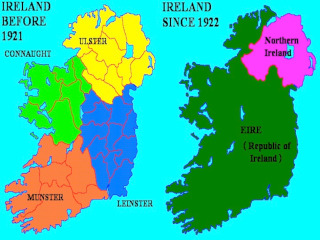
The six counties of what would become Northern Ireland opt out of the Irish Free State on December 7, 1922, and become a separate political entity with allegiance to England.

The Irish Free State Constitution Act 1922 (Session 2) is an Act of the Parliament of the United Kingdom, passed in 1922 to enact in UK law the Constitution of the Irish Free State, and to ratify the 1921 Anglo-Irish Treaty formally.

As originally enacted, the Irish Free State Constitution Act 1922 consists of a preamble, five sections (three of which are very brief), and a schedule. The schedule is the text of the Constitution of the Irish Free State (Saorstát Éireann) Act 1922, which had been passed in Ireland by the Third Dáil sitting as a constituent assembly and provisional parliament for the nascent Free State. This Irish Act itself has two schedules, the first being the actual text of the Constitution, and the second the text of the 1921 Treaty, formally the Articles of Agreement for a treaty between Great Britain and Ireland.

The Irish Act had been approved by the Irish constituent assembly on 25 October 25, 1922. The bill for the UK Act is introduced by the Prime Minister Bonar Law into the Parliament of the United Kingdom in November 1922. The bill’s third reading in the House of Commons is on November 30. The Act receives Royal assent on December 5, 1922.

On December 7, 1922, the day after the establishment of the Irish Free State, the Parliament of Northern Ireland addresses King George V requesting its secession from the Irish Free State. The address is unanimous, with the abstentionist Nationalist Party and Sinn Féin members absent. The King replies shortly thereafter to say that he has caused his Ministers and the Government of the Irish Free State to be informed that Northern Ireland is to do so.

After the Statute of Westminster 1931, the UK government recognises the right of the Irish government to amend or repeal the UK act, but in fact the Irish government does not do so until it is formally repealed as spent by the Statute Law Revision Act 2007. The Irish government amends the Irish act in 1933 and the 1937 Constitution of Ireland repeals the entire Free State constitution. The UK Judicial Committee of the Privy Council rules in 1935 that the 1933 Act had implicitly amended the UK Act with respect to the jurisdiction of the Free State. The Supreme Court of Ireland has taken the view that the Free State constitution was enacted by the Irish Act, not by the subsequent UK Act. This reflects the view of popular sovereignty rather than parliamentary sovereignty, with the constitution’s legitimacy ultimately springing from the 1922 Irish general election.


Leave a comment

The Constitution of Ireland Comes Into Force

constitution-of-ireland-1937

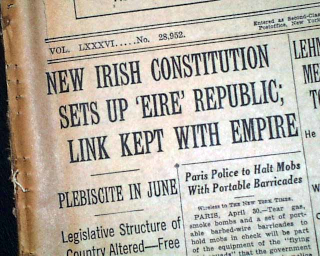
The Constitution of Ireland, the second constitution of the Irish state since independence, comes into force on December 29, 1937, following a statewide plebiscite held on July 1, 1937, replacing the 1922 Constitution of the Irish Free State. It asserts the national sovereignty of the Irish people. The constitution falls broadly within the tradition of liberal democracy, being based on a system of representative democracy. It guarantees certain fundamental rights, along with a popularly elected non-executive president, a bicameral parliament based on the Westminster system, a separation of powers and judicial review. The Constitution may be amended solely by a national referendum.

The Constitution of Ireland replaces the Constitution of the Irish Free State which had been in effect since the independence, as a dominion, of the Irish state from the United Kingdom on December 6, 1922. There are two main motivations for replacing the constitution in 1937. Firstly, the Statute of Westminster 1931 grants parliamentary autonomy to the six British Dominions (now known as Commonwealth realms) within a British Commonwealth of Nations. This has the effect of making the dominions sovereign nations in their own right. The Irish Free State constitution of 1922 is, in the eyes of many, associated with the controversial Anglo-Irish Treaty. The anti-treaty faction, who oppose the treaty initially by force of arms, is so opposed to the institutions of the new Irish Free State that it initially takes an abstentionist line toward them, boycotting them altogether. However, the largest element of this faction becomes convinced that abstentionism cannot be maintained forever. This element, led by Éamon de Valera, forms the Fianna Fáil party in 1926, which enters into government following the 1932 Irish general election.

After 1932, under the provisions of the Statute of Westminster, some of the articles of the original Constitution which were required by the Anglo-Irish Treaty are dismantled by acts of the Oireachtas of the Irish Free State. Such amendments remove references to the Oath of Allegiance, appeals to the United Kingdom’s Judicial Committee of the Privy Council, the British Crown and the Governor-General of the Irish Free State. The sudden abdication of Edward VIII in December 1936 is quickly used to redefine the Royal connection. Nevertheless, the Fianna Fáil government still desires to replace the constitutional document they see as having been imposed by the British government in 1922.

The second motive for replacing the original constitution is primarily symbolic. De Valera wants to put an Irish stamp on the institutions of government and chooses to do this in particular through the use of Irish Gaelic nomenclature.

The text of the draft constitution, with minor amendments, is approved on June 14, 1937, by Dáil Éireann, then the sole house of parliament as the Seanad had been abolished the previous year.

The draft constitution is then put to a plebiscite on July 1, 1937, the same day as the 1937 Irish general election, when it is passed by a plurality of 56% of the voters, comprising 38.6% of the whole electorate. The constitution formally comes into force on December 29, 1937.

Among the groups who oppose the constitution are supporters of Fine Gael and the Labour Party, Unionists, and some independents and feminists. The Seal of the President of Ireland is also adopted in the same year. Ireland does not become a republic until 1948.

(Pictured: Headline from The New York Times, May 1, 1937)