seamus dubhghaill

Promoting Irish Culture and History from Little Rock, Arkansas, USA


Leave a comment

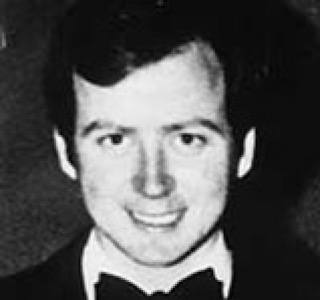
Death of Gerard Steenson, Leader of the IPLO

Gerard Steenson, an Irish republican paramilitary and a leader of the Irish People’s Liberation Organisation during the Troubles, is killed in an ambush in Ballymurphy, Belfast, on March 14, 1987.

Steenson, a Catholic and the son of Frank Steenson, is born in 1957 and raised in heavily republican West Belfast. He is nicknamed “Doctor Death” by the media and the Royal Ulster Constabulary (RUC) for the multiple assassinations he purportedly accomplishes according to The New York Times. However, Fortnight alleges that he got his nickname after he dressed up in a white coat to attack British soldiers guarding a patient at the Royal Victoria Hospital.

Steenson is widely associated with internecine violence between Irish republican groups. He joins the Official Irish Republican Army‘s Belfast Brigade in 1972 at the age of 14, becoming part of the Brigade’s C Company. Two years later, he leaves to join the Irish National Liberation Army (INLA) upon that paramilitary group’s formation, consequent to their split from the Official IRA. He becomes head of the INLA in Belfast.

Steenson first comes to notoriety as a teenager in 1975 for killing Billy McMillen, the Official IRA’s Belfast leader, during the feud between the INLA and the Official IRA. Jim Cusack, a journalist describes him as the “assassin-in-chief” of Hugh Torney.

During the 1981 Northern Ireland local elections, Steenson and Seán Mackin both lead efforts within the INLA to obstruct Irish Republican Socialist Party (IRSP) candidates which disrupts their votes, viewing the decision to run in the election as wasteful, believing that the allocated resources would be better spent on weapons. Following the election, Steenson later changes his mind with regards to elections, declaring that the party should have run more candidates.

In December 1981, Steenson, fearing that the Dublin INLA leadership will make a move on him following his efforts to set up a parallel organisation, plans an assassination attempt on the Dublin leader, Harry Flynn. Following a meeting of the Ard Comhairle on December 5, Flynn and others go out for drinks in the Flowing Tide pub at the corner of Sackville Place and Marlborough Street in Dublin. Shortly before 11 p.m., Steenson’s gunman enters the pub and fires shots at Flynn before his gun jams and he flees. Though seriously wounded, Flynn survives. After the botched assassination attempt, Steenson then unsuccessfully threatens Seán Flynn for his seat on Belfast City Council. Later, on January 25, 1982, a botched attempt is also made on Seán Flynn and Bernard Dorrian at a bar in the Short Strand area, provoking a feud where a unit from the Derry INLA comes to Belfast searching for Steenson. Failing to secure power, the attacks only demoralise the IRSP and INLA and begin a trend of internal feuds.

In 1985, Steenson is convicted of 67 terrorist offences (including six murders) after his former friend, Harry Kirkpatrick, testifies against him. Kirkpatrick and Steenson are rarely seen apart in public and are given the nicknames “Pinkie and Perky.”

In 1986, Steenson, Jimmy Brown, and Martin “Rook” O’Prey form the Irish People’s Liberation Organisation (IPLO), consisting of disaffected and expelled INLA members, with the express intention of wiping out the INLA and IRSP and replacing them with their own organisation. He argues in letters, written while he is in prison in the early 1980s, that the INLA has become militarily “inefficient” and that the IRSP leadership has become “ineffective” and requires “realignment.”

Steenson is involved in the Rosnaree Hotel shooting on January 20, 1987, where a meeting between the leadership of the INLA and IPLO is to take place to end hostilities. However, IPLO members ambush the four INLA members at the hotel, killing Thomas “Ta” Power and John “Jap” O’Reilly, while Hugh Torney and Peter Stewart manage to escape.

Steenson is viewed highly in the movement with Brown calling him a “committed and highly efficient military activist and a dedicated revolutionary.” However, he is described by Lord Justice Carswell as “a most dangerous and sinister terrorist. A ruthless and highly dedicated, resourceful and indefatigable planner of criminal exploits who did not hesitate to take a leading role in assassinations and other crimes.” Henry McDonald and Jack Holland write, “Both his friends and enemies spoke in a tone of awestruck at his paramilitary abilities.” Ken Wharton refers to him as a “notorious psychopath.” Sean O’Callaghan describes him as someone who “never took to orders.”

Terry George writes of Steenson that he “was extremely clever and even wittier than Billy McMillan. He had an angelic face and women adored him. He was also ruthless, cunning and fearless.”

On March 14, 1987, Steenson and Tony “Boot” McCarthy return to Ballymurphy after a night of drinking which is cut short by anger over the INLA GHQ faction’s show of force in the Divis Flats earlier in the day. After bringing their car to a stop on Springhill Avenue, they are killed in an ambush by an INLA active unit, with a member of the unit closing the security gate at the top of the street to trap the pair. An INLA spokesperson says Steenson was killed for being “actively involved in continuous and concerted efforts to undermine the authority of the … movement.” Jimmy Brown gives the graveside oration.

The IPLO later kills Emmanuel Gargan in the Hatfield Bar on the Lower Ormeau Road and Kevin Barry Duffy in Armagh, County Armagh, in retaliation for the killing of Steenson. The IPLO draws the ire of the Lower Ormeau community through the circumstances surrounding the killing of Gargan, with graffiti appearing in the area labeled “IPLOscum.”

On Halloween 1992, the Provisional Irish Republican Army carries out a large-scale operation (dubbed the “Night of Long Knives”) with the goal of neutralising the IPLO. Following the operation and execution of Jimmy Brown, both the Belfast Brigade and Army Council factions disband.

Leave a comment

The Ballygawley Bus Bombing

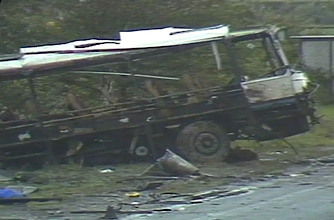
The Ballygawley bus bombing is a roadside bomb attack by the Provisional Irish Republican Army (IRA) on a bus carrying British soldiers in Northern Ireland. It occurs in the early hours of August 20, 1988, in the townland of Curr near Ballygawley, County Tyrone. The attack kills eight soldiers and wounds twenty-eight. In the wake of the bombing, the British Army begins ferrying its troops in and out of County Tyrone by helicopter.

The Irish Times reports that “This stretch of road has been a favourite ambush spot for successive generations of IRA men since the 1920s.” The Provisional IRA has been attacking British Army patrols and convoys with roadside bombs regularly since the beginning of the Troubles in the early 1970s. Most of these attacks take place in rural parts of Northern Ireland, especially eastern and southern County Tyrone (where the IRA’s Tyrone Brigade is active) and southern County Armagh (heartland of the South Armagh Brigade). In August 1979, the IRA ambushes a British Army convoy with two large roadside bombs near Warrenpoint, killing eighteen soldiers. This is the deadliest attack on the British Army in Northern Ireland during the Troubles. In December 1979, four more British soldiers are killed on Ballygawley Road in the Dungannon land mine attack. In May 1981, five British soldiers are killed when their Saracen APC is ripped apart by a roadside bomb at Altnaveigh, County Armagh. In July 1983, four Ulster Defence Regiment (UDR) soldiers are killed when their vehicle strikes an IRA land mine near Ballygawley, County Tyrone. In December 1985, the Tyrone IRA launches an assault on the police barracks in Ballygawley, shooting dead two officers and destroying the barracks with a bomb.

In June 1988, six off-duty British soldiers are killed when an IRA bomb explodes underneath their van in Lisburn. It had been attached to the van as the soldiers are taking part in a charity marathon.

On the night of August 19/20, 1988, an unmarked 52-seater bus is transporting 36 soldiers of The Light Infantry from Aldergrove Flying Station to a military base near Omagh. The soldiers, who came from England, have just finished 18 months of a two-year tour of duty in Northern Ireland and are returning to the base after a short holiday.

As it is driving along the main road from Ballygawley to Omagh, at about 12:30 a.m., IRA members remotely detonate a roadside bomb containing 200 pounds (91 kg) of Semtex. According to police, the bomb had been planted in a vehicle by the roadside and had been detonated by command wire from 330 yards (300 m) away. A statement by one of the survivors claims instead that the roadside bomb was made of “two fertilizer bags filled with Semtex.” The blast hurls the bus 30 metres down the road and throws the soldiers into neighbouring hedges and fields. It leaves a crater 6 feet deep and scatters body parts and twisted metal over a wide area. Witnesses describe finding dead, dying and wounded soldiers strewn on the road and caught in the wreckage of the bus. Others are walking around “stunned.” Some of the first to arrive on the scene and offer help are loyalist bandsmen of the Omagh Protestant Boy’s Band returning from a parade in Portadown, who have also been traveling in buses.

Eight of the soldiers are killed and the remaining 28 are wounded. The soldiers killed are: Jayson Burfitt (aged 19), Richard Greener (aged 21), Mark Norsworthy (aged 18), Stephen Wilkinson (aged 18), Jason Winter (aged 19), Blair Bishop (aged 19), Alexander Lewis (aged 18) and Peter Bullock (aged 21). This is the single biggest loss of life for the British Army from an IRA attack in Northern Ireland since the Warrenpoint ambush in 1979, although eleven off-duty British soldiers had been killed in the Droppin Well bombing in 1982, carried out by the Irish National Liberation Army (INLA). An account from one of the survivors is published in Ken Wharton‘s book A Long Long War: Voices from the British Army in Northern Ireland, 1969–98 (2008).

An inquest into the attack is told that the road is usually off-limits to military vehicles, due to the threat from the IRA. The driver of the bus, who is also a soldier, claims he had been directed on to the road by diversion signs. The inquest hears that signs had not been placed by the police or the roads service. The IRA denies placing any signs and says that military buses often use the road. The mother of one of those killed accuses the British military of negligence and claims it is “trying to conceal the truth.”

Shortly thereafter, the Provisional IRA issues a statement claiming responsibility. It says that the attack had been carried out by its Tyrone Brigade and adds: “We will not lay down our arms until the peace of a British disengagement from Ireland.” The security forces suspect that an informer may have told the IRA of the bus’s route and the time it would pass a specific spot. After the attack, the British military decides to start ferrying their troops to and from East Tyrone by helicopter to avoid any future attacks like this.

Tom King, then Secretary of State for Northern Ireland, says there is “some evidence” that the explosives used are part of a consignment from Libya. He also states that the possibility of reintroducing internment is “under review”. Libyan weaponry enables the IRA to mount some of its biggest operations during its campaign. The Ballygawley bus bombing is believed to be one of these attacks. One former IRA member later suggests that Semtex explosive was not crucial to the outcome of the attack, saying, “we were having plenty of success without Semtex… at Ballygawley we ‘only’ got eight, but it was a bus of about fifty-six. If we’d used a fertiliser bomb, the whole bus would have been destroyed.”

On August 30, 1988, three IRA members are ambushed and killed by the Special Air Service (SAS) at Drumnakilly, County Tyrone. According to author Nick Van der Bijl, the men—Gerard Harte, Martin Harte and Brian Mullin—are identified by British intelligence as the perpetrators of the bombing. Peter Taylor, instead, says that only Mullin is suspected, and that plans for the SAS operation were already underway at the time of the IRA attack.

Two months after the attack, the British Government introduces the broadcasting ban. It means that the voices of Sinn Féin and IRA members are not allowed to be broadcast on television or radio. The Ballygawley bus bombing is believed to have influenced the Government’s decision to introduce the ban.

According to state papers declassified in 2019, the attack sparks “panic” in the British Government, and tension between the Royal Ulster Constabulary (RUC) and the British Army over who is at fault for the security lapse. British Prime Minister Margaret Thatcher warns RUC chief, John Hermon, that she will no longer send British troops over “in waves to be killed.”