seamus dubhghaill

Promoting Irish Culture and History from Little Rock, Arkansas, USA


Leave a comment

Passage of the Constitution (Removal of Oath) Act 1933

The Constitution (Removal of Oath) Act 1933 (act no. 6 of 1933, previously bill no. 2 of 1932), an Act of the Oireachtas of the Irish Free State amending the Constitution of the Irish Free State and the Constitution of the Irish Free State (Saorstát Eireann) Act 1922, is passed on May 3, 1933. The Act removes the Oath of Allegiance required of members of the Oireachtas and of non-Oireachtas extern ministers.

The oath, pledging allegiance to the Constitution and fidelity to George V as King of Ireland, is required by the Anglo-Irish Treaty signed in 1921, and has been the symbolic focus of Irish republican opposition to the Treaty in the 1922–23 Irish Civil War. When Fianna Fáil is founded in 1926 by veterans of the losing anti-Treaty side in the Civil War, abolishing the oath is a core aim. It is a main item in the manifesto for its successful 1932 Irish general election campaign, after which it forms a minority government whose first action is to introduce the Constitution (Removal of Oath) Bill 1932. Seanad Éireann has more ex-unionists and others conciliatory towards the United Kingdom and vote to reject the bill unless the Treaty can be amended by agreement. After the 1933 Irish general election, the Fianna Fáil majority government is able to override the Seanad and enact the law.

As well as amending the Constitution, the 1933 act also amends the Constitution of the Irish Free State (Saorstát Eireann) Act 1922, which had both created the Constitution in Irish law and also prohibited any Constitutional amendment incompatible with the Treaty. Since the Free State cannot unilaterally amend the Treaty, Fianna Fáil amends the 1922 act to remove the Treaty’s precedence over the Constitution. Later constitutional amendments are also incompatible with the terms of the Treaty, in particular by weakening and ultimately abolishing the office of Governor-General of the Irish Free State. There is legal controversy over whether the Oireachtas has the power to amend the 1922 act, because it had been passed by the Third Dáil sitting as a constituent assembly before the Oireachtas had come into being. In 1935 the Judicial Committee of the Privy Council (JCPC) in London rules that, in British law, the Oireachtas does have the power, under the Statute of Westminster 1931. Irish jurisprudence takes issue with many of the assumptions underlying the 1935 decision.

The question is rendered moot with the adoption of the Constitution of Ireland in 1937 which repeals the Free State Constitution. The 1933 act is itself repealed as spent by the Statute Law Revision Act 2016.

(Pictured: Great Seal of the Irish Free State)


Leave a comment

The Battle of Connor

grave-of-king-edward-de-bruce

The Battle of Connor is fought on September 10, 1315, in the townland of Tannybrake just over a mile north of what is now the modern village of Connor, County Antrim, Northern Ireland. It is part of the Bruce campaign in Ireland.

Edward Bruce lands in Larne, in modern-day County Antrim, on May 26, 1315. In early June, Donall Ó Néill of Tyrone and some twelve fellow northern Kings and lords meet Bruce at Carrickfergus and swear fealty to him as King of Ireland. Bruce holds the town of Carrickfergus but is unable to take Carrickfergus Castle. His army continues to spread south, through the Moyry Pass to take Dundalk.

Outside the town of Dundalk, Bruce encounters an army led by John FitzThomas FitzGerald, 4th Lord of Offaly, his son-in-law Edmund Butler, Earl of Carrick and Maurice FitzGerald, 4th Baron Desmond. The Scottish push them back towards Dundalk and on June 29 lay waste to the town and its inhabitants.

By July 22 Edmund Butler, the Justiciar in Dublin, assembles an army from Munster and Leinster to join Richard Óg de Burgh, 2nd Earl of Ulster, to fight Bruce. De Burgh refuses to let the government troops into Ulster, fearing widespread damage to his land. Bruce is able to exploit their dispute and defeat them separately.

Bruce slowly retreats north, drawing de Burgh in pursuit. Bruce and his O’Neill allies sack Coleraine, destroying the bridge over the River Bann to delay pursuit. Edward sends word to Fedlim Ó Conchobair that he will support his position as king in Connacht if he withdraws. He sends the same message to rival claimant Ruaidri mac Cathal Ua Conchobair. Cathal immediately returns home, raises a rebellion and declares himself king. De Burgh’s Connacht allies under Felim then follow as Felim leaves to defend his throne. Bruce’s force then crosses the River Bann in boats and attacks. The Earl of Ulster withdraws to Connor.

The armies meet in Connor on September 10, 1315. The superior force of Bruce and his Irish allies defeat the depleted Ulster forces. The capture of Connor permits Bruce to re-supply his army for the coming winter from the stores the Earl of Ulster had assembled at Connor. Earl’s cousin, William de Burgh, is captured, as well as, other lords and their heirs. Most of his army retreats to Carrickfergus Castle, which the pursuing Scots put under siege. The Earl of Ulster manages to return to Connacht.

The government forces under Butler do not engage Bruce, allowing him to consolidate his hold in Ulster. His occupation of Ulster encourages risings in Meath and Connacht, further weakening de Burgh. Despite this, and another Scottish/Irish victory at the Battle of Skerries, the campaign is to be defeated at the Battle of Faughart.

(Pictured: Grave of King Edward Bruce, Faughart, County Louth)


Leave a comment

Coronation of James II as King of England & Ireland

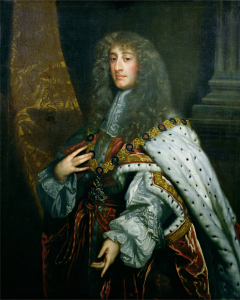
The coronation of James II as King of England and Ireland takes place at Westminster Abbey on April 23, 1685. He is also crowned King of Scotland as James VII. He is the last Roman Catholic monarch of EnglandScotland and Ireland.

The second surviving son of Charles I, James ascends the throne upon the death of his brother, Charles II. There is little initial opposition to his accession, and there are widespread reports of public rejoicing at the orderly succession. The new Parliament that assembles in May 1685, which gains the name of “Loyal Parliament,” is initially favourable to James, and the new King sends word that even most of the former exclusionists will be forgiven if they acquiesce to his rule.

Members of Britain’s Protestant political elite increasingly suspect him of being pro-French and pro-Catholic and of having designs on becoming an absolute monarch. When he produces a Catholic heir, leading nobles call on his Protestant son-in-law and nephew William of Orange to land an invasion army from the Dutch Republic, which he does in the Glorious Revolution of 1688. James flees England and thus is held to have abdicated. He is replaced by his eldest, Protestant daughter Mary and her husband William of Orange.

James makes one serious attempt to recover his crowns from William and Mary when he lands in Ireland in 1689. After the defeat of the Jacobite forces by the Williamites at the Battle of the Boyne in July 1690, James returns to France. He lives out the rest of his life as a pretender at a court sponsored by his cousin and ally, King Louis XIV.

James is best known for his struggles with the English Parliament and his attempts to create religious liberty for English Roman Catholics and Protestant nonconformists, against the wishes of the Anglican establishment. This tension makes James’s four-year reign a struggle for supremacy between the English Parliament and the Crown, resulting in his deposition, the passage of the Bill of Rights, and the accession of his daughter and her husband as king and queen.